Polymerase-Kettenreaktion (PCR)
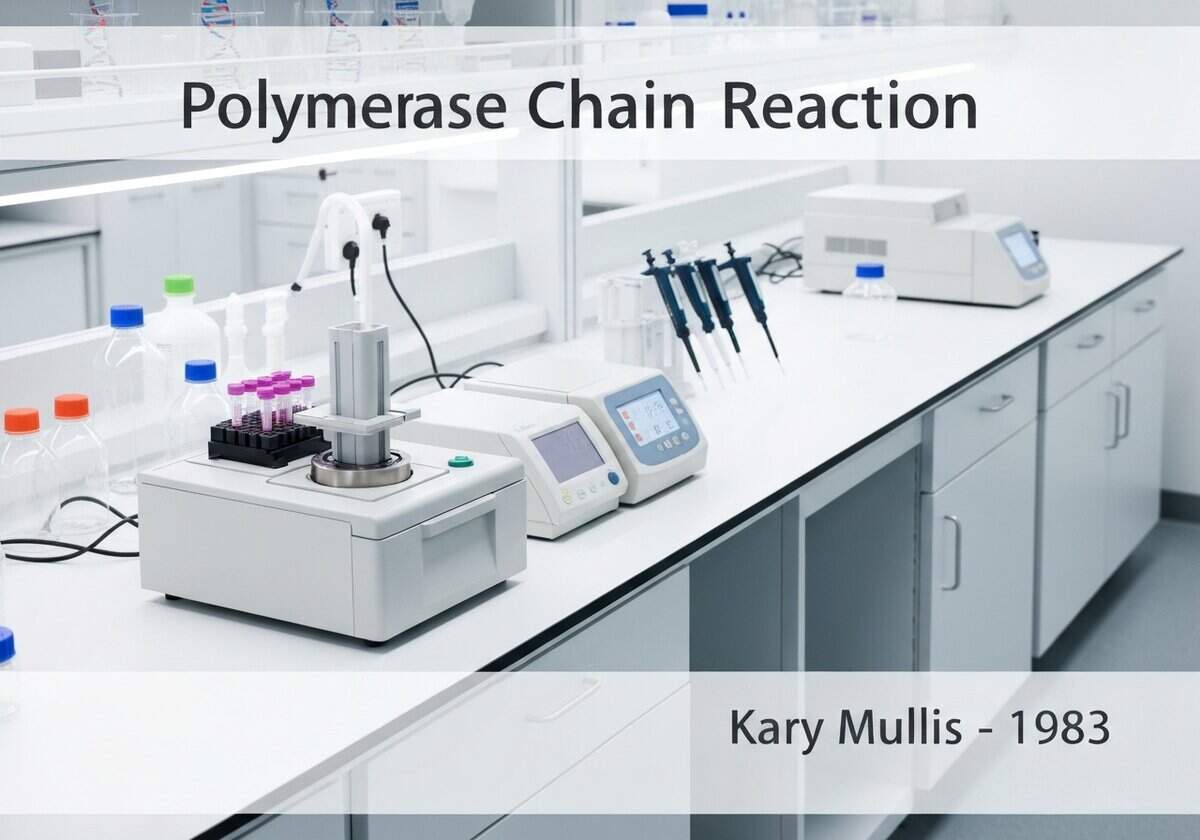
Die Polymerase-Kettenreaktion (PCR) ist eine Labortechnik zur Vervielfältigung eines spezifischen DNA-Abschnitts, wodurch aus einer kleinen Ausgangsprobe Millionen bis Milliarden von Kopien erzeugt werden. Verfahren basiert auf thermischen Zyklen, die aus wiederholten Erhitzungs- und Abkühlungszyklen für das Schmelzen der DNA, das Anlagern der Primer und die enzymatische Replikation der DNA mithilfe einer thermostabilen DNA-Polymerase bestehen, was zu einer exponentiellen Amplifikation führt.
The Polymerase Chain Reaction (PCR) is a revolutionary in vitro method for exponentially amplifying a specific target DNA sequence. Its power lies in its ability to generate billions of copies from a minute starting quantity of DNA, making it possible to analyze DNA from samples as small as a single cell. The process is driven by a series of temperature changes, or thermal cycles, managed by a machine called a thermal cycler. Each cycle consists of three core steps. First, Denaturation: the reaction mixture is heated to 94–98 °C for a short period, causing the double-stranded DNA template to separate into single strands. Second, Annealing: the temperature is lowered to 50–65 °C, allowing short, single-stranded DNA primers to bind (anneal) to their complementary sequences on the now single-stranded template DNA. These primers flank the target region to be amplified. Third, Extension: the temperature is raised to 72 °C, the optimal temperature for the key enzyme, a thermostable DNA polymerase, to work. The most commonly used is Taq polymerase, isolated from the thermophilic bacterium *Thermus aquaticus*. The polymerase binds to the primer-template complex and begins synthesizing a new complementary DNA strand, extending from the primer. This three-step cycle is repeated 20-40 times. With each cycle, the number of copies of the target DNA sequence doubles, leading to an exponential amplification, mathematically described as [latex]2^n[/latex], where n is the number of cycles. The result is a solution containing a vast quantity of the specific DNA fragment, which can then be easily visualized by gel electrophoresis or used in subsequent molecular biology applications like sequencing or cloning.
UNESCO Nomenclature: 2406
- Molekularbiologie
Verwendung
Weitverbreitete Verwendung
Vorläufer
- Entdeckung der DNA-Struktur
- Verständnis der DNA-Replikationsprinzipien
- Isolierung von DNA-Polymerase-Enzymen
- Entdeckung thermostabiler Organismen und ihrer Enzyme (z. B. Taq-Polymerase)
- Entwicklung der Oligonukleotidsynthese für Primer
Anwendungen
- DNA-Fingerabdruck für die Forensik
- medizinische Diagnostik bei Infektionskrankheiten (z. B. COVID-19)
- genetische Tests auf Erbkrankheiten
- Klonen von Genen
- Sequenzierung von Genomen
- phylogenetische Analyse
Patente:
- US4683195
- US4683202
- US4965188
Potenzielle Innovationsideen
Aufgrund des hohen Datenverkehrs durch Web-Scraping-Bots, der derzeit mehr als 40.000 Anfragen pro Tag umfasst, ist dieser Inhalt ausschließlich Community-Mitgliedern vorbehalten.
> Anmelden < oder > Registrieren < (100% kostenlos) Zugriff darauf sowie auf alle anderen eingeschränkten Inhalte und Tools.
Verwandt mit: PCR, Polymerase-Kettenreaktion, DNA-Amplifikation, Kary Mullis, Taq-Polymerase, Thermocyclierung, Forensik, Diagnostik, molekulares Klonen, Gentests.