Product Design, Manufacturing & Innovation Resources
» Polymerase Chain Reaction (PCR)

Polymerase Chain Reaction (PCR)

1983
  • Kary Mullis
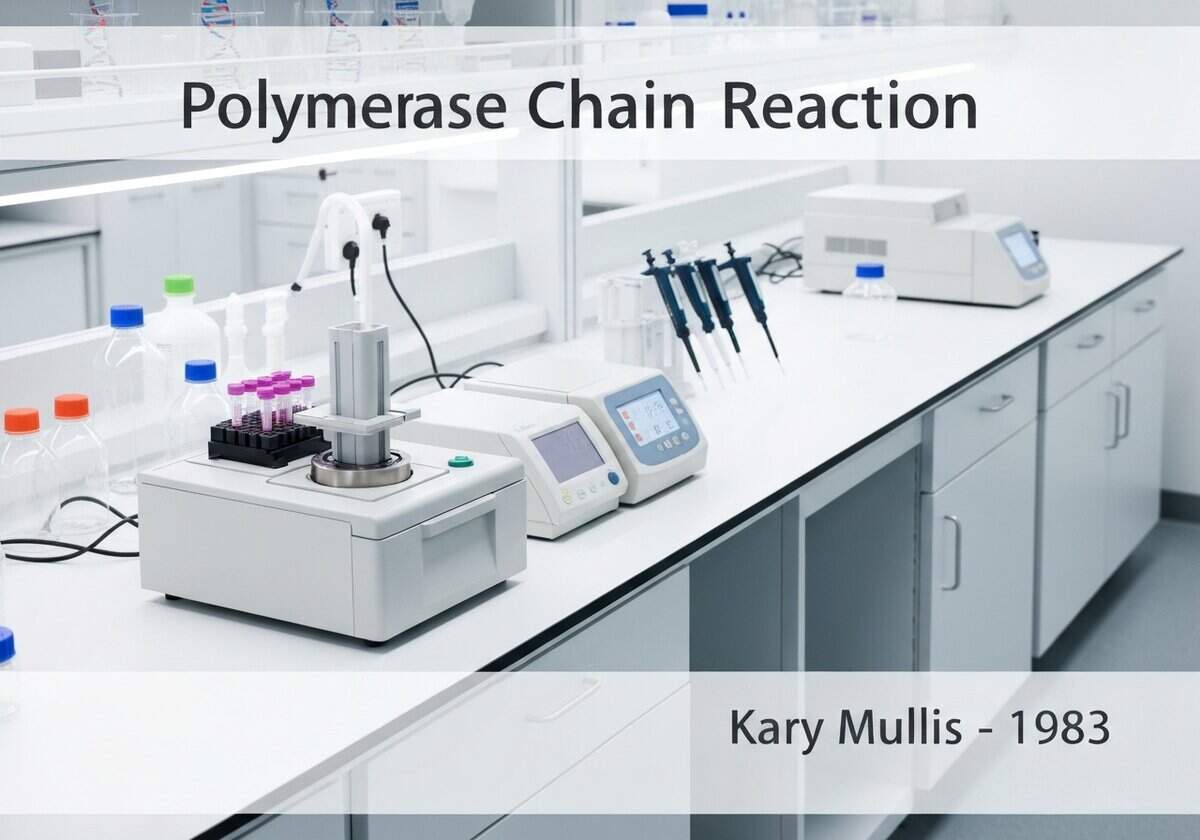
Thermal cycler amplifying DNA in a molecular biology laboratory setting.

(설명을 위한 생성된 이미지입니다)

The Polymerase Chain Reaction (PCR) is a laboratory technique used to amplify a specific segment of DNA, generating millions to billions of copies from a small initial sample. The 방법 relies on thermal cycling, consisting of repeated cycles of heating and cooling for DNA melting, primer annealing, and enzymatic replication of the DNA using a thermostable DNA polymerase, resulting in exponential amplification.
The Polymerase Chain Reaction (PCR) is a revolutionary in vitro method for exponentially amplifying a specific target DNA sequence. Its power lies in its ability to generate billions of copies from a minute starting quantity of DNA, making it possible to analyze DNA from samples as small as a single cell. The process is driven by a series of temperature changes, or thermal cycles, managed by a machine called a thermal cycler. Each cycle consists of three core steps. First, Denaturation: the reaction mixture is heated to 94–98 °C for a short period, causing the double-stranded DNA template to separate into single strands. Second, Annealing: the temperature is lowered to 50–65 °C, allowing short, single-stranded DNA primers to bind (anneal) to their complementary sequences on the now single-stranded template DNA. These primers flank the target region to be amplified. Third, Extension: the temperature is raised to 72 °C, the optimal temperature for the key enzyme, a thermostable DNA polymerase, to work. The most commonly used is Taq polymerase, isolated from the thermophilic bacterium *Thermus aquaticus*. The polymerase binds to the primer-template complex and begins synthesizing a new complementary DNA strand, extending from the primer. This three-step cycle is repeated 20-40 times. With each cycle, the number of copies of the target DNA sequence doubles, leading to an exponential amplification, mathematically described as [latex]2^n[/latex], where n is the number of cycles. The result is a solution containing a vast quantity of the specific DNA fragment, which can then be easily visualized by gel electrophoresis or used in subsequent molecular biology applications like sequencing or cloning.

UNESCO Nomenclature: 2406
분자생물학

유형

화학 공정

분열

혁명가

용법

널리 사용됨

전구체

  • discovery of DNA structure
  • understanding of DNA replication principles
  • isolation of DNA polymerase enzymes
  • discovery of thermostable organisms and their enzymes (e.g., Taq polymerase)
  • development of oligonucleotide synthesis for primers

응용 프로그램

  • DNA fingerprinting for forensics
  • medical diagnostics for infectious diseases (e.g., COVID-19)
  • genetic testing for hereditary diseases
  • cloning genes
  • sequencing genomes
  • phylogenetic analysis

특허:

  • US4683195
  • US4683202
  • US4965188

잠재적 혁신 아이디어

현재 하루 4만 건이 넘는 봇 트래픽을 차단하기 위해 이 콘텐츠는 커뮤니티 회원만 이용할 수 있습니다.
> 로그인 < 또는 >등록 < 이 콘텐츠를 비롯한 모든 제한된 콘텐츠와 도구는 (100% 무료로) 이용할 수 있습니다.

Related to: PCR, polymerase chain reaction, DNA amplification, kary mullis, taq polymerase, thermal cycling, forensics, diagnostics, molecular cloning, genetic testing.

역사적 맥락

Polymerase Chain Reaction (PCR)

1973
1975
1979
1983
1988
1990
1990
1970
1975
1977
1983
1987
1990
1990
1990

(날짜를 알 수 없거나 관련이 없는 경우, 예를 들어 "유체역학"의 경우, 주목할 만한 등장 시기를 대략적으로 추정하여 제공합니다.)

관련 발명, 혁신 및 기술 원칙

고화질 이미지 및 다운로드는 등록된 회원에게만 100% 무료로 제공됩니다.

> 로그인 <