Product Design, Manufacturing & Innovation Resources
Heim » Insulin-Signaltransduktionsweg

Insulin-Signaltransduktionsweg

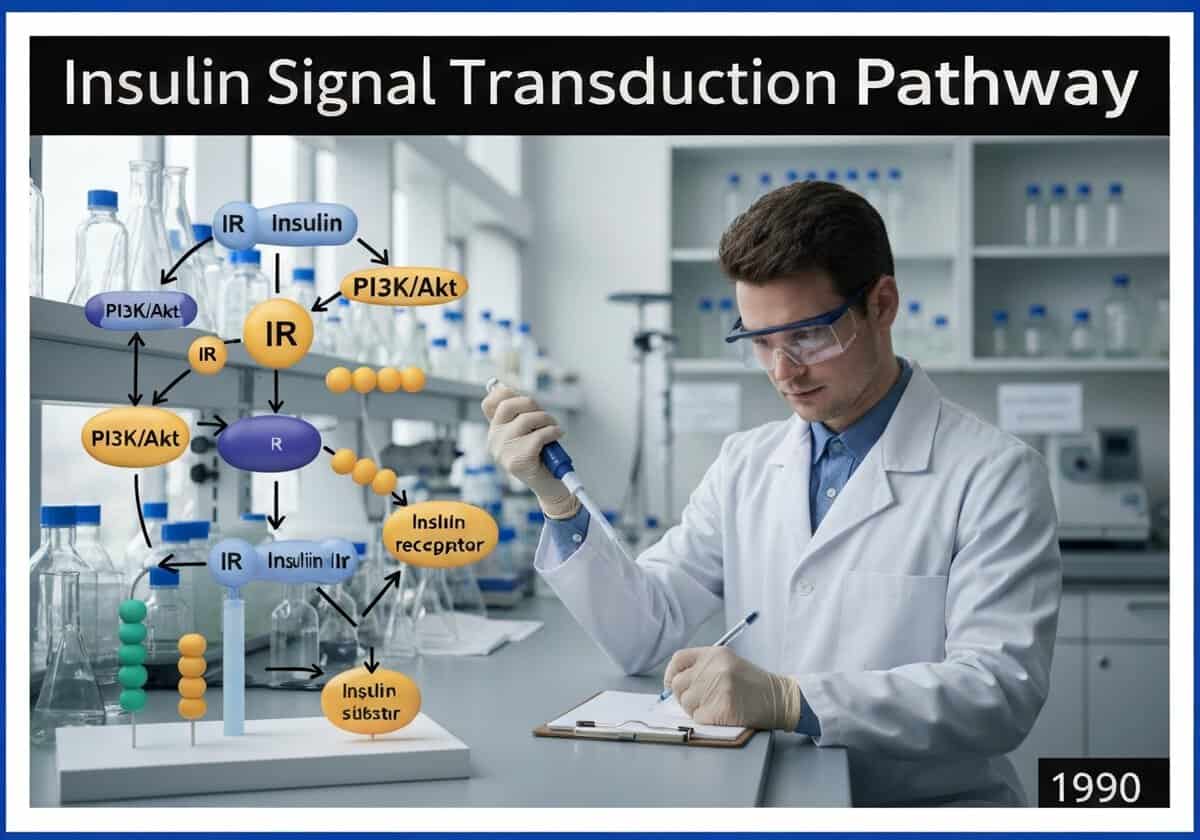
1990
Laborszene, die den Insulinsignalweg mit Rezeptor und nachgeschalteten Effekten darstellt.

(Abbildung dient nur zur Veranschaulichung)

Insulin initiates its effects by binding to the insulin receptor (IR), a receptor tyrosine kinase. This binding triggers autophosphorylation of the receptor, creating docking sites for insulin receptor substrate (IRS) proteins. Phosphorylated IRS proteins then activate downstream pathways, primarily the PI3K/Akt pathway, which mediates most of insulin’s metabolic effects, including the translocation of GLUT4 glucose transporters to the cell membrane.

Der Insulin signaling cascade is a complex and highly regulated network that controls cellular growth, survival, and metabolism. It begins when insulin binds to the extracellular alpha subunits of the insulin receptor (IR). This causes a conformational change, activating the tyrosine kinase domain located on the intracellular beta subunits. The activated kinase phosphorylates specific tyrosine residues on the opposing beta subunit, a process called autophosphorylation. These phosphotyrosine sites act as recruitment platforms for various adapter proteins, most notably the insulin receptor substrate (IRS) family (IRS1-4). Once docked, IRS proteins are themselves phosphorylated by the IR kinase. This creates binding sites for other signaling molecules containing SH2 domains, such as phosphatidylinositol 3-kinase (PI3K). The recruitment of PI3K to the plasma membrane is a critical step. Activated PI3K phosphorylates the lipid [latex]PIP_2[/latex] (phosphatidylinositol 4,5-bisphosphate) to generate [latex]PIP_3[/latex] (phosphatidylinositol 3,4,5-trisphosphate). [latex]PIP_3[/latex] acts as a second messenger, recruiting and activating other kinases, including PDK1 and Akt (also known as Protein Kinase B). Activated Akt is a central node in the pathway, phosphorylating a multitude of downstream targets to mediate insulin’s effects. A key action of Akt is to promote the translocation of vesicles containing the glucose transporter GLUT4 from the cell’s interior to the plasma membrane in muscle and adipose tissue. This insertion of GLUT4 allows for the rapid uptake of glucose from the bloodstream, lowering blood sugar levels. Akt also promotes glycogen synthesis, Proteinsynthese, and lipid synthesis, while inhibiting processes like gluconeogenesis and apoptosis.

UNESCO Nomenclature: 2403
- Zellbiologie

Typ

Abstraktes System

Störung

Grundlegendes

Verwendung

Weitverbreitete Verwendung

Vorläufer

  • Entdeckung der Proteinphosphorylierung als Regulationsmechanismus durch Edwin G. Krebs und Edmond H. Fischer
  • Konzept der zweiten Boten von Earl Sutherland, Jr.
  • Identifizierung und Klonierung des Insulinrezeptorgens
  • Entdeckung von Tyrosinkinasen und sh2-Domänen

Anwendungen

  • Entwicklung von Medikamenten für Typ-2-Diabetes, die auf Komponenten des Signalwegs abzielen (z. B. Metformin, TZDs)
  • Krebsforschung, da der Pi3k/Akt-Signalweg in Tumoren oft dysreguliert ist
  • Verständnis der molekularen Grundlagen der Insulinresistenz
  • research into aging and longevity, as this pathway is linked to Lebensdauer Verordnung
  • Entwicklung von Therapien für das Metabolische Syndrom

Patente:

NA

Potenzielle Innovationsideen

  • Entwicklung von Pi3k-Inhibitoren zur Krebsbehandlung
  • akt-zielgerichtete Therapien für verschiedene Krankheiten
  • Hochdurchsatz-Screening für Modulatoren des Insulinweges
  • optogenetische Werkzeuge zur Steuerung spezifischer Schritte der Signalkaskade in Echtzeit
  • Systembiologische Modelle zur Vorhersage des Signalwegverhaltens bei Gesundheit und Krankheit
  • Entwicklung von Medikamenten, die die Insulinsensitivität in peripheren Geweben gezielt erhöhen
  • Therapien, die auf nachgelagerte Effektoren wie mtor abzielen, für Anti-Aging-Zwecke
  • Biomarker basierend auf dem Phosphorylierungsstatus von Signalwegkomponenten zur Diagnose von Insulinresistenz
  • Gentherapien zur Korrektur von Defekten im Insulin-Signalweg
  • nanoparticle delivery systems for targeted drug action within the cascade
Verwandt mit: Signaltransduktion, Insulinrezeptor, Tyrosinkinase, IRS, PI3K, AKT, GLUT4, Insulinresistenz, Zellbiologie, Phosphorylierung.

Historischer Kontext

Insulin-Signaltransduktionsweg

1977
1983
1987
1990
1990
1990
1997
1975
1979
1983
1988
1990
1990
1997
2000

(wenn das Datum unbekannt oder nicht relevant ist, z. B. „Strömungsmechanik“, wird eine gerundete Schätzung seines bemerkenswerten Auftretens bereitgestellt)

10. Jahr Jubiläum

Bilder in voller Größe und Downloads sind ausschließlich für registrierte Mitglieder kostenlos verfügbar.

> Login <