Product Design, Manufacturing & Innovation Resources
Casa » Gaussian Beam

Gaussian Beam

1960
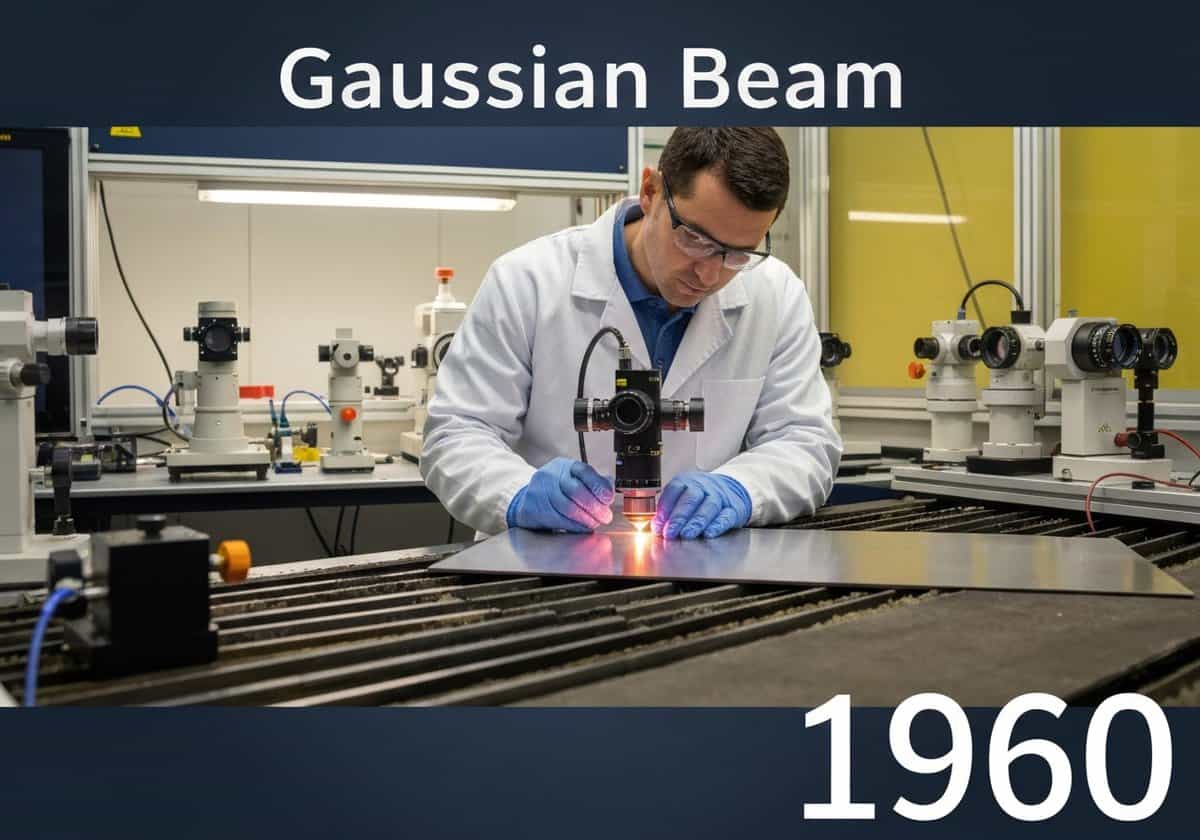
Macchina per il taglio laser che utilizza un fascio gaussiano in un laboratorio di ottica.

(Immagine generata a solo scopo illustrativo)

A Gaussian beam is a beam of electromagnetic radiation whose transverse electric field and intensity distributions are described by Gaussian functions. It is the most common output profile of lasers operating in the fundamental transverse mode (TEM00). This profile allows the beam to remain tightly focused over a long distance and represents the ideal case for high beam quality.

The Gaussian beam is a solution to the paraxial Helmholtz equation, which is an approximation of Maxwell’s equations for beams that do not diverge rapidly. The intensity [latex]I(r, z)[/latex] of a Gaussian beam as a function of radial distance [latex]r[/latex] from the center of the beam and axial distance [latex]z[/latex] from its narrowest point (the ‘beam waist’) is given by [latex]I(r, z) = I_0 \left(\frac{w_0}{w(z)}\right)^2 \exp\left(\frac{-2r^2}{w(z)^2}\right)[/latex]. Here, [latex]I_0[/latex] is the peak intensity at the beam waist, [latex]w_0[/latex] is the beam waist radius (where the intensity drops to [latex]1/e^2[/latex] of its axial value), and [latex]w(z)[/latex] is the beam radius at distance [latex]z[/latex].

Key parameters describing a Gaussian beam include the beam waist ([latex]w_0[/latex]), the Rayleigh range ([latex]z_R[/latex]), which is the distance over which the beam remains relatively collimated, and the beam divergence angle ([latex]\theta[/latex]), which describes how fast the beam spreads out in the far field. These parameters are all interrelated. A smaller beam waist results in a larger divergence angle, a consequence of diffraction. The quality of a real laser beam is often described by the M-squared ([latex]M^2[/latex]) factor, which compares its beam parameter product (waist radius times far-field divergence) to that of an ideal Gaussian beam, for which [latex]M^2=1[/latex]. The Gaussian profile is desirable because it can be focused to the smallest possible spot size for a given wavelength, maximizing intensity.

UNESCO Nomenclature: 2210
- Ottica

Tipo

Sistema astratto

Interruzione

Fondamento

Utilizzo

Uso diffuso

Precursori

  • Equazioni di Maxwell dell'elettromagnetismo
  • Huygens–Fresnel principle of diffraction
  • development of laser resonators that naturally support a fundamental mode

Applicazioni

  • laser cutting and welding
  • fiber optic coupling
  • laser pointers
  • barcode scanners
  • intrappolamento ottico (pinzette ottiche)
  • sistemi di comunicazione laser

Brevetti:

NA

Idee e potenziali innovazioni

A causa dell'eliminazione del traffico generato dai bot, che attualmente supera i 40.000 al giorno, questo contenuto è riservato ai membri della community.
> Accedi O > Registrati L'accesso a questo contenuto, così come a tutti gli altri contenuti e strumenti riservati, è (100% gratuito).

Argomenti correlati: fascio gaussiano, profilo del fascio laser, EM00, punto focale del fascio, intervallo di Rayleigh, divergenza del fascio, M-quadrato, approssimazione parassiale, diffrazione, qualità del fascio.

Contesto storico

Gaussian Beam

1960
1960
1960
1960
1961
1962
1963
1960
1960
1960
1960
1960-05-16
1962
1963
1964

(se la data è sconosciuta o non rilevante, ad esempio "meccanica dei fluidi", viene fornita una stima approssimativa della sua notevole comparsa)

Le immagini a grandezza naturale e i download sono disponibili, 100% gratuitamente, solo per i membri registrati.

> Login <