Amorphe Metalle (Metallisches Glas)
Amorphous metals, or metallic glasses, are alloys with a disordered, non-crystalline atomic structure, similar to that of common glass. This is achieved by cooling the molten Legierung at extremely high rates (e.g., [latex]10^6[/latex] K/s), preventing the atoms from organizing into a regular crystal lattice. Lacking grain boundaries, they exhibit unique properties like high strength, elasticity, and Korrosionsbeständigkeit.
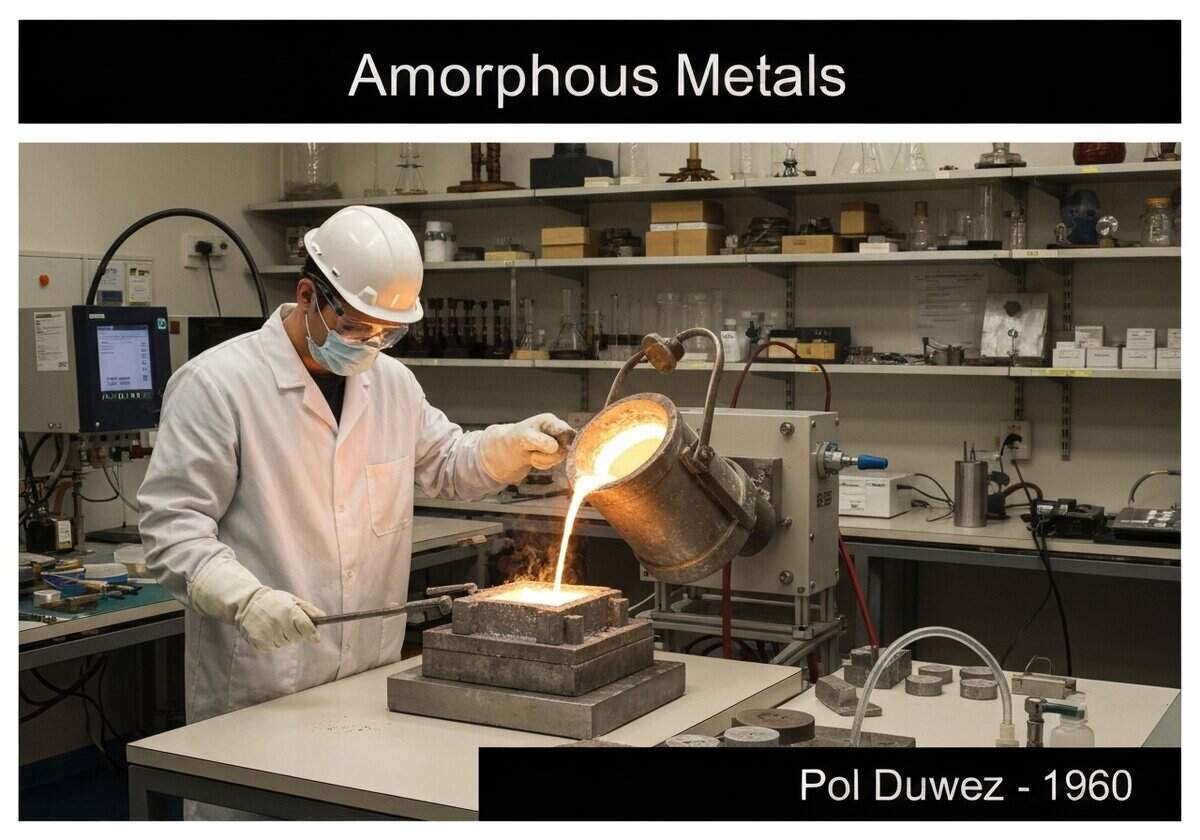
The creation of an amorphous metal requires bypassing crystallization during solidification. Every liquid, when cooled, has a thermodynamic driving force to crystallize, but this process takes time for atoms to arrange themselves. By cooling the molten alloy faster than this critical rate, the liquid’s disordered structure is ‘frozen’ into the solid state. The first amorphous alloy, Au₇₅Si₂₅, was produced by Pol Duwez’s team using a ‘gun technique’ to propel a molten droplet onto a cold copper substrate, achieving the necessary rapid quenching.
A significant challenge was the limitation to very thin ribbons or foils, as heat could not be extracted quickly enough from thicker sections. This led to the development of Bulk Metallic Glasses (BMGs). BMGs are multi-component alloys (typically 3 or more elements) with large atomic size mismatches, which frustrates the crystallization process and dramatically lowers the required critical cooling rate, allowing for the casting of parts several centimeters thick. Unlike crystalline metals that deform plastically through dislocation motion, metallic glasses deform elastically to much higher strains. Once their elastic limit is exceeded, deformation localizes into narrow regions called shear bands, often leading to catastrophic failure with little to no overall ductility. This combination of extreme strength but limited toughness is a key area of ongoing research.
UNESCO Nomenclature: 2211
- Festkörperphysik
Verwendung
Nische/Spezialisiert
Vorläufer
- Verständnis der Glasbildung in Silikaten und Polymeren
- Entwicklung von Schnellverfestigungstechniken (z. B. Schmelzspinnen, Splat-Quenching)
- thermodynamische Theorien der Keimbildung und des Kristallwachstums
- das Konzept der Glasübergangstemperatur in Polymeren
Anwendungen
- hocheffiziente Transformatorkerne durch geringe magnetische Hystereseverluste
- hochwertige Sportartikel wie Golfschlägerköpfe und Baseballschläger
- Gehäuse für Unterhaltungselektronik (z. B. Smartphones, Uhren)
- Präzisions-Chirurgieklingen und Skalpelle
- verschleißfeste Beschichtungen für Industrieteile
Potenzielle Innovationsideen
Aufgrund des hohen Datenverkehrs durch Web-Scraping-Bots, der derzeit mehr als 40.000 Anfragen pro Tag umfasst, ist dieser Inhalt ausschließlich Community-Mitgliedern vorbehalten.
> Anmelden < oder > Registrieren < (100% kostenlos) Zugriff darauf sowie auf alle anderen eingeschränkten Inhalte und Tools.
Related to: amorphous metal, metallic glass, non-crystalline, rapid cooling, bulk metallic glass, glass transition, high strength, corrosion resistance, solid state physics, shear bands.