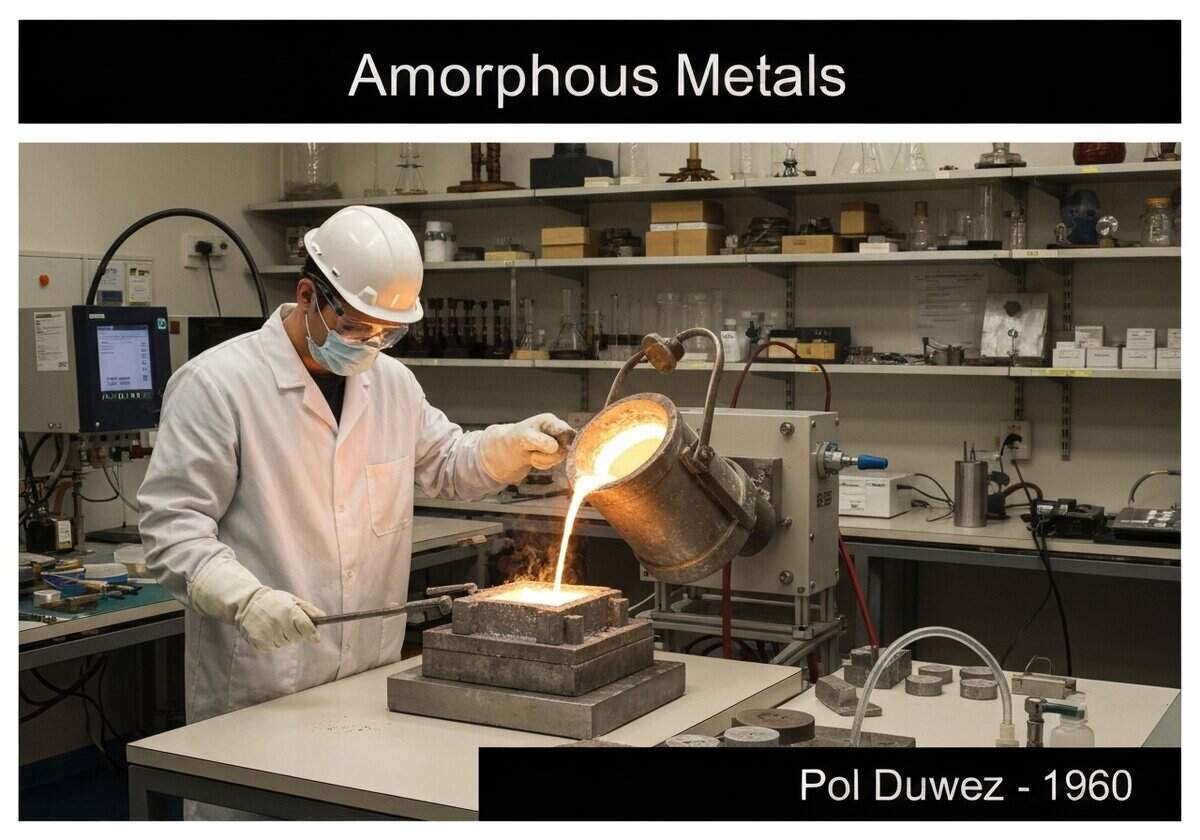
非晶質金属、または金属ガラスは、一般的なガラスと同様に、無秩序な非結晶性原子構造を持つ合金です。これは、溶融金属を冷却することによって実現されます。 合金 極めて高い速度(例えば、[latex]10^6[/latex] K/s)で、原子が規則的な結晶格子に組織化されるのを妨げます。粒界がないため、高い強度、弾性、および 耐食性.


(画像はイメージです)
非晶質金属、または金属ガラスは、一般的なガラスと同様に、無秩序な非結晶性原子構造を持つ合金です。これは、溶融金属を冷却することによって実現されます。 合金 極めて高い速度(例えば、[latex]10^6[/latex] K/s)で、原子が規則的な結晶格子に組織化されるのを妨げます。粒界がないため、高い強度、弾性、および 耐食性.
The creation of an amorphous metal requires bypassing crystallization during solidification. Every liquid, when cooled, has a thermodynamic driving force to crystallize, but this process takes time for atoms to arrange themselves. By cooling the molten alloy faster than this critical rate, the liquid’s disordered structure is ‘frozen’ into the solid state. The first amorphous alloy, Au₇₅Si₂₅, was produced by Pol Duwez’s team using a ‘gun technique’ to propel a molten droplet onto a cold copper substrate, achieving the necessary rapid quenching.
A significant challenge was the limitation to very thin ribbons or foils, as heat could not be extracted quickly enough from thicker sections. This led to the development of Bulk Metallic Glasses (BMGs). BMGs are multi-component alloys (typically 3 or more elements) with large atomic size mismatches, which frustrates the crystallization process and dramatically lowers the required critical cooling rate, allowing for the casting of parts several centimeters thick. Unlike crystalline metals that deform plastically through dislocation motion, metallic glasses deform elastically to much higher strains. Once their elastic limit is exceeded, deformation localizes into narrow regions called shear bands, often leading to catastrophic failure with little to no overall ductility. This combination of extreme strength but limited toughness is a key area of ongoing research.
ボットによるトラフィック(現在1日あたり4万件以上)を排除するため、このコンテンツはコミュニティメンバー限定となっています。
> ログイン < または > 登録 < (100%無料)でこれにアクセスできます。他のすべての制限付きコンテンツとツールも同様です。
非晶質金属(金属ガラス)
(日付が不明または関連性がない場合、例えば「流体力学」などでは、その注目すべき出現時期の概算値が提示されます。)

フルサイズの画像とダウンロードは、登録会員のみが100%無料で利用できます。
> ログイン <