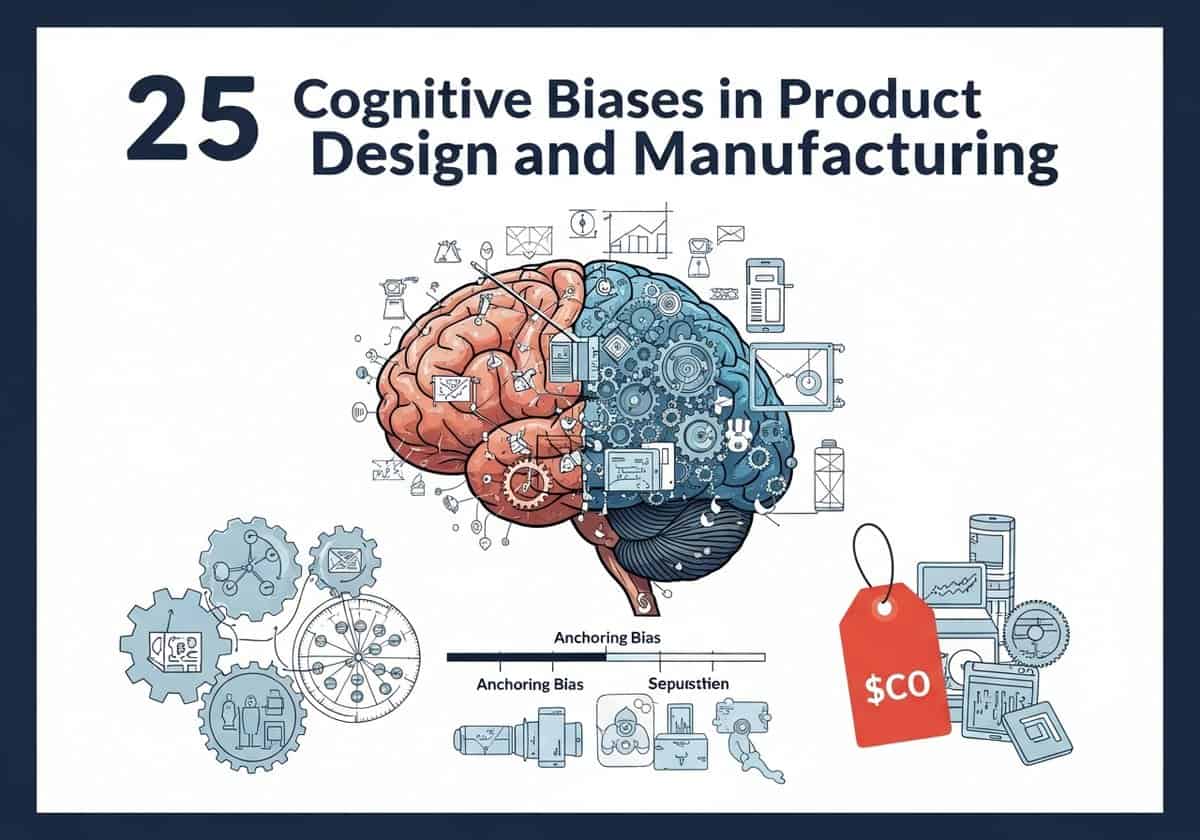
التحيزات الإدراكية هي اختصارات في التفكير البشري تشكل جميع القرارات. يمكن لمصممي ومهندسي المنتجات تحسين عملهم من خلال مراعاة هذه الأنماط الذهنية المتأصلة. وعلى الرغم من أن هذه الاختصارات مفيدة، إلا أنها تنتج أيضاً أخطاء منهجية متوقعة ومنتظمة في الحكم. تسمح المعرفة العملية بهذه التحيزات للمبدعين ببناء منتجات أكثر بديهية ونجاحاً لأنها تتماشى مع كيفية عمل عقول الناس في الواقع.
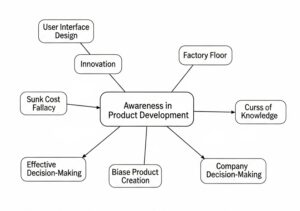
يمتد هذا الوعي إلى ما هو أبعد من المستخدم تصميم واجهة المستخدم to the full product دورة الحياة, from innovation to the factory floor. The same biases that affect a consumer’s choice also influence the internal الفرق that develop the product and check its quality. The Sunk Cost Fallacy can trap a team in a failing project, while the Curse of Knowledge can lead an engineer to write instructions that are clear to them but confusing for a machine operator. Identifying these patterns is a tool with two functions: it informs the creation of more effective products and it refines a company’s own decision-making, cutting down on expensive mistakes.
1. التحيز التثبيتي
الميل إلى الاعتماد بشكل كبير على أول معلومة يتم تقديمها. في تطوير المنتجات، تعمل التقديرات الأولية للميزانيات أو الجداول الزمنية أو نطاق الميزات كمراسي قوية يصعب تعديلها. يصبح الجدول الزمني الأولي لمدير المشروع "شهرين"، حتى لو كان تخمينًا تقريبيًا، معيارًا للنجاح، مما يقيد الفرق الهندسية ويثبط الحلول المبتكرة التي قد تظهر بعد بدء المشروع ولكنها تستغرق وقتًا أطول.
- يُساء استخدامها لـ: المفاوضات استراتيجية التسعيروإدارة توقعات أصحاب المصلحة. فالسعر الأولي المرتفع يجعل السعر الأولي المرتفع يجعل السعر اللاحق المنخفض يبدو وكأنه صفقة جيدة، حتى لو كان لا يزال أعلى من القيمة السوقية.
- مثال في مجال البحث والتطوير: يمكن أن تؤدي نتيجة مبكرة مفرطة التفاؤل من تجربة واحدة إلى ترسيخ توقعات مشروع بحثي بأكمله. قد يتشبث فريق البحث والتطوير والإدارة بهذا "الإنجاز" الأولي، مما يجعل من الصعب إجراء تقييم موضوعي للبيانات اللاحقة الأقل تفاؤلاً وتوجيه المشروع نحو مسار أكثر قابلية للتطبيق.
2. دليل التوفر
المبالغة في تقدير أهمية المعلومات التي يسهل تذكرها. قد يبالغ الفريق في إعطاء الأولوية لميزة تعالج مشكلة عانى منها أحد المنافسين البارزين مؤخرًا بشكل علني، لأن هذا الفشل واضح و"متاح" في أذهانهم. يمكن أن يؤدي ذلك إلى تحويل الموارد الهندسية عن معالجة المشاكل الأقل إثارة، ولكن الأكثر انتشارًا، والتي تم اكتشافها في أبحاث المستخدمين الخاصة بهم.
- تُستخدم لـ تسويق campaigns, news media, and risk assessment. Fear-based advertising often highlights vivid but rare negative events to sell insurance or safety products.
- مثال في الجودة و تصنيع:: قد يطبق فريق مراقبة الجودة إجراءات فحص مضنية ومستهلكة للوقت لنوع معين من العيوب التي تسببت في سحب منتج كبير لا يُنسى قبل عامين، بينما يولي اهتمامًا أقل لمشكلة جودة أكثر تواترًا ولكن أقل دراماتيكية تتسبب حاليًا في زيادة استياء العملاء.
3. تأثير الفرقة الموسيقية

الميل إلى تبني سلوكيات أو معتقدات معينة لأن العديد من الأشخاص الآخرين يفعلون ذلك.
وغالباً ما يدفع هذا الأمر إلى اعتماد حزم التكنولوجيا الشائعة أو أنظمة التصميم أو منهجيات إدارة المشاريع (مثل نظام Agile المحدد نطاق) دون تحليل دقيق لمدى ملاءمتها لمنتج معين أو لثقافة الفريق. قد يدفع أحد القادة الهندسيين إلى استخدام تقنية معقدة مثل Kubernetes لمجرد أن هذا ما يفعله "الجميع في مجال التكنولوجيا الكبيرة"، وليس لأن حجم المشروع يتطلب ذلك.
- يُساء استخدامها لـ: اتجاهات القيادة التسويق الفيروسيوخلق دليل اجتماعي لتبني المنتج. فهو يخلق "الخوف من الضياع" (FOMO) الذي يشجع الناس على الانضمام إلى حركة متنامية.
- مثال في مجال الابتكار: قد يشعر قسم الابتكار أو الشركة بالضغط من أجل الاستثمار بكثافة في مشاريع الذكاء الاصطناعي التوليدي لمجرد أنه الاتجاه السائد وأن المنافسين يعلنون جميعًا عن مبادراتهم في مجال الذكاء الاصطناعي. وهذا يمكن أن يؤدي إلى مشاريع متسرعة وغير مدروسة بشكل جيد تلاحق الضجة بدلاً من حل مشكلة حقيقية في العمل.
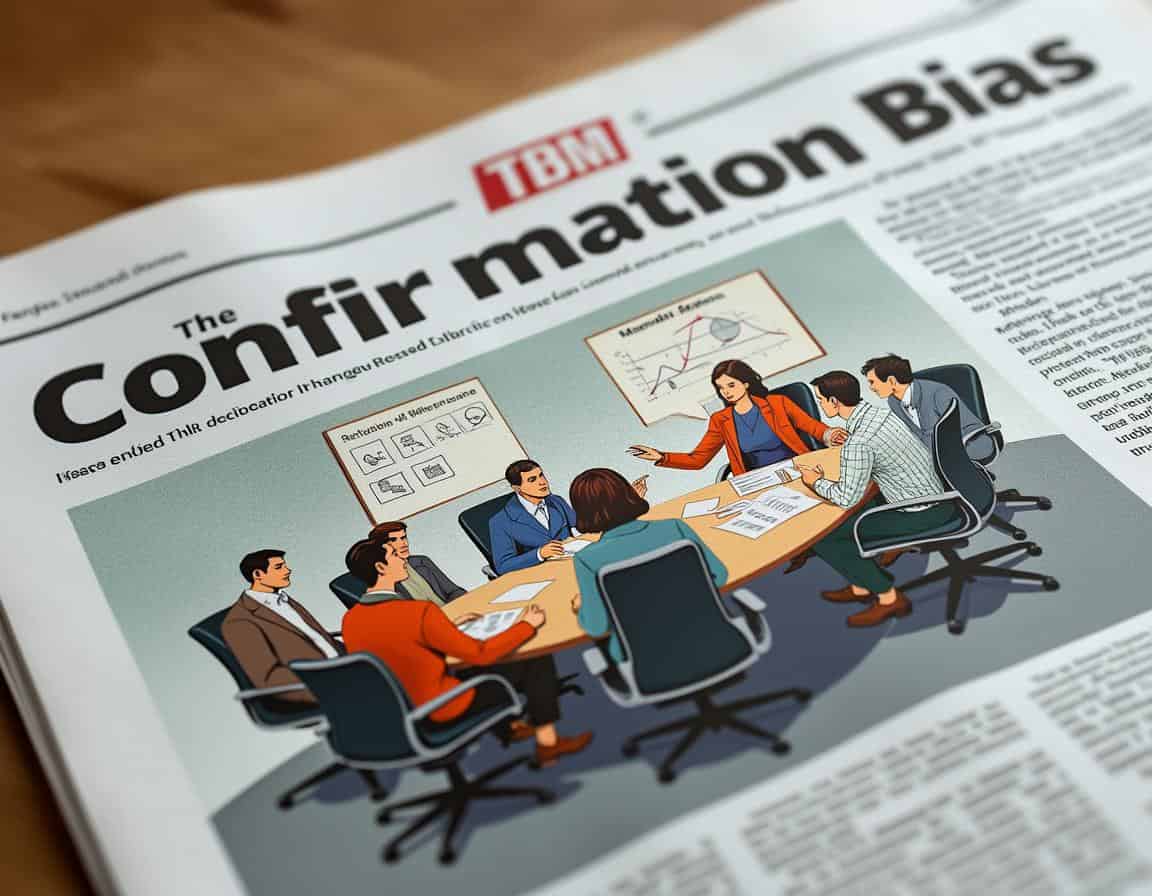
4. التحيز التأكيدي
الميل إلى البحث عن المعلومات التي تؤكد المعتقدات الموجودة مسبقاً وتفسيرها واسترجاعها.
Once a team commits to a product idea, they subconsciously seek user feedback and data that validate their chosen path. During سهولة الاستخدام testing, a مصمم might unintentionally ask leading questions to elicit positive responses, or a project manager might highlight metrics that show progress while ignoring those that signal a flawed strategy, leading the team further down the wrong road.
- تُستخدم من أجل: إنشاء غرف صدى الصوت في وسائل التواصل الاجتماعي، والرسائل السياسية، وتعزيز الولاء للعلامة التجارية من خلال تغذية العملاء بالمعلومات التي تؤكد حكمة شرائهم.
- مثال على ذلك في مجال البحث والتطوير: قد يفسر العالم الذي يعتقد أن جزيء معين هو مفتاح دواء جديد دون وعي نتائج الاختبارات الغامضة على أنها دليل إيجابي ويرفض البيانات المتناقضة على أنها شذوذ أو أخطاء في القياس. وقد يؤدي ذلك إلى إهدار الكثير من الوقت والموارد في السعي وراء طريق مسدود.
5. لعنة المعرفة
صعوبة أن يتخيل الخبراء كيف يبدو الأمر بالنسبة لشخص لا يملك مستواهم المعرفي. هذا مصدر أساسي للاحتكاك بين المهندسين والمستخدمين. قد يقوم المهندسون، الذين يفهمون بنية النظام، بتصميم واجهة أو واجهة برمجة تطبيقات منطقية من وجهة نظر تقنية ولكنها غير بديهية تماماً بالنسبة لمستخدم جديد يفتقر إلى هذا النموذج العقلي الأساسي، مما يؤدي إلى تجربة سيئة في عملية الانضمام إلى النظام وتكاليف دعم عالية. هذا التحيز هو أكثر من عقبة متأصلة. وهو يتجلى في العروض التقديمية المليئة بالمصطلحات، وأدلة المستخدم المعقدة للغاية، والواجهات "البديهية" التي لا تكون بديهية إلا لمنشئيها.
- مثال في مجال التصنيع: قد يقوم المهندس الذي يصمم آلة تجميع جديدة معقدة بكتابة تعليمات تشغيل واضحة تمامًا لمهندس آخر، ولكنها غير مفهومة لفني الأرض الذي يتعين عليه استخدامها واستكشاف الأخطاء وإصلاحها يوميًا. وهذا يؤدي إلى أخطاء المشغل، وانخفاض الكفاءة، ومخاطر محتملة تتعلق بالسلامة. يمكن أن تكون هناك مشكلة مماثلة في كتابة تعليمات الاستخدام (IFU) لمنتج ما.
6. تأثير الشرك الخادع
الظاهرة التي يمكن أن يتغير فيها تفضيل الأشخاص لأحد الخيارين عند تقديم خيار ثالث غير متماثل يهيمن عليه خيار ثالث. في استراتيجية المنتج وإدارة المشاريع، يمكن استخدام ذلك لتوجيه قرارات أصحاب المصلحة. عند تقديم خرائط طريق المشروع، فإن مدير المنتج قد يتضمن خيارًا "خداعيًا" - خيارًا ذا توازن ضعيف بشكل واضح بين الميزات مقابل الجهد الهندسي - لجعل خيارهم الاستراتيجي المفضل يبدو أكثر جاذبية ومنطقية بالمقارنة.
- Abused for: subscription pricing tiers and product line-ups. A “medium” popcorn is priced just slightly less than the “large,” making the large seem like a great value and the intended choice.
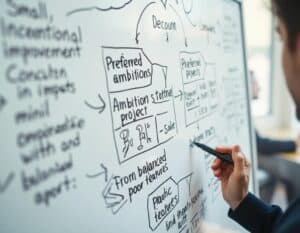
- Example in R&D: when pitching innovative projects for funding, a team can present three options: 1) A small, incremental improvement, 2) Their preferred, ambitious project, and 3) A “decoy” project that is almost as expensive as the ambitious one but offers far fewer benefits. The decoy makes the preferred project look like the most efficient and valuable choice.
7. The Default Bias

The tendency to stick with pre-set options.
The power of defaults is immense in both product design and engineering. For users, the default privacy settings or subscription plan can dictate behavior on a massive scale. Internally, the default configurations in a development environment or a “starter” project template will be used by the vast majority of engineers, making the choice of these defaults a critical decision that impacts security, efficiency, and code consistency across the organization.
- Used for: increasing sign-up rates for newsletters (opt-out vs. opt-in), setting برمجة installation options, and establishing company-wide 401(k) enrollment.
- Example in quality: in a manufacturing setting, if the default setting on a machine is “standard tolerance,” most operators will use it for all jobs unless explicitly told otherwise. If a higher-quality product requires “tight tolerance,” relying on operators to remember to change it will lead to errors. Setting the default to the highest required quality standard (or the safest setting) is a powerful way to reduce defects.
نصيحة: indeed, a default selected value can save time. But in some cases, it worth to have no default value and oblige the user or operator to “think” and apply or justify his choice.
8. The Dunning-Kruger Effect
The tendency for individuals with low ability at a task to overestimate their ability. In project planning, a manager with a limited understanding of a new technology might drastically underestimate its complexity, leading to unrealistic deadlines. Similarly, a junior engineer might confidently claim a task will take two days when it will actually take two weeks, causing cascading delays throughout the project plan.
This Bias is rarely used intentionally; its effects are mostly negative. It explains why novices can be overconfident and resistant to feedback, while experts are often more aware of their own limitations.
9. The Endowment Effect
The tendency to place a higher value on things one owns or has created.
This bias is a primary driver of resistance to change in engineering.
Teams become attached to the code and systems they have built (they are “endowed” with them), causing them to defend legacy systems and resist migrating to more modern, efficient التقنيات. This “not invented here” syndrome can stifle innovation and saddle a company with costly technical debt.
- Abused for: free trials and money-back guarantees. Once a user integrates a product into their life, the feeling of ownership makes them less likely to “lose” it by cancelling.
- Example in product development: an innovation team that has spent six months developing a prototype becomes heavily invested in it. When market feedback suggests the core concept is flawed, the team’s sense of “ownership” can cause them to defend the prototype and resist pivoting, arguing for “just a few more features” instead of acknowledging the need for a fundamental change.
10. The Framing Effect
Very frequently used, voluntary or involuntary, it consist in drawing different conclusions from the same information, depending on how it is presented. The perception of the project health is highly susceptible to framing:
طريقة a): the project manager reporting progress as “75% of features are code-complete” creates a positive frame of accomplishment
Method b): reporting the same status as “25% of critical code is still untested and un-integrated” creates a negative frame of risk, which can dramatically alter stakeholder confidence and decisions.
- Abused for: public relations, marketing, and political messaging. A medical treatment’s success can be framed as “90% survival rate” (positive) or “10% mortality rate” (negative).
- Another example in Quality Assurance: a QA report can frame its findings to influence action. Stating “the software passed 95% of test cases” encourages a launch decision. Framing the same data as “5% of tests failed, including 2 critical security vulnerabilities” will almost certainly halt the launch. The framing directly impacts the perception of product readiness.
11. The Halo Effect
The tendency for a positive impression in one area to positively influence one’s opinion in other areas. A product with a stunning, polished visual design often benefits from a halo effect, leading users and stakeholders to perceive it as more usable, secure, and well-engineered than it actually is. This can mask serious underlying usability flaws or technical debt, delaying critical feedback until after the product has launched.
- Used for: celebrity endorsements, luxury branding, and interviews. An articulate and charismatic candidate might be perceived as more competent, regardless of their actual skills.
- Example in R&D: a research proposal from a scientist who recently won a prestigious award may be scrutinized less rigorously by a funding committee. The “halo” of the award can lead the committee to overlook potential flaws in the experimental design or budget, assuming the entire proposal is as brilliant as the scientist’s past work.
12. Hick’s Law
The time it takes to make a decision increases with the number and complexity of choices. This applies equally to user interfaces and internal engineering systems. A settings menu with 50 options will overwhelm a user. Likewise, a microservices architecture with too many interdependent services and configuration flags creates immense cognitive load on engineers, making troubleshooting and innovation slow and error-prone.
This is primarily a principle to design against.
It is abused when companies intentionally create confusing options to nudge users toward a default or more expensive choice. It must be used constructively to simplify remote controls, application menus, and emergency procedures.
- Example in sales: never offer too many options to the customer: instead of pleasing him, he may not decide, and buy nothing at all!
- Example in Manufacturing: a control panel for a piece of factory machinery with dozens of unordered buttons and switches will slow down operators and increase the chance of error. A well-designed panel uses Hick’s Law by grouping related controls, hiding advanced options, and simplifying common workflows to reduce decision time and improve safety.
13. The IKEA Effect

Placing a disproportionately high value on products one has partially created. This is leveraged by products that involve user customization and setup.
In an enterprise or development context, when an engineering team invests significant effort in configuring and customizing a third-party platform (like a CRM or a data dashboard), they become heavily invested in it. This increases loyalty but can also make them resistant to switching to a better, simpler solution in the future because they don’t want to abandon their effort.
- Used for: building brand loyalty and user investment. Meal-kit services, build-a-bear workshops, and customizable online profiles all benefit from users valuing the final product more because of their own effort.
- Example in brainstorming: an innovation challenge that provides teams with a basic toolkit and requires them to build their own prototype can be more effective than just asking for ideas. The teams that invest the effort to build something, even if it’s rudimentary, will feel a stronger sense of ownership and be more passionate advocates for their innovative solution.
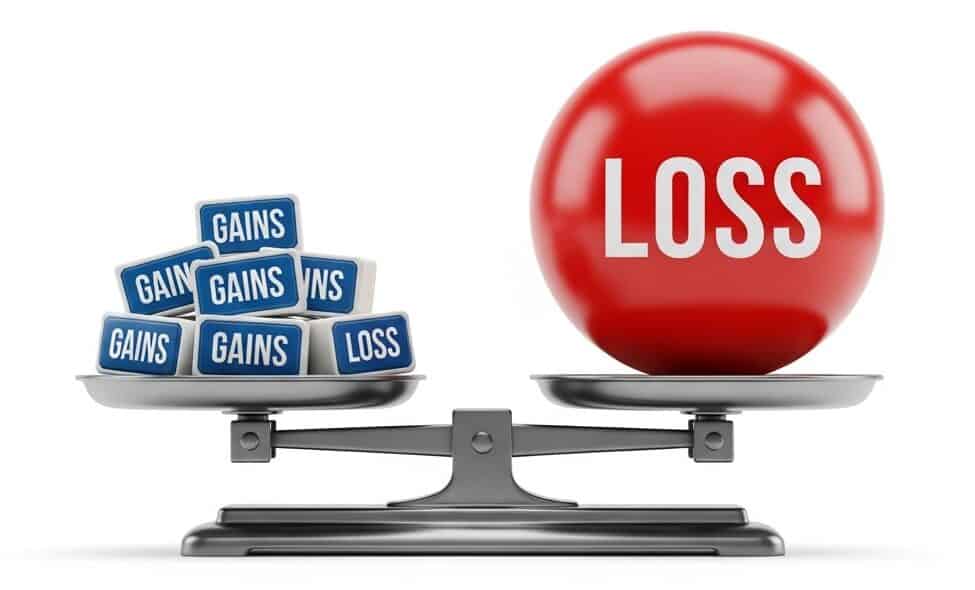
14. The Loss Aversion
The tendency to feel that the pain of a loss is twice as powerful as the pleasure of an equivalent gain.
This is a major impediment to تطور المنتج and project agility. Proposing the removal of a rarely-used feature will trigger strong opposition from the few who use it (a perceived loss), which often outweighs the broad, diffuse benefit of a cleaner product for everyone else. This makes it psychologically and politically difficult for product managers to simplify and streamline their products.
- Abused for: driving urgency in sales with “limited-time offer” messages (avoid the loss of the deal) and in user retention by framing cancellation as “losing your benefits.”
- Example in manufacturing: proposing a change to a long-standing manufacturing process, even if data shows it will increase efficiency (a gain), will be met with strong resistance. Workers may focus on the “loss” of their familiar routine and perceived expertise, fearing the uncertainty of the new process more than they value the promised efficiency gains.
15. The Negativity Bias
Related to the Loss Aversion, the Negativity Bias is the tendency to give more weight to negative experiences than positive ones. In project retrospectives (“post-mortems”), teams often fixate on the one or two things that went wrong (a server outage, a missed deadline) while glossing over the dozens of things that went right. This can lead to a risk-averse culture that penalizes experimentation and discourages ambitious innovation.
- Used/Abused For: customer reviews and news reporting. A single one-star review can outweigh ten five-star reviews. Negative headlines get more clicks than positive ones.
- Example in Quality Assurance: a QA tester’s role is inherently focused on finding flaws, which can institutionalize negativity bias. They might produce a bug report that is a long list of minor issues, creating an overwhelming and demoralizing impression of the product’s quality, when in fact the core functionality is stable and the تجربة المستخدم is largely positive.
16. The Mental Model
A person’s thought process for how something works in the real world. A critical failure point in product development is a mismatch between the engineer’s mental model and the user’s. For example, an engineer may think of “saving a file” as a distinct action, while a user accustomed to cloud apps has a mental model where work is saved continuously and automatically.
Designing against the user’s mental model leads to confusion and a steep learning curve.
This is a core concept in user experience design. It’s used to create intuitive interfaces that match user expectations (e.g., a shopping cart icon). It’s a source of problems when ignored, leading to user error.
- Example in Quality/Safety: in a manufacturing plant, if an emergency stop button is designed as a touchscreen icon (engineer’s mental model of a modern interface) but the universal mental model for workers under ضغط is a large, physical red button, this mismatch can lead to a catastrophic failure in an emergency. Quality and safety procedures must align with ingrained mental models.
17. The Mere Exposure Effect
With some commonalities with the Mental Model, this bias is the tendency to develop a preference for things merely because of familiarity. This is why engineering teams often resist adopting new tools or processes. They are comfortable with the existing toolchain (e.g., Jira, Jenkins) not because it is the best, but because they are familiar with its quirks and workflows. Overcoming this inertia is a key challenge for innovation in development practices.
- Abused for: advertising and branding. Seeing a brand الشعار repeatedly, even subconsciously, builds a sense of familiarity and trust that can influence purchasing decisions.
- Example in R&D: a lab might continue to purchase measurement instruments from a specific brand, even when a competitor offers a more accurate or cheaper alternative. The researchers are simply more comfortable and familiar with the old brand’s interface and operation, and this preference born of familiarity can inhibit the adoption of superior technology.
18. The Peak-End Rule

Judging an experience largely based on how it was felt at its peak (most intense point) and at its end.
The overall perception of a year-long project is often not an average of the entire experience. Instead, the team and stakeholders will remember the most stressful week (the “peak”) and the final launch experience (the “end”).
نصيحة: a skilled project manager can salvage a difficult project by ensuring the final weeks are smooth, successful, and celebratory, thus creating a positive lasting memory.
- Used for: designing customer service experiences and user journeys. A difficult installation process can be “saved” by a final, delightful success screen and a welcoming on-boarding tour.
- Example in innovation: when running a pilot program for an innovative new product, the experience must end on a high note. Even if there were mid-program glitches (peaks), ensuring the final off-boarding process is smooth, gathers positive feedback, and provides a “thank you” gift can leave participants with a much more positive overall memory of the innovation.
19. The Serial Position Effect
Very close to the Peak-End Rule, this one is the tendency to best recall the first and last items in a series. In critical meetings like a project kickoff or a quarterly review, stakeholders will most clearly remember what is said at the beginning and what is said at the end. Important information, such as the project’s primary goal or the biggest risk, should be communicated at the very start or summarized at the very end to ensure maximum retention and impact.
- Can be used for: structuring presentations, writing sales copy, and designing lists. Key benefits are listed first, and the call-to-action is placed at the very end.
- Example in Quality Control: when an inspector checks a batch of products, they may be most attentive at the beginning and end of the batch.
نصيحة: this can be dangerous if it leads to less scrutiny for items in the middle. To counteract this, quality procedures should mandate randomized sampling or structured breaks to reset attention and ensure consistent inspection throughout the entire batch.
20. Reciprocity
The social norm of responding to a positive action with another positive action. Within a company, this is the glue of cross-functional collaboration. When an engineer goes out of their way to help a designer debug a prototype, the designer is more likely to prioritize that engineer’s future requests for design assets. This informal system of reciprocity is often more effective at getting things done than formal project plans.
- Abused in Marketing: content marketing (giving away a free ebook to get an email address), sales (offering free samples), and building social obligations.
21. Scarcity

The tendency to see more value in something that is perceived to be limited in supply. Product managers use this to create focus and drive decisions. By framing engineering time as a scarce resource (“We only have the bandwidth for one of these two features this quarter”), they force stakeholders to make difficult but necessary trade-offs, preventing scope creep and ensuring resources are allocated to the highest-priority initiatives.
- Abused in Marketing: driving sales with “limited edition” products, “only 3 left in stock” messages, and countdown timers for deals.
- Can be used positively if done seldom : to push rapid progress, an innovation team might be given a “scarcity” constraint: a small, fixed budget and a two-week timeline to develop a proof-of-concept. This scarcity of time and money forces the team to be highly creative, focus only on what’s essential, and avoid over-engineering, often leading to more inventive solutions.
22. The Self-Serving Bias
The tendency to attribute successes to personal skills and failures to external factors. When a product launch exceeds its goals, the engineering team may credit their “clean code” while the design team credits their “intuitive تجربة المستخدم.” If it fails, the same teams may blame “unrealistic deadlines from management” or “a poor marketing strategy.” This bias can prevent a team from learning the true lessons from both its successes and failures.
This is a self-preservation bias. It’s commonly seen in performance reviews and project post-mortems where individuals or teams deflect blame and claim credit.
- Example in R&D: if an experiment succeeds, the lead scientist may attribute it to their brilliant hypothesis and skill. If it fails, they may blame a faulty piece of equipment or a contaminated sample (external factors). This bias can prevent them from re-evaluating their core hypothesis, which may be the actual source of the failure.
23. The Social Proof

The tendency to assume the actions of others reflect correct behavior.
This is profoundly influential in technology choices. Engineering teams will often adopt a language, framework, or database not after a deep, first-principles analysis, but because a respected “unicorn” tech company uses it and has written blog posts about its success. This can lead to teams adopting solutions that are far too complex for their actual needs.
- Abused for: displaying customer testimonials, user counts (“Join 10 million users”), and influencer marketing to build trust and drive adoption.
- Example in Manufacturing: a factory manager might be hesitant to invest in a new, unproven الروبوتات technology. However, if they learn that their three main competitors have successfully adopted it and are seeing productivity gains, the social proof from their peers can be the final nudge needed to approve the investment.
24. The Sunk Cost Fallacy

With many similarities with The Endowment Effect, this one consists of continuing a behavior or endeavor as a result of previously invested resources (time, money, or effort).
This is one of the most destructive biases in product development. It compels project managers to continue pouring engineering resources into a failing feature or product because “we’ve already spent so much on it.” The inability to cut losses and pivot, due to an emotional attachment to sunk costs, has قاد countless innovative projects to a grinding halt.
This is a trap that people and organizations fall into. It’s used in arguments to justify continuing a failing project or war: “We can’t pull out now, because our soldiers’ lives would have been wasted.”
- Example in R&D: an organization might continue to fund a pharmaceutical research project for a drug that consistently shows poor efficacy and high side effects simply because $50 million has already been invested over five years. The rational decision would be to cut losses and reinvest in a more promising drug candidate, but the sunk cost makes this emotionally and politically difficult. See also “The Dead Horse” analogy.
25. The Zeigarnik Effect
The tendency for people to better remember uncompleted or interrupted tasks than completed tasks. This creates a persistent cognitive load for engineering teams, as unresolved bugs and pending feature requests linger in their minds.
نصيحة: a savvy project manager can leverage this by using tools like كانبان boards and progress bars, which make the “open loops” visible and motivate the team to move tasks to “done” to achieve psychological closure.
- Abused for: creating cliffhangers in TV series and using progress bars in user profiles (e.g., “Your profile is 80% complete”) to motivate users to finish the task.
- Example in Manufacturing: on an assembly line, an incomplete product at a worker’s station creates a natural cognitive tension to finish it.
Tip: this effect can be harnessed by ensuring that work-in-progress is always clearly visible. Conversely, if a worker is frequently interrupted and has too many incomplete tasks open at once, the resulting cognitive load can increase stress and the likelihood of errors.

خاتمة
The intentional misuse of these cognitive triggers moves design from beneficial guidance to active manipulation. When product designers exploit biases like Loss Aversion to create addictive feedback loops, or use the Decoy Effect in “dark patterns” to trick people into more expensive choices, they breach user trust. This exploitation is not limited to customers; a project manager can misuse Anchoring to impose unrealistic deadlines on an engineering team, compromising quality and well-being. Such actions prioritize short-term gain over ethical responsibility, transforming psychological insight into a tool for deception.
This unethical conduct carries substantial legal and commercial risks.
Regulatory bodies now actively penalize companies for deceptive واجهة المستخدم designs that trap consumers in subscriptions or obscure data collection practices.
In technical settings, misrepresenting safety data through Framing to downplay risks can lead to corporate negligence charges if a product fails. The resulting public backlash from such revelations can destroy a company’s سمعة far more completely than any financial penalty, eroding customer loyalty and repelling skilled applicants who refuse to work for a deceptive organization.
مسرد المصطلحات المستخدمة
Application Programming Interface (API): مجموعة من القواعد والبروتوكولات التي تسمح لتطبيقات البرامج المختلفة بالتواصل والتفاعل مع بعضها البعض، مما يتيح تكامل الوظائف وتبادل البيانات بين الأنظمة.
Conversion Rate (CR): نسبة زوار موقع الويب أو صفحة الهبوط الذين يكملون إجراءً مرغوبًا فيه، مثل إجراء عملية شراء أو الاشتراك في النشرة الإخبارية، ويتم حسابها عن طريق قسمة عدد التحويلات على إجمالي عدد الزوار.
Customer Relationship Management (CRM): نظام لإدارة تفاعلات الشركة مع العملاء الحاليين والمحتملين، باستخدام تحليل البيانات لتحسين علاقات العمل، وتعزيز استبقاء العملاء، ودفع نمو المبيعات. يدمج النظام قنوات اتصال متنوعة، ويُؤتمت العمليات لتبسيط تفاعل العملاء.
instruction For Use (IFU): وثيقة تقدم معلومات مفصلة حول الاستخدام الصحيح والتعامل والصيانة لجهاز أو منتج طبي، مما يضمن السلامة والفعالية للمستخدمين.
User experience (UX): الرضا العام والإدراك لدى المستخدم عند التفاعل مع منتج أو نظام أو خدمة، بما في ذلك قابلية الاستخدام وإمكانية الوصول والتصميم والاستجابة العاطفية طوال عملية التفاعل بأكملها.
User Interface (UI): نظام يتيح التفاعل بين المستخدمين وتطبيقات البرامج، ويشمل عناصر مرئية، وأدوات تحكم، وتخطيطًا عامًا لتسهيل مهام المستخدم وتحسين التجربة.