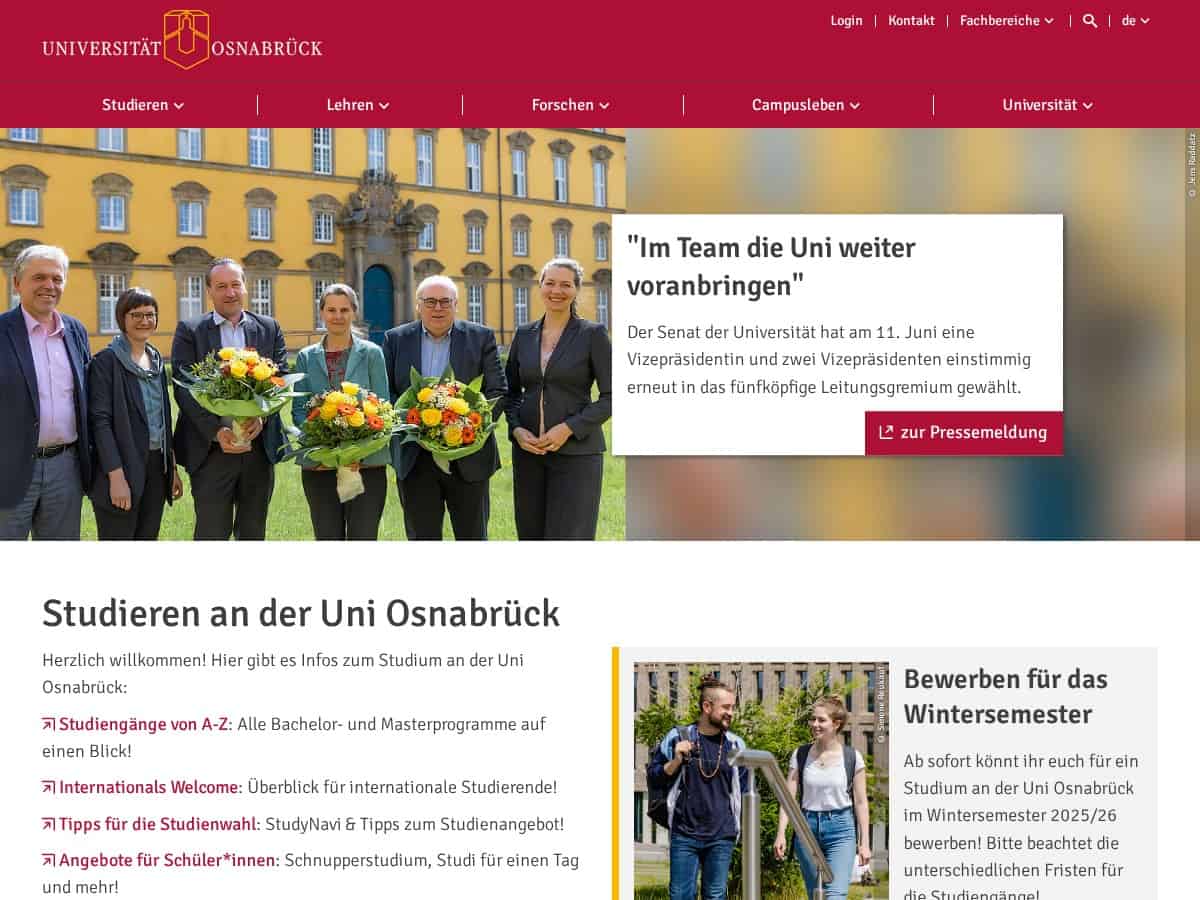
Osnabrück University is a university in the city of Osnabrück in Lower Saxony, Germany. Its main building is the baroque Schloss, the Fürstbischöfliches Schloss, which was formerly the residence of the Prince-Bishops of Osnabrück.
Teaching began in 1974, when the university succeeded a teacher-training college (Pädagogische Hochschule) in Osnabrück. The university offers a broad portfolio of subjects across several academic fields.
The university has about 14,000 students. The Schloss, a baroque building dating from the 1660s, serves as the central building and administrative seat of the university.
Domains taught:
AI and Machine Learning, Astroscience, Automation, Bioengineering, Bioinformatics, Chemistry, Computer Vision, Data Analytics, Ecology and Sustainability, Electrical and Electronics, Ergonomics and UX, Fluid Dynamics, Life Sciences, Materials, Mathematics, Mechanical Engineering, Microbiology and Genetics, Nanotechnologies, Optics, Physics, Process Control, Robotics, Signal Processing, Software Engineering, Statistics, Structural Engineering, Telecommunications, Thermodynamics
Diplomas*:
Bachelor, Doctor, Master
Status:
Public
Partnerships:
Internationally recognized for cognitive science research. Strong interdisciplinary links.
Research:
Artificial intelligence and cognitive modeling, Nanoscience and materials physics, Cell biology and systems biology, Data science and environmental informatics.
Famous Alumnis:
Christian Wulff
International recognition**:
Number of staff***:
1500
Current students***:
14000
Foreign students***:
N/A%
Cumulative former students***:
N/A
Pros
Leading in cognitive science research, strong computer science and physics programs, interdisciplinary environment.
Cons
Less focused on traditional engineering disciplines.
Best For
Research university renowned for cognitive science, with strong programs in computer science, physics, and nanoscience.
Universität Bielefeld lists Computer Science & Intelligent Systems and Physics & Nanoscience, a profile close to this university.
Universität Paderborn is a public university in Paderborn with Computer Science & Engineering and Mechanical Engineering.
Carl von Ossietzky Universität Oldenburg, in Oldenburg, is listed with Renewable Energy & Environmental Physics.
Universität Potsdam lists Earth & Environmental Sciences and Cognitive Sciences & Data Science in Potsdam.
Universität des Saarlandes in Saarbrücken is listed with Computer Science & AI and Materials Science & Engineering.
Most Similar Schools Abroad
Radboud Universiteit in the Netherlands is a public university with Neuroscience, Artificial Intelligence and Chemistry.
Tilburg University in the Netherlands is a public university whose fields include Data Science and Cognitive Science & AI.
Università degli Studi di Trento in Italy is a public university with Materials Science among its listed fields.
Université Grenoble Alpes in France is a public university with Physics & Nanosciences and Computer Science & AI.
Vrije Universiteit Brussel in Belgium is a public university listed with Photonics, Artificial Intelligence and Engineering.
*our own picks (our criteria: a mix between domains, diploma delivered, reputation and size), but obviously too many criteria for an apple-to-apple ranking.
FAQ
When did Osnabrück University begin teaching?
Teaching started in 1974.
Which institution preceded the university?
A teacher-training college (Pädagogische Hochschule) in Osnabrück, the Adolf-Reichwein-Hochschule, was its predecessor.
Where is the main building?
It is the baroque Fürstbischöfliches Schloss in the city of Osnabrück, the former seat of the Prince-Bishops.
How many students does the university have?
It has about 14,000 students.
What range of subjects is taught?
The university describes a broad portfolio of subjects across several academic fields.
*: without any judgment of the quality, readers are strongly encouraged to check the official status of the exact diploma envisioned as many universities have a mix of recognized diplomas, not recognized, “co-delivered,” “equivalent to”, “some pathways” (…), can change over time, and can be named differently from one country to another.
**: international reputation: is based on some criteria that do not mean much in some domains or specialties (number of researchers, of scientific publications, on budget ….). Our approximate 1-4 scale:
known locally
known locally and internationally
is listed in some of the world university’s classifications
is listed among the 20 firsts in some of world university’s classifications
***: estimated numbers, based on online sources and/or feedbacks. The numbers can vary greatly depending on school organisation (ex.: school is part of a group, it employs internal staff or external consultants or has public staff without employing them …). Refer to all the links provided to have accurate and updated numbers.
Innovation.world is not affiliated with this school/university. We recommend to contact them directly on their website for any special request.
To complete or correct any information here or share your opinion, please comment below or > send us a direct message <.