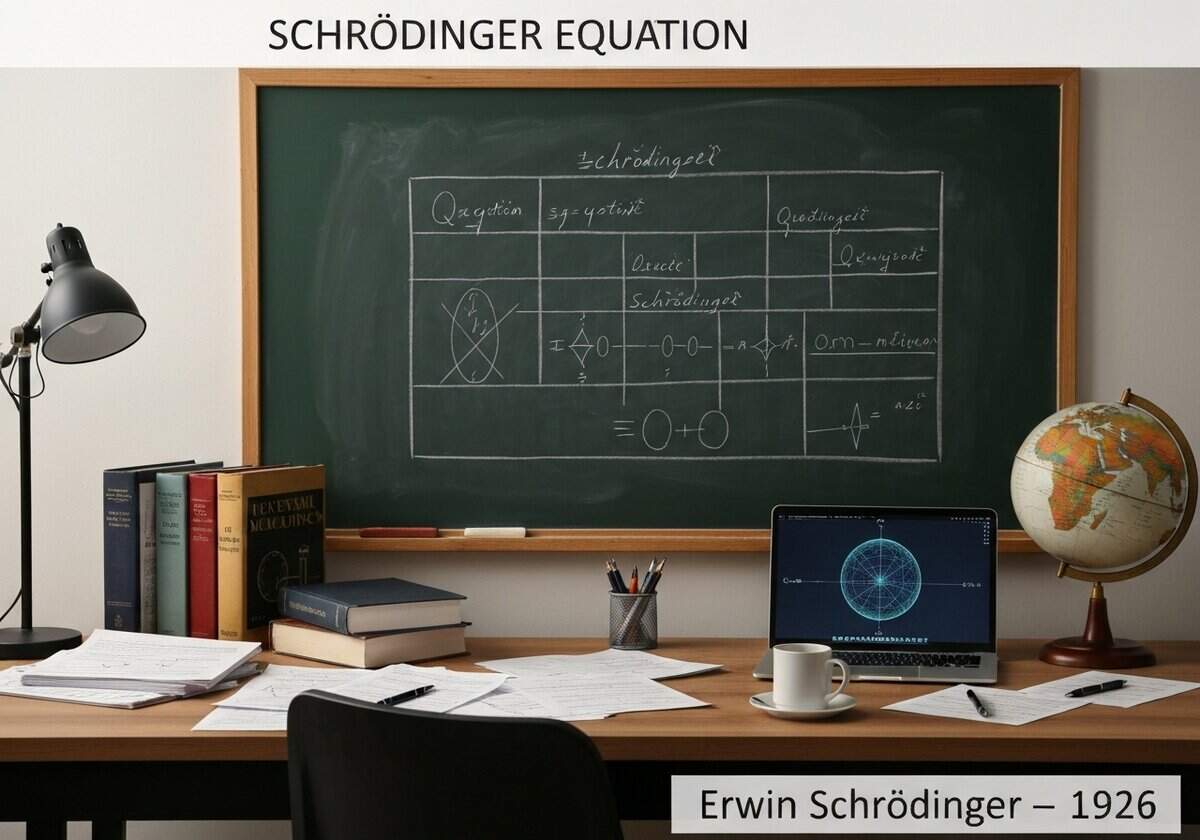
这是量子力学中的一个基本方程,描述了物理系统的量子态如何随时间变化。它是波函数的线性偏微分方程,即 [latex]/Psi(x,t)[/latex]。与时间相关的版本是 [latex]i\hbar\frac\{partial}\{partial t}\Psi = \hat{H}\Psi[/latex], 其中 [latex]\hat{H}[/latex] 是哈密顿算子,代表系统的总能量。


(图片仅供参考)
这是量子力学中的一个基本方程,描述了物理系统的量子态如何随时间变化。它是波函数的线性偏微分方程,即 [latex]/Psi(x,t)[/latex]。与时间相关的版本是 [latex]i\hbar\frac\{partial}\{partial t}\Psi = \hat{H}\Psi[/latex], 其中 [latex]\hat{H}[/latex] 是哈密顿算子,代表系统的总能量。

薛定谔方程是牛顿第二定律的量子力学对应物。 第二定律 在经典力学中,牛顿定律预测粒子的运动轨迹,而薛定谔方程则预测系统波函数的未来行为。波函数Ψ是一个复值概率振幅,其幅值的平方|Ψ|²给出了粒子在给定位置和时间出现的概率密度。该方程主要有两种形式:含时形式和不含时形式。
The time-dependent Schrödinger equation (TDSE), [latex]i\hbar\frac{\partial}{\partial t}\Psi(x, t) = \hat{H}\Psi(x, t)[/latex], describes a system evolving in time. The time-independent Schrödinger equation (TISE), [latex]\hat{H}\Psi(x) = E\Psi(x)[/latex], is used for systems in a stationary state, where the energy [latex]E[/latex] is constant. Solving the TISE for a given potential yields the allowed energy eigenvalues ([latex]E[/latex]) and the corresponding energy eigenfunctions ([latex]\Psi[/latex]), which represent the stable states of the system, such as the electron orbitals in an atom. The 汉密尔顿 operator [latex]\hat{H}[/latex] is constructed from the classical expression for the total energy (kinetic plus potential) by replacing classical variables with their corresponding quantum operators. For a single non-relativistic particle, [latex]\hat{H} = -\frac{\hbar^2}{2m}\nabla^2 + V(x, t)[/latex].
薛定谔方程
(如果日期未知或不相关,例如“流体力学”,则提供其显著出现的近似估计)

只有注册会员才能免费获取完整尺寸的图片和下载内容。
> 登录 <