Address: 27 King’s College Circle, M5S 1A1 Toronto, Ontario, Canada
Medicine, Engineering, Artificial Intelligence
Founded in 1827, Canada’s largest university, renowned globally for research and teaching across three campuses: St. George, Mississauga, and Scarborough. A leader in fields like medicine, AI, and humanities.
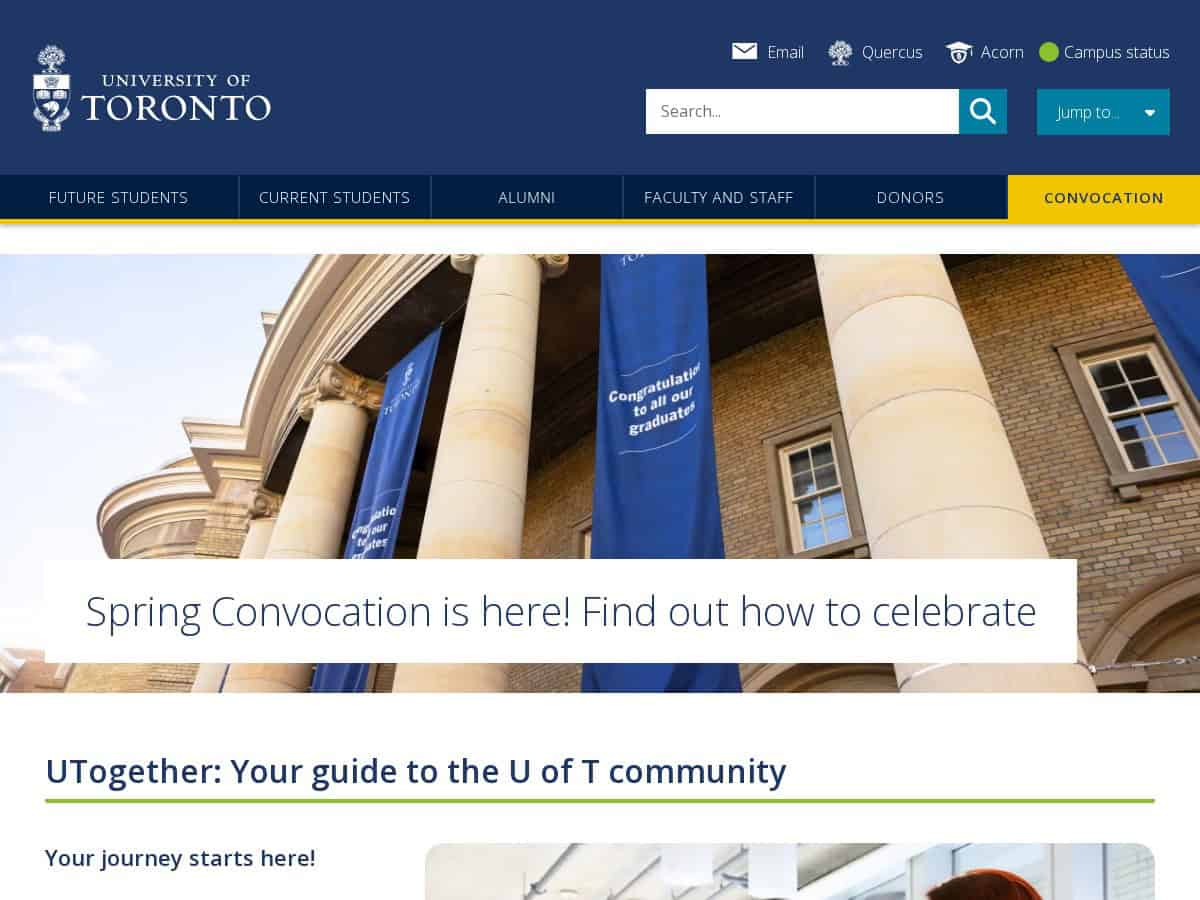
The University of Toronto is the largest university in Canada, with about 97,500 students, 15,200 staff and a foreign student share of roughly 20 percent. It works on three campuses: St. George in downtown Toronto, Mississauga and Scarborough. Each has its own character, but degrees, libraries and research institutes are shared, and the St. George campus around King’s College Circle remains the centre of engineering and medicine.
Its place in scientific history is concrete. Insulin was isolated in Toronto in 1921 by Frederick Banting, Charles Best, James Collip and John Macleod, and the first evidence for stem cells came from Ernest McCulloch and James Till in the early 1960s. In artificial intelligence the university is just as central: Geoffrey Hinton, who shared the 2024 Nobel Prize in Physics for foundational work on neural networks, spent most of his academic career in Toronto, and the Vector Institute, created in 2017, keeps the research close to industry.
Engineering is taught at the Faculty of Applied Science and Engineering, whose Engineering Science programme is among the most selective in the country. The Professional Experience Year lets students take a twelve to sixteen month paid placement between study terms. Annual research funding is above one billion Canadian dollars, and partnerships range from the Max Planck Society and Oxford to hospitals and companies in the MaRS Discovery District.
Courses are in English. Domestic tuition is moderate by North American standards, while international undergraduate fees are several times higher, particularly in engineering, so students from abroad should check the current schedule and scholarship options. Admission to most programmes depends on secondary school grades, with supplementary applications for engineering, architecture and some others.
Toronto is the largest city in Canada and rents in the central districts are high, so many students live in residence in the first year and share flats afterwards. About 665,000 people have graduated from the university, among them Margaret Atwood and former prime minister Lester B. Pearson.
Domains taught:
AI and Machine Learning, Chemistry, Data Analytics, Engineering, Life Sciences, Physics, Software Engineering
Diplomas*:
Bachelor, Certificate, Diploma, Doctor, Graduate Certificate, Graduate Diploma, Master, MBA
Status:
Public
Partnerships:
Extensive global partnerships with universities (e.g., Max Planck Society, University of Oxford) and industry. Member of U15 Group of Canadian Research Universities and Association of American Universities.
Research:
A leading research institution with over $1.4 billion annual research funding. Strengths include AI (Vector Institute), regenerative medicine, public policy, quantum computing, and health sciences.
Famous Alumnis:
Frederick Banting, Charles Best, Margaret Atwood, Norman Jewison, Lester B. Pearson, Roberta Bondar, Malcolm Gladwell, Donald Sutherland
International recognition**:
Number of staff***:
15200
Current students***:
97500
Foreign students***:
20%
Cumulative former students***:
665000
Pros
World-renowned research and teaching, vast program diversity, extensive network of affiliated hospitals, vibrant city location, strong global rankings, large alumni network.
Cons
Very large student population can feel impersonal, highly competitive programs, high cost of living in Toronto, some large undergraduate class sizes.
Best For
Students seeking a world-class, research-intensive education with diverse program options in a major global city, offering extensive research and networking opportunities.
Think of McGill University when physics, life sciences and data analytics is the priority: it covers ecology and sustainability as well, and is smaller, enrolling about 39,500 students against roughly 97,500 here.
Université de Montréal follows much the same lines as this institution, with chemistry, physics and life sciences as common ground, and it covers bioinformatics as well, and is slightly smaller, at about 67,500 students against roughly 97,500 here.
For students who like the life sciences, data analytics and AI and machine learning focus of this university but want another option nearby, University of British Columbia fits well: it does not run the graduate certificate and graduate diploma programmes found here and covers marine science and ecology and sustainability as well.
University of Ottawa offers a comparable education in chemistry, life sciences and data analytics: it covers optics as well, and is smaller, enrolling about 45,000 students against roughly 97,500 here.
For students who like the chemistry, physics and life sciences focus of this university but want another option nearby, Queen's University fits well: it is far smaller, with about 31,000 students against roughly 97,500 here, and is also a public institution.
Most Similar Schools Abroad
The closest overseas parallel on chemistry, physics and life sciences is University of California, Berkeley, located in the United States; it is smaller, enrolling about 45,300 students against roughly 97,500 here, and is also a public institution.
Monash University offers an international parallel to this university, with chemistry, physics and life sciences as common ground; it has almost the same size, at about 86,600 students, and is also a public institution.
For chemistry, physics and life sciences outside the home country, University of Melbourne in Australia is a natural reference; it covers agriculture and microbiology and genetics as well, and is smaller, enrolling about 58,100 students against roughly 97,500 here.
If this university is on your list for life sciences, data analytics and AI and machine learning, University of Washington in the United States deserves a comparison, because it does not run the certificate, diploma, graduate certificate and graduate diploma programmes found here, and covers marine science and bioengineering as well.
Beyond national borders, The University of Manchester stands out as a comparable school for chemistry, physics and life sciences; it is also a public institution, and does not run the certificate, diploma, graduate certificate and graduate diploma programmes found here.
*our own picks (our criteria: a mix between domains, diploma delivered, reputation and size), but obviously too many criteria for an apple-to-apple ranking.
FAQ
Where is the University of Toronto?
The St. George campus is at 27 King's College Circle in downtown Toronto. The university also has campuses in Mississauga and Scarborough.
How large is the university?
About 97,500 students and 15,200 staff, which makes it the largest university in Canada.
What is the University of Toronto known for?
Medicine, engineering, artificial intelligence, life sciences and the humanities, with more than one billion Canadian dollars in annual research funding.
What was discovered at Toronto?
Insulin was isolated by Banting, Best, Collip and Macleod in 1921, and McCulloch and Till produced the first evidence of stem cells in the early 1960s.
What is the Vector Institute?
It is an artificial intelligence research institute in Toronto, created in 2017, which works with the university, hospitals and industry.
What language is used for teaching?
English.
How much does tuition cost?
Domestic tuition is moderate by North American standards. International undergraduate fees are several times higher, so check the current fee schedule.
Is there a co-op programme?
Engineering students can take the Professional Experience Year, a paid placement of twelve to sixteen months. Other co-op options exist in some programmes.
How do you apply?
Most programmes require secondary school grades through the Ontario application system or an international equivalent. Engineering and some other programmes require a supplementary application.
Who are some famous alumni?
Frederick Banting, Charles Best, Margaret Atwood and Lester B. Pearson are among them, and Geoffrey Hinton, Nobel laureate in physics, spent much of his career at the university.
Artificial Intelligence (AI), Biomedical Sensors, Engineering, Innovation, Medical, Sustainable Development
*: without any judgment of the quality, readers are strongly encouraged to check the official status of the exact diploma envisioned as many universities have a mix of recognized diplomas, not recognized, “co-delivered,” “equivalent to”, “some pathways” (…), can change over time, and can be named differently from one country to another.
**: international reputation: is based on some criteria that do not mean much in some domains or specialties (number of researchers, of scientific publications, on budget ….). Our approximate 1-4 scale:
known locally
known locally and internationally
is listed in some of the world university’s classifications
is listed among the 20 firsts in some of world university’s classifications
***: estimated numbers, based on online sources and/or feedbacks. The numbers can vary greatly depending on school organisation (ex.: school is part of a group, it employs internal staff or external consultants or has public staff without employing them …). Refer to all the links provided to have accurate and updated numbers.
Innovation.world is not affiliated with this school/university. We recommend to contact them directly on their website for any special request.
To complete or correct any information here or share your opinion, please comment below or > send us a direct message <.