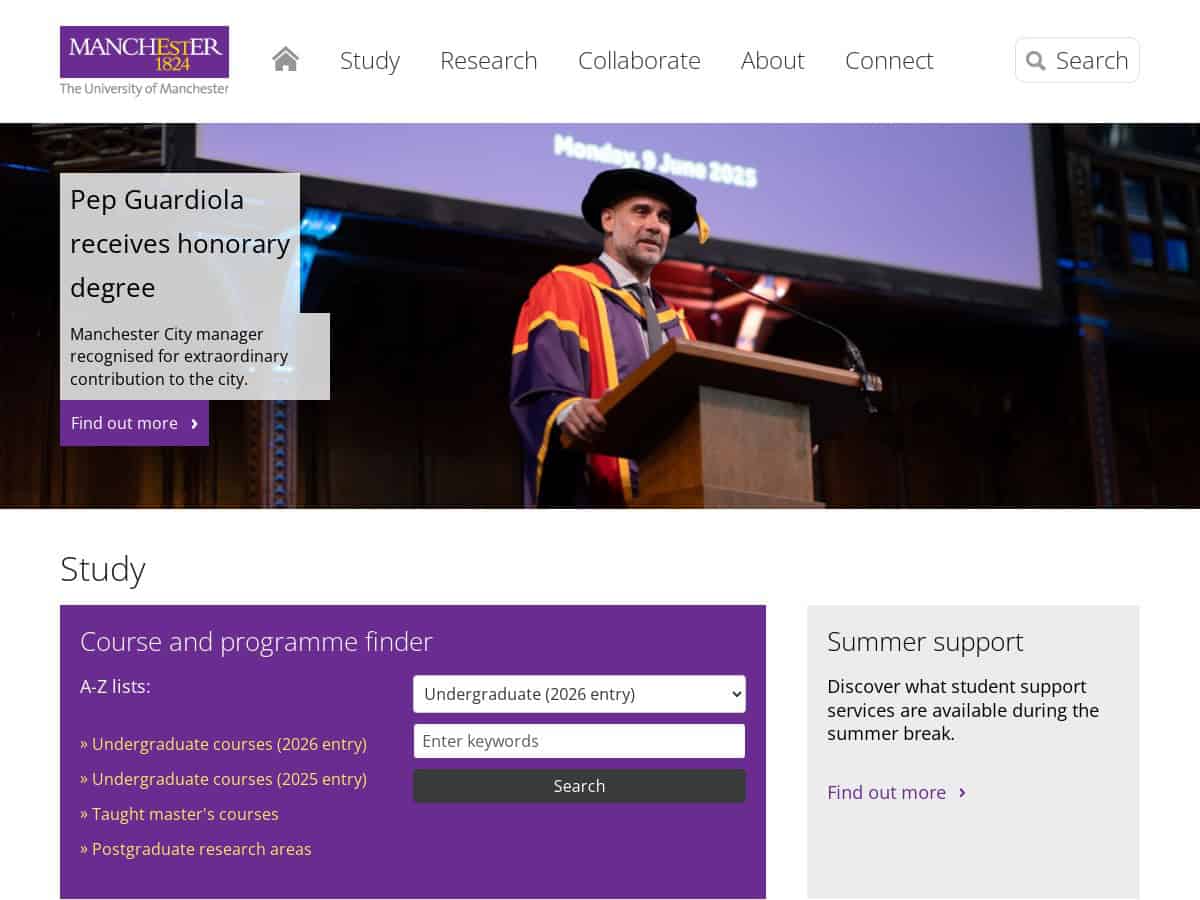
Address: Oxford Road, Manchester, M13 9PL, England, United Kingdom
Sciences, Engineering, Medicine
A large public research university, formed in 2004 by the merger of UMIST and the Victoria University of Manchester. Member of the Russell Group. Largest single-site university in the UK.
The University of Manchester was formed in 2004 by merging the Victoria University of Manchester and the University of Manchester Institute of Science and Technology, UMIST. The older institution traces its history to Owens College, founded in 1851 with a bequest from the merchant John Owens. It has about 46,500 students and 12,500 staff, and around 30 percent of the students come from abroad. The campus on Oxford Road, south of the city centre, is one of the largest urban campuses in the United Kingdom, with Gothic Revival buildings next to modern laboratories.
Manchester has a record of physics and computing. Ernest Rutherford discovered the nucleus of the atom there in 1911 with Hans Geiger and Ernest Marsden, and in 1917 he split the atom for the first time. Alan Turing worked at Manchester, and the Manchester Baby, which ran its first program in 1948, was the first stored-program computer. In 2004 Andre Geim and Konstantin Novoselov isolated graphene at the university, which brought them the 2010 Nobel Prize in Physics.
The university runs the National Graphene Institute and the Henry Royce Institute for advanced materials, and it operates the Jodrell Bank Observatory in Cheshire, which includes the Lovell Telescope and is a UNESCO World Heritage Site. Strengths include materials, engineering, physics, computer science, medicine, business, social sciences and the humanities. Alliance Manchester Business School is a leading business school, and the university’s museums, the Manchester Museum and the Whitworth Art Gallery, are open to the public.
Undergraduate applications go through UCAS. Tuition for home students is capped by the government at about nine and a half thousand pounds a year, while international students pay much higher fees, often between twenty-five and thirty-five thousand pounds depending on the course, and more for medicine and dentistry. Check the current tariff. Teaching is in English, and scholarships and bursaries exist.
Manchester is a lively city with a large student population and lower living costs than London. Student halls are concentrated in Fallowfield and near the campus, and buses run along Oxford Road all day.
Domains taught:
AI and Machine Learning, Chemistry, Engineering, Life Sciences, Materials, Physics, Software Engineering
Diplomas*:
Bachelor, Doctor, Master, MBA
Status:
Public
Partnerships:
Member of Russell Group and N8 Research Partnership. Extensive global research and industry collaborations (e.g. National Graphene Institute). 25 Nobel laureates among current/former staff and students.
Research:
World-leading research across almost all disciplines. Particular strengths in advanced materials (graphene), cancer research, industrial biotechnology, AI, and social sciences.
Famous Alumnis:
Alan Turing, Ernest Rutherford, Brian Cox, Benedict Cumberbatch, Andre Geim, Konstantin Novoselov
International recognition**:
Number of staff***:
12500
Current students***:
46500
Foreign students***:
30%
Cumulative former students***:
510000
Pros
Major Russell Group university, vast range of courses, significant research power and funding, located in a vibrant city, strong global reputation.
Cons
Very large student population, can feel impersonal, highly competitive, some older facilities.
Best For
Highly ambitious students seeking a world-class research-intensive education at one of the UK’s largest and most dynamic universities, with strengths in science, engineering, and medicine.
University of Glasgow takes a similar route through chemistry, physics and life sciences, and it is also a public institution, and runs the same bachelor's, master's, doctoral and mba programmes.
University of Nottingham takes a similar route through chemistry, physics and life sciences, and it teaches at the same levels, namely bachelor's, master's, doctoral and mba, and covers agriculture as well.
The comparison with University College London is straightforward on subjects, since both focus on physics, life sciences and AI and machine learning, and it has almost the same size, at about 48,000 students, and is also a public institution.
University of Bristol follows much the same lines as this university, with chemistry, physics and life sciences as common ground, and it is smaller, enrolling about 29,000 students against roughly 46,500 here, and is also a public institution.
On content, University of Birmingham and this university are close, as both teach chemistry, physics and life sciences; it teaches at the same levels, namely bachelor's, master's, doctoral and mba, and covers mechanical engineering as well.
Most Similar Schools Abroad
Beyond national borders, University of California, Berkeley stands out as a comparable school for chemistry, physics and life sciences; it also offers graduate diploma programmes and covers data analytics as well.
University of California, Los Angeles brings a the United States setting to the same core fields, materials, life sciences and AI and machine learning, and it runs the same bachelor's, master's, doctoral and mba programmes, and covers industrial design and data analytics as well.
Beyond national borders, Henan University stands out as a comparable school for chemistry, physics and materials; it has almost the same size, at about 50,000 students, and is also a public institution.
On content, National University of Singapore in Singapore and this institution are close, as both teach chemistry, physics and materials; it covers finance and mathematics as well, and is slightly smaller, at about 35,900 students against roughly 46,500 here.
Nanyang Technological University, based in Singapore, is built around chemistry, physics and materials much like this university, and it runs the same bachelor's, master's, doctoral and mba programmes, and covers mathematics and data analytics as well.
*our own picks (our criteria: a mix between domains, diploma delivered, reputation and size), but obviously too many criteria for an apple-to-apple ranking.
FAQ
Where is the University of Manchester?
On Oxford Road in Manchester, England, south of the city centre.
When was it formed?
In 2004, by merging the Victoria University of Manchester and UMIST.
How large is it?
About 46,500 students and 12,500 staff.
What did Rutherford do at Manchester?
He discovered the nucleus of the atom in 1911 with Hans Geiger and Ernest Marsden, and he split the atom in 1917.
What is the Manchester Baby?
The first stored-program computer, which ran its first program in 1948.
What is the link with graphene?
Andre Geim and Konstantin Novoselov isolated graphene at the university in 2004 and received the 2010 Nobel Prize in Physics.
What is Jodrell Bank?
A radio astronomy observatory in Cheshire that includes the Lovell Telescope and is a UNESCO World Heritage Site.
How do you apply?
Undergraduate applications go through UCAS.
What does it cost?
Home tuition is capped at about nine and a half thousand pounds a year. International fees are much higher. Check the current tariff.
*: without any judgment of the quality, readers are strongly encouraged to check the official status of the exact diploma envisioned as many universities have a mix of recognized diplomas, not recognized, “co-delivered,” “equivalent to”, “some pathways” (…), can change over time, and can be named differently from one country to another.
**: international reputation: is based on some criteria that do not mean much in some domains or specialties (number of researchers, of scientific publications, on budget ….). Our approximate 1-4 scale:
known locally
known locally and internationally
is listed in some of the world university’s classifications
is listed among the 20 firsts in some of world university’s classifications
***: estimated numbers, based on online sources and/or feedbacks. The numbers can vary greatly depending on school organisation (ex.: school is part of a group, it employs internal staff or external consultants or has public staff without employing them …). Refer to all the links provided to have accurate and updated numbers.
Innovation.world is not affiliated with this school/university. We recommend to contact them directly on their website for any special request.
To complete or correct any information here or share your opinion, please comment below or > send us a direct message <.