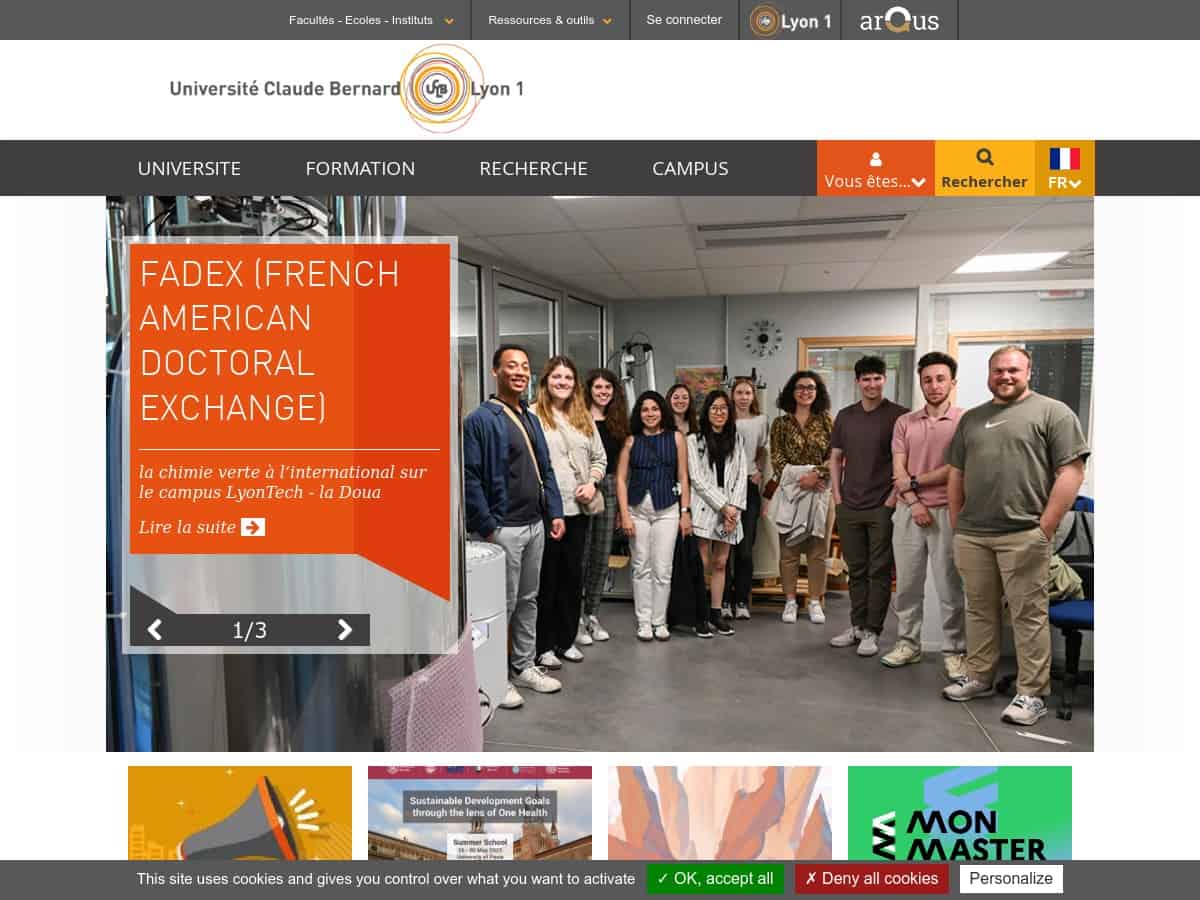
Address: 43 boulevard du 11 Novembre 1918, 69100 Villeurbanne, Auvergne-Rhône-Alpes, France
Life & Health Sciences, Chemistry & Materials Science, Computer Science & Engineering
Claude Bernard University Lyon 1, usually shortened to UCBL, was created in 1971 and carries the name of the French physiologist Claude Bernard. It is a public university with its main base in Villeurbanne, next to Lyon, and further health-science sites elsewhere in the city, among them the faculties of medicine at Lyon Est and Lyon Sud.
Its faculties, schools and institutes include the Faculty of Science and Technology, the sports-science faculty STAPS, the faculties of medicine and odontology, the Institute of Financial and Insurance Science (ISFA), the engineering school Polytech Lyon and the Observatoire de Lyon.
The mix of units gives the university a profile built on science, technology, health and sport. Students can move from basic biosciences, chemistry, physics, mathematics and computer science to actuarial studies, rehabilitation and pharmaceutical sciences within one institution, and the Observatoire de Lyon is part of the same university.
Domains taught:
Aerospace, AI and Machine Learning, Astroscience, Automation, Bioengineering, Bioinformatics, Chemistry, Civil Engineering, Computer Vision, Data Analytics, Ecology and Sustainability, Electrical and Electronics, Engineering, Fluid Dynamics, Food Science, Geotechnics, Life Sciences, Manufacturing, Materials, Mathematics, Mechanical Engineering, Microbiology and Genetics, Nanotechnologies, Optics, Physics, Process Control, Robotics, Signal Processing, Software Engineering, Sound Engineering, Statistics, Structural Engineering, Telecommunications, Thermodynamics
Diplomas*:
Bachelor, Doctor, Master
Status:
Public
Partnerships:
Part of Université de Lyon COMUE. Member of ARQUS European University Alliance. Strong links with Lyon’s chemical industry (Chemical Valley”) and biotech sector.”
Research:
Infectious diseases, Cancer research, Catalysis & green chemistry, Materials science, Data science & AI, Environmental science.
Famous Alumnis:
Cédric Villani (studied)
International recognition**:
Number of staff***:
5000
Current students***:
46000
Foreign students***:
10%
Cumulative former students***:
N/A
Pros
Leading French university in health and sciences, high research output, located in a major European city with strong industrial sectors.
Cons
Large university, some campuses are aging, competition for resources.
Best For
Leading university for science, technology, and health with a strong research focus.
Université de Strasbourg is a public university whose fields include chemistry, life sciences and health, and physics and engineering, a spread comparable to Lyon 1.
Université de Montpellier pairs ecology and environmental science with biology, health sciences and chemistry in a public setting.
Institut National des Sciences Appliquées de Lyon is a public engineering school at Villeurbanne, in the same urban area, listing mechanical engineering, computer science and materials science.
Université Grenoble Alpes, public and based at Saint-Martin-d'Hères, covers physics and nanosciences, computer science and AI, and earth and environmental sciences.
Université de Bordeaux, a public university in Talence, lists neurosciences and health, materials science and engineering, and optics and photonics.
Most Similar Schools Abroad
Universität Basel (Switzerland) is a public university in Basel with life sciences, nanoscience, physics and chemistry as main fields.
Albert-Ludwigs-Universität Freiburg (Germany), public and located in Freiburg im Breisgau, combines life sciences and bioengineering with materials science.
Università degli Studi di Padova (Italy) is a public university in Padua with engineering, physics and life sciences as main fields.
University of Washington (United States) is a public university in Seattle in which medicine, computer science and engineering are leading fields.
Osaka University (Japan) is a public university in Osaka, focused on physics and chemistry as well as engineering.
*our own picks (our criteria: a mix between domains, diploma delivered, reputation and size), but obviously too many criteria for an apple-to-apple ranking.
FAQ
When was Lyon 1 created?
The university dates from 1971, and its first president was elected in January 1971. In 2011 it celebrated forty years of existence.
Why is it named after Claude Bernard?
The French physiologist Claude Bernard gives the university its name. Its health and life-science units reflect that scientific heritage.
Which components does the university have?
They include the Faculty of Science and Technology, STAPS, the faculties of medicine and odontology, ISFA, Polytech Lyon and the Observatoire de Lyon. Pharmaceutical and rehabilitation institutes are also part of it.
Where are its campuses?
The main administrative and teaching base is in Villeurbanne. Health teaching takes place at sites in Lyon, including Lyon Est and Lyon Sud.
Does it offer engineering training?
Yes, through Polytech Lyon, the university's engineering school. Other technology and computing courses are in the Faculty of Science and Technology.
Can students study sport sciences there?
Yes, the UFR STAPS is the university's sport sciences component. It is listed among the components of science and technology at the university.
How can applicants find official requirements?
The official site univ-lyon1.fr presents each faculty, school and institute with its admission procedure. Many programmes are taught in French, so applicants should check the language requirements of the course they choose.
Biomedical Sensors, Chemistry, Innovation, Sustainable Development
*: without any judgment of the quality, readers are strongly encouraged to check the official status of the exact diploma envisioned as many universities have a mix of recognized diplomas, not recognized, “co-delivered,” “equivalent to”, “some pathways” (…), can change over time, and can be named differently from one country to another.
**: international reputation: is based on some criteria that do not mean much in some domains or specialties (number of researchers, of scientific publications, on budget ….). Our approximate 1-4 scale:
known locally
known locally and internationally
is listed in some of the world university’s classifications
is listed among the 20 firsts in some of world university’s classifications
***: estimated numbers, based on online sources and/or feedbacks. The numbers can vary greatly depending on school organisation (ex.: school is part of a group, it employs internal staff or external consultants or has public staff without employing them …). Refer to all the links provided to have accurate and updated numbers.
Innovation.world is not affiliated with this school/university. We recommend to contact them directly on their website for any special request.
To complete or correct any information here or share your opinion, please comment below or > send us a direct message <.