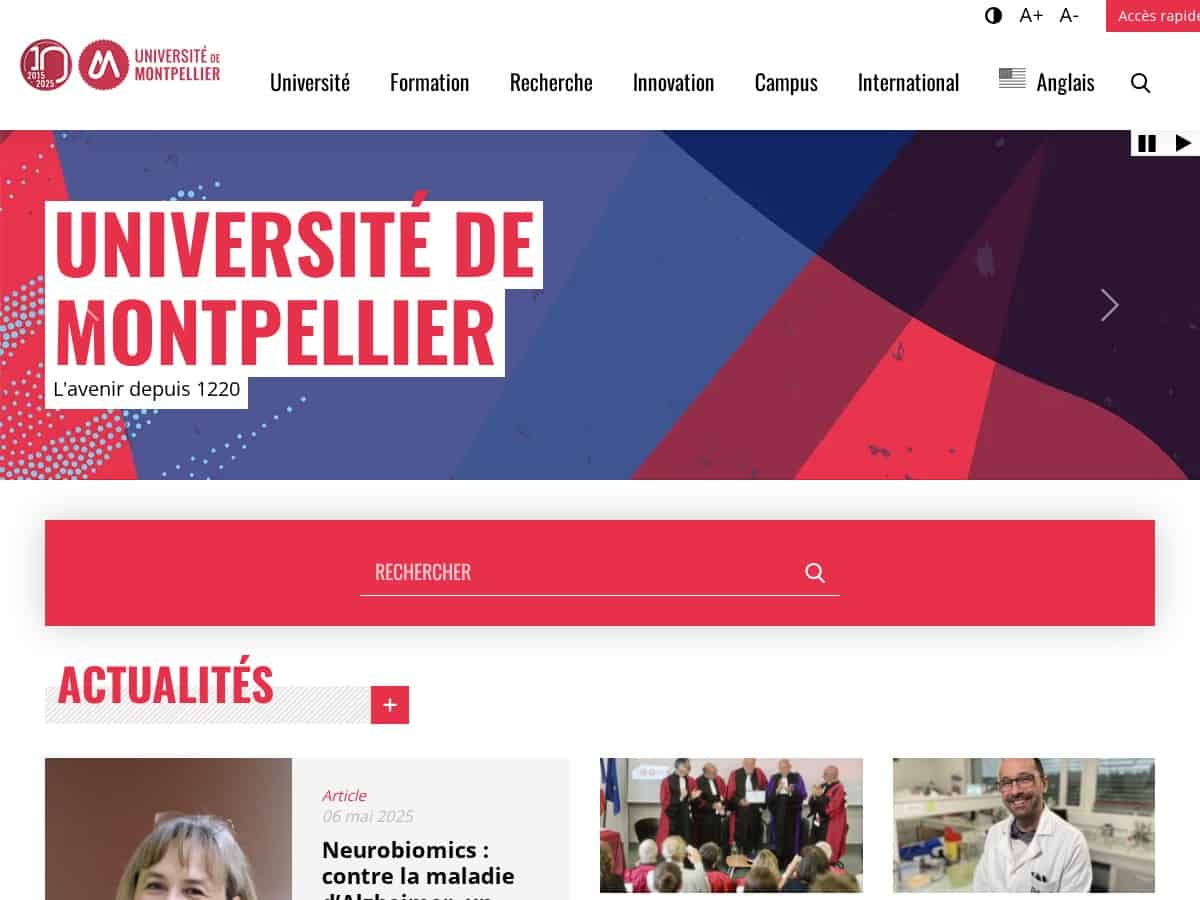
The Université de Montpellier took its present form on 1 January 2015, when the former Universities Montpellier 1 and Montpellier 2 merged into a single public institution. It is based in Montpellier, the prefecture of the Hérault département in the Occitanie region of southern France. Its roots are far older than the merger: the university’s School of Medicine received its first charter in 1220 from the cardinal legate Conrad of Urach, and Pope Nicholas IV issued the apostolic constitution Quia Sapientia in 1289.
Like the other provincial universities of France, Montpellier was suppressed at the start of the French Revolution, and a later reorganisation of French higher education produced three separate universities in the city, two of which were reunited in 2015. The university and Wikipedia both describe the School of Medicine as the oldest medical school still in operation, and the school marked its 800th anniversary in 2020. The Jardin des Plantes, created in 1593 at the king’s behest under Pierre Richer de Belleval, was France’s first Royal Garden and is described as the country’s oldest botanical garden.
The university’s English website speaks of more than 51,000 students in its 17 faculties, schools and institutes, while Wikipedia gives about 41,000. Its medical faculty also operates under the name Montpellier-Nîmes School of Medicine, which reflects a presence in Nîmes.
Domains taught:
Aerospace, AI and Machine Learning, Automation, Bioengineering, Bioinformatics, Chemistry, Civil Engineering, Computer Vision, Data Analytics, Ecology and Sustainability, Electrical and Electronics, Engineering, Fluid Dynamics, Food Science, Geotechnics, Life Sciences, Manufacturing, Materials, Mathematics, Mechanical Engineering, Microbiology and Genetics, Nanotechnologies, Optics, Physics, Process Control, Robotics, Software Engineering, Statistics, Structural Engineering, Telecommunications, Thermodynamics
Diplomas*:
Bachelor, Doctor, Master
Status:
Public
Partnerships:
Part of CHARM-EU European University Alliance, Udice. Strong collaborations with research institutes (CNRS, IRD, CIRAD) in Montpellier.
Research:
Biodiversity & Agroecology, Water sciences, Tropical infectious diseases, Advanced materials, ICT for health & environment.
Famous Alumnis:
Alexander Grothendieck (taught), Rabelais (studied medicine)
International recognition**:
Number of staff***:
5000
Current students***:
50000
Foreign students***:
20%
Cumulative former students***:
N/A
Pros
Internationally recognized for ecology and environmental sciences, strong research potential, pleasant student city in Southern France.
Cons
Large and complex structure, some facilities are dispersed.
Best For
Major research university with strengths in ecology, environment, and health sciences.
Université Claude Bernard Lyon 1 in Villeurbanne works in life and health sciences, chemistry and materials science, and computer science and engineering, so it shares Montpellier's health focus.
Université de Strasbourg is another large public university whose main fields are chemistry, life sciences and health, and physics and engineering.
Looking for neurosciences and health alongside materials science? Université de Bordeaux, in Talence, adds optics and photonics to that mix.
At Université Toulouse III - Paul Sabatier, life and earth sciences sit next to computer science and artificial intelligence, offering a southern-France science university of broad scope.
Aix-Marseille Université spans physical sciences, engineering and health sciences in Marseille, which makes it a comprehensive peer on the Mediterranean coast.
Most Similar Schools Abroad
University of Milan in Italy lists medicine, sciences, agriculture and food sciences, and veterinary medicine, a spread of life-science fields close to Montpellier's health and environmental profile.
Comparable breadth appears at University of Granada in Spain, where sciences, health sciences and pharmacy are taught alongside law, economics and computer science.
In the Netherlands, Vrije Universiteit Amsterdam combines neurosciences, artificial intelligence and environmental sciences in a research-oriented city university.
The United Kingdom's University of Aberdeen offers energy, health sciences and environmental science, which echoes Montpellier's environmental side.
For a narrower life-science focus, Norwegian University of Life Sciences in Norway covers life sciences, environmental sciences and veterinary medicine.
*our own picks (our criteria: a mix between domains, diploma delivered, reputation and size), but obviously too many criteria for an apple-to-apple ranking.
FAQ
What are the historical roots of the University of Montpellier?
Its School of Medicine received its first charter in 1220 from the cardinal legate Conrad of Urach, and Pope Nicholas IV issued the apostolic constitution Quia Sapientia in 1289. It was suppressed during the French Revolution, so the institution seen today is a modern reorganisation of a medieval foundation.
How did the present university come about in 2015?
On 1 January 2015 the former Montpellier 1 and Montpellier 2 merged, ending a split into separate universities in the city. The result is a single multidisciplinary university.
Where is the university and which region does it belong to?
It is located in Montpellier, the prefecture of the Hérault département in the Occitanie region. Its medical faculty also operates under the name Montpellier-Nîmes, which reflects a presence in Nîmes.
Roughly how many students does Montpellier enrol?
Sources differ: the university's English website speaks of more than 51,000 students, while Wikipedia gives about 41,000. Counts vary with the year and with what is included, so the latest key figures should be read on the university's own website.
Which landmark links the university to the sixteenth century?
The Jardin des Plantes was created in 1593 at the king's behest under Pierre Richer de Belleval. It was France's first Royal Garden and is described as the oldest botanical garden in the country.
Why is the Montpellier School of Medicine often called the oldest in operation?
The university and Wikipedia both describe it as the oldest medical school still working today, and the school celebrated its 800th anniversary in 2020. The date of 1220 refers to the school's first charter, which Wikipedia describes as its first statutes.
*: without any judgment of the quality, readers are strongly encouraged to check the official status of the exact diploma envisioned as many universities have a mix of recognized diplomas, not recognized, “co-delivered,” “equivalent to”, “some pathways” (…), can change over time, and can be named differently from one country to another.
**: international reputation: is based on some criteria that do not mean much in some domains or specialties (number of researchers, of scientific publications, on budget ….). Our approximate 1-4 scale:
known locally
known locally and internationally
is listed in some of the world university’s classifications
is listed among the 20 firsts in some of world university’s classifications
***: estimated numbers, based on online sources and/or feedbacks. The numbers can vary greatly depending on school organisation (ex.: school is part of a group, it employs internal staff or external consultants or has public staff without employing them …). Refer to all the links provided to have accurate and updated numbers.
Innovation.world is not affiliated with this school/university. We recommend to contact them directly on their website for any special request.
To complete or correct any information here or share your opinion, please comment below or > send us a direct message <.