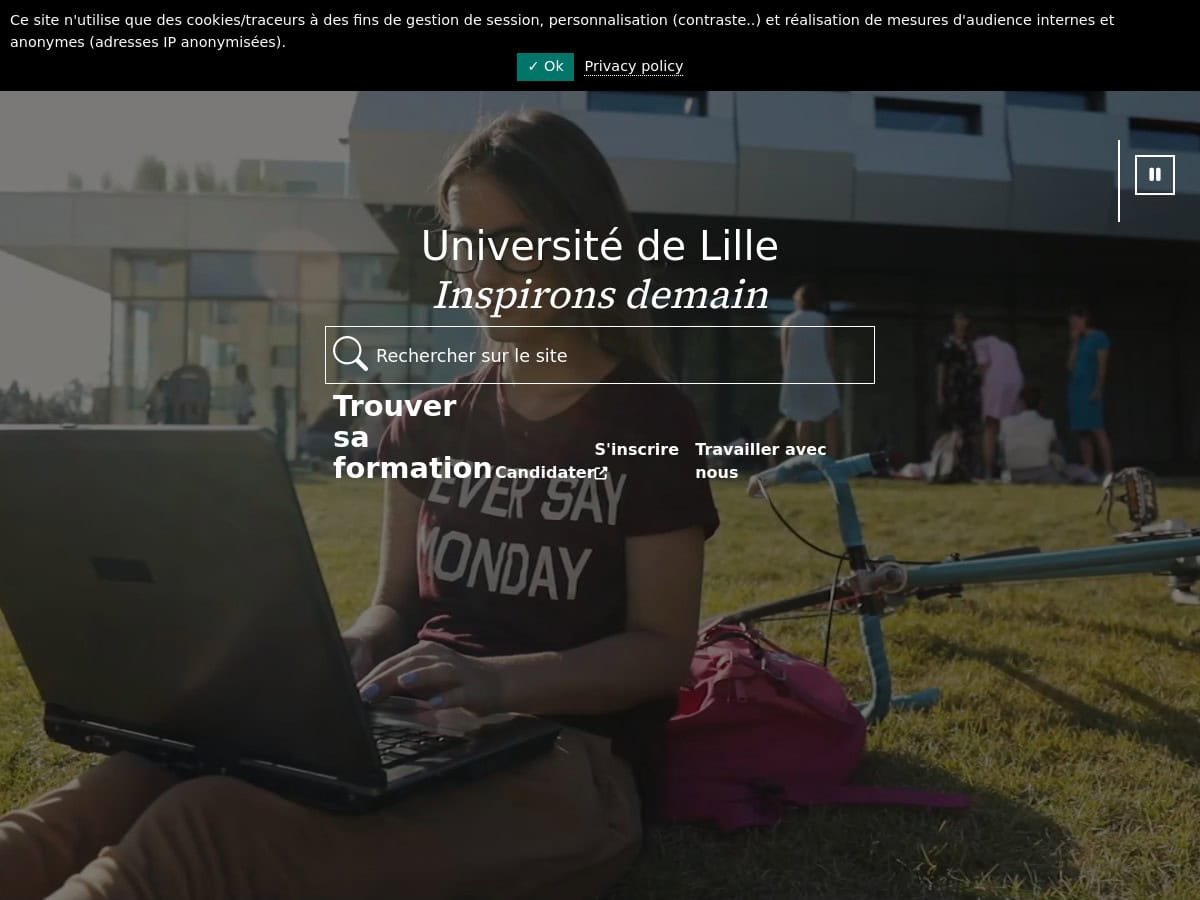
The University of Lille was officially established in 2018 from the merger of three universities (Lille 1 Sciences and Technologies, Lille 2 Health and Law, Lille 3 Human and Social Sciences), with historical roots dating back to 1559. It’s a major multidisciplinary university.
The Université de Lille is one of the largest universities in France, with about 74,000 students and 6,000 staff. It was formed in 2018 by merging the three universities of Lille, and it covers sciences, health, law, economics and the humanities on several campuses. The science and technology campus is in Villeneuve-d’Ascq, a few kilometres east of the city centre, while the medical campus and the university hospital are in Lille itself.
Lille is a city on the border with Belgium, about one hour from Paris, Brussels and London by high-speed train, and this position is part of the university’s appeal. The surrounding metropolitan area has more than a million inhabitants and a large student population, with strong industry in textiles, logistics and, increasingly, digital technology. The university works closely with engineering schools such as Centrale Lille, IMT Nord Europe and Polytech Lille.
Research is strong in physics, chemistry, biology and computer science, with large laboratories in photonics, nanotechnology, materials science and health. The Pasteur Institute of Lille, where Albert Calmette and Camille Guérin developed the BCG tuberculosis vaccine in the early twentieth century, is a close research partner, and the CHU Lille hospital carries out clinical research in cardiology, neurology and infectious diseases.
Registration fees follow the low national rates, under three hundred euros for bachelor’s and master’s degrees, and non-EU students may pay higher differentiated fees that the university can reduce. Teaching is mainly in French, and several master’s programmes are in English. Applicants use Parcoursup for bachelor’s degrees, the national master portal for master’s degrees and Campus France when applying from outside the EU.
Housing is cheaper than in Paris, and Lille has a lively student scene, with a large old town and a metro system that serves most campuses. The weather is mild and rainy. About 20 percent of the students receive state grants, and the university runs a number of services for scholarship holders.
Domains taught:
Aerospace, AI and Machine Learning, Astroscience, Automation, Bioengineering, Bioinformatics, Chemistry, Civil Engineering, Computer Vision, Data Analytics, Ecology and Sustainability, Electrical and Electronics, Engineering, Fluid Dynamics, Food Science, Geotechnics, Industrial Design, Life Sciences, Manufacturing, Materials, Mathematics, Mechanical Engineering, Microbiology and Genetics, Nanotechnologies, Optics, Physics, Process Control, Robotics, Software Engineering, Statistics, Structural Engineering, Telecommunications, Thermodynamics
Diplomas*:
Bachelor, Doctor, Master
Status:
Public
Partnerships:
Member of Udice, EUniWell. Strong cross-border collaborations (Belgium, UK) and regional partnerships.
Sorbonne Université offers a comparable education in astroscience, aerospace and bioinformatics: it is slightly smaller, at about 55,000 students against roughly 74,000 here, and is also a public institution.
A good alternative in the same country is Aix-Marseille Université, which likewise covers astroscience, aerospace and food science; it covers sound engineering and marine science as well, and has almost the same size, at about 78,000 students.
Nantes Université takes a similar route through astroscience, aerospace and food science, and it runs the same bachelor's, master's and doctoral programmes, and covers sound engineering and marine science as well.
Université de Lorraine takes a similar route through aerospace, food science and bioinformatics, and it runs the same bachelor's, master's and doctoral programmes, and covers project management as well.
Also strong in aerospace, food science and bioinformatics, Université de Montpellier makes a sensible second look at home; it is slightly smaller, at about 50,000 students against roughly 74,000 here, and is also a public institution.
Most Similar Schools Abroad
Beyond national borders, Sichuan University stands out as a comparable school for food science, bioinformatics and geotechnics; it is slightly smaller, at about 60,000 students against roughly 74,000 here, and is also a public institution.
Università degli Studi di Napoli Federico II in Italy pursues a similar profile in astroscience, aerospace and food science, and it covers marine science and agriculture as well, and has almost the same size, at about 80,000 students.
Abroad, Sun Yat-sen University (China) covers astroscience, bioinformatics and geotechnics in a comparable way, and it is also a public institution, and runs the same bachelor's, master's and doctoral programmes.
If this institution is on your list for astroscience, aerospace and food science, Università degli Studi di Bologna in Italy deserves a comparison, because it is slightly larger, at about 90,000 students against roughly 74,000 here, and is also a public institution.
Abroad, Johann Wolfgang Goethe-Universität Frankfurt am Main (Germany) covers astroscience, bioinformatics and geotechnics in a comparable way, and it covers signal processing as well, and is smaller, enrolling about 46,000 students against roughly 74,000 here.
*our own picks (our criteria: a mix between domains, diploma delivered, reputation and size), but obviously too many criteria for an apple-to-apple ranking.
FAQ
Where is the Université de Lille?
The administrative address is 42 rue Paul Duez in Lille. The science campus is in Villeneuve-d'Ascq.
How large is it?
About 74,000 students and 6,000 staff.
How was it formed?
In 2018, by merging the three universities of Lille.
What is it best known for?
Physics, chemistry, biology, computer science, health, law and the humanities.
Which engineering schools work with it?
Centrale Lille, IMT Nord Europe and Polytech Lille, among others.
What is the Pasteur Institute of Lille?
It is a research institute where Albert Calmette and Camille Guérin developed the BCG tuberculosis vaccine, and it is a close partner of the university.
What does it cost?
Registration fees are under three hundred euros for bachelor's and master's degrees. Non-EU students may pay higher differentiated fees.
In which language are courses taught?
Mainly in French, with several master's programmes in English.
How far is Lille from Paris?
About one hour by high-speed train. Brussels and London are also about one hour away.
Is Lille affordable for students?
Yes. Housing is cheaper than in Paris, and the metro serves most campuses.
*: without any judgment of the quality, readers are strongly encouraged to check the official status of the exact diploma envisioned as many universities have a mix of recognized diplomas, not recognized, “co-delivered,” “equivalent to”, “some pathways” (…), can change over time, and can be named differently from one country to another.
**: international reputation: is based on some criteria that do not mean much in some domains or specialties (number of researchers, of scientific publications, on budget ….). Our approximate 1-4 scale:
known locally
known locally and internationally
is listed in some of the world university’s classifications
is listed among the 20 firsts in some of world university’s classifications
***: estimated numbers, based on online sources and/or feedbacks. The numbers can vary greatly depending on school organisation (ex.: school is part of a group, it employs internal staff or external consultants or has public staff without employing them …). Refer to all the links provided to have accurate and updated numbers.
Innovation.world is not affiliated with this school/university. We recommend to contact them directly on their website for any special request.
To complete or correct any information here or share your opinion, please comment below or > send us a direct message <.