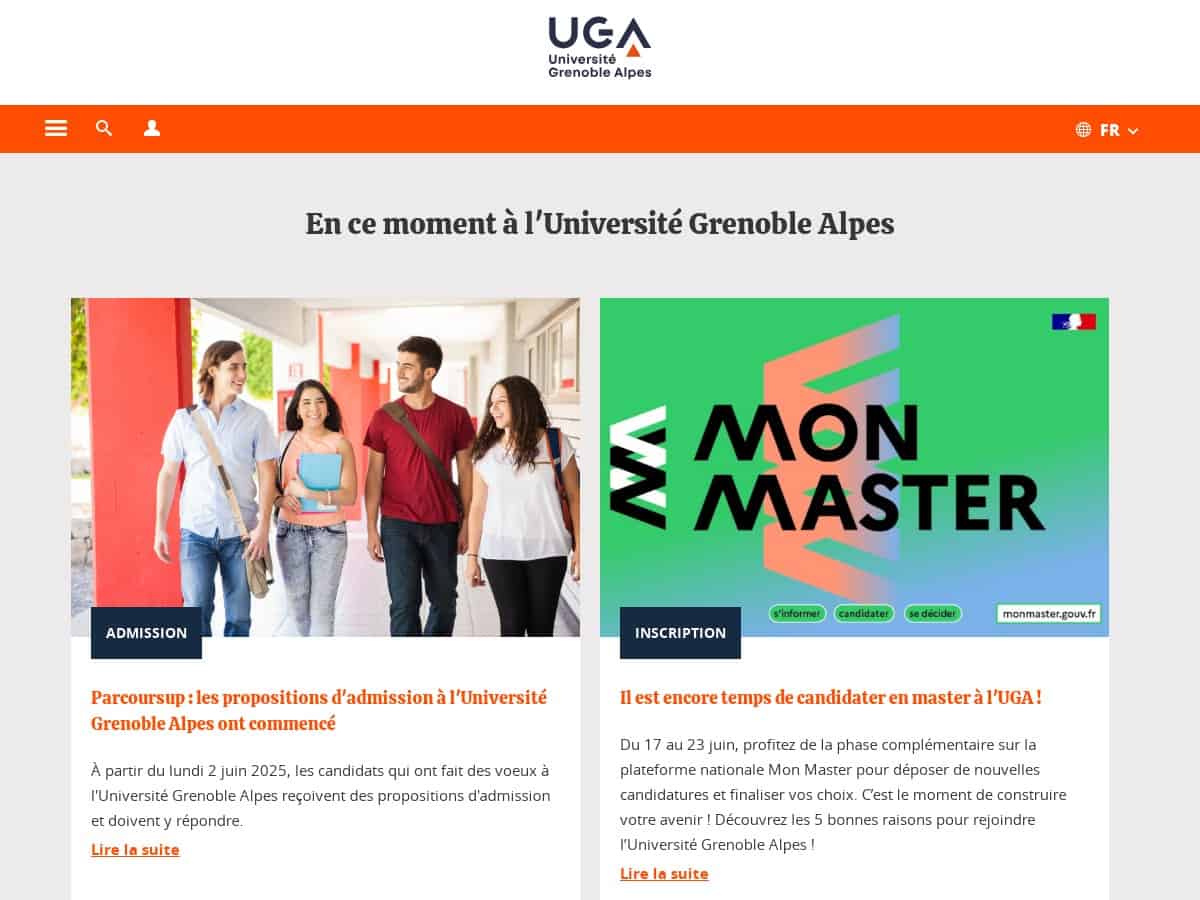
Established in its current form in 2016 (with roots from 1339), UGA is a major public research university, known for its strengths in natural sciences, engineering, computer science, and social sciences, located in a vibrant scientific environment.
Université Grenoble Alpes has about 59,000 students and 5,900 staff, and it is one of the main scientific centres of France. Grenoble sits in a basin surrounded by the Vercors, Chartreuse and Belledonne mountains, and the main campus in Saint-Martin-d’Hères and Gières lies on flat land a few kilometres from the centre. The university took its present form in 2016, when three local universities merged, and integrated Grenoble INP in 2020.
Physics, nanoscience and computer science are the leading fields, and they benefit from one of the densest research environments in Europe. The Polygone scientifique, a peninsula where two rivers meet, holds the European Synchrotron Radiation Facility, the Institut Laue-Langevin neutron source and the CEA Grenoble research centre. Louis Néel, who received the 1970 Nobel Prize in Physics for work on magnetism, helped to create this scientific hub after the Second World War.
The Minatec campus brings together microelectronics and nanotechnology research with companies such as STMicroelectronics, and Grenoble has built an industrial fabric in energy, electronics and software that is often compared to a mountain Silicon Valley. Earth and environmental sciences, with glaciology, hydrology and risk studies, are another speciality, and the university also covers medicine, law, humanities and social sciences.
Registration fees are low and set nationally, under three hundred euros for bachelor’s and master’s degrees, and non-EU students may pay higher differentiated fees that the university can reduce. Teaching is mainly in French, with an increasing number of master’s programmes in English. Applications use Parcoursup, the national master portal and Campus France.
Grenoble is a young city, with a large student population, a tram network and ski resorts within an hour. Rents are moderate by French standards. About 100,000 people work in research and innovation in the area, which gives students many opportunities for internships and doctoral projects.
Domains taught:
Aerospace, AI and Machine Learning, Astroscience, Automation, Bioengineering, Bioinformatics, Chemistry, Civil Engineering, Computer Vision, Data Analytics, Ecology and Sustainability, Electrical and Electronics, Engineering, Fluid Dynamics, Food Science, Geotechnics, Industrial Design, Life Sciences, Manufacturing, Marine Science, Materials, Mathematics, Mechanical Engineering, Microbiology and Genetics, Nanotechnologies, Optics, Physics, Process Control, Robotics, Signal Processing, Software Engineering, Sound Engineering, Statistics, Structural Engineering, Telecommunications, Thermodynamics, Transportations
Diplomas*:
Bachelor, Doctor, Master
Status:
Public
Partnerships:
Member of Udice (French research universities group), The Guild. Strong ties with research organizations (CEA, CNRS, INRIA) and Grenoble’s Presqu’île scientifique”.”
Research:
Quantum engineering, AI & digital society, Sustainable planet & society, Health & well-being, Mountains & environment.
Famous Alumnis:
Gérard Mourou
International recognition**:
Number of staff***:
5900
Current students***:
59000
Foreign students***:
20%
Cumulative former students***:
N/A
Pros
Leading French research university, strong in sciences and technology, dynamic innovation ecosystem in Grenoble.
Cons
Large and complex university, competition for certain programs, student housing can be an issue.
Best For
Major research university with excellence in nanoscience, computer science, and environmental studies.
Another national school that puts astroscience, aerospace and food science at the centre is Université Paris-Saclay, and it is slightly smaller, at about 48,000 students against roughly 59,000 here, and is also a public institution.
Sorbonne Université follows much the same lines as this university, with sound engineering, astroscience and marine science as common ground, and it is also a public institution, and teaches at the same levels, namely bachelor's, master's and doctoral.
Among national alternatives, Université de Rennes stands out for its focus on astroscience, marine science and aerospace, and it is also a public institution, and teaches at the same levels, namely bachelor's, master's and doctoral.
On content, Université de Lille and this institution are close, as both teach astroscience, aerospace and food science; it is also a public institution, and teaches at the same levels, namely bachelor's, master's and doctoral.
For students who like the astroscience, food science and bioinformatics focus of this institution but want another option nearby, Université de Strasbourg fits well: it is also a public institution, and runs the same bachelor's, master's and doctoral programmes.
Most Similar Schools Abroad
The closest overseas parallel on sound engineering, astroscience and marine science is Universität Hamburg, located in Germany; it covers project management as well, and is slightly smaller, at about 43,000 students against roughly 59,000 here.
For astroscience, marine science and aerospace outside the home country, UTokyo in Japan is a natural reference; it is also a public institution, and teaches at the same levels, namely bachelor's, master's and doctoral.
Tsinghua in China pursues a similar profile in aerospace, transportations and bioinformatics, and it is slightly smaller, at about 50,000 students against roughly 59,000 here, and is also a public institution.
Technische Universität München offers an international parallel to this institution, with aerospace, food science and transportations as common ground; it is also a public institution, and teaches at the same levels, namely bachelor's, master's and doctoral.
Zhejiang University offers an international parallel to this university, with astroscience, marine science and aerospace as common ground; it runs the same bachelor's, master's and doctoral programmes, and covers agriculture and project management as well.
*our own picks (our criteria: a mix between domains, diploma delivered, reputation and size), but obviously too many criteria for an apple-to-apple ranking.
FAQ
Where is Université Grenoble Alpes?
The main campus is on avenue Centrale in Saint-Martin-d'Hères, near Grenoble.
How large is UGA?
About 59,000 students and 5,900 staff.
How was it formed?
In 2016, by merging three local universities, and it integrated Grenoble INP in 2020.
What is UGA best known for?
Physics, nanoscience, computer science, artificial intelligence, earth and environmental sciences and engineering.
Which research facilities are nearby?
The European Synchrotron Radiation Facility, the Institut Laue-Langevin neutron source and the CEA Grenoble centre.
What is Minatec?
It is an innovation campus for microelectronics and nanotechnology research, linking laboratories with companies such as STMicroelectronics.
What does it cost?
Registration fees are under three hundred euros for bachelor's and master's degrees. Non-EU students may pay higher differentiated fees.
In which language are courses taught?
Mainly in French, with an increasing number of master's programmes in English.
How do you apply?
Through Parcoursup for bachelor's degrees, the national master portal for master's degrees and Campus France for international candidates.
What is Grenoble like for students?
A young city with a large student population, a tram network and ski resorts within about an hour.
Artificial Intelligence (AI), Environmental Engineering, Innovation, Sustainable Development
*: without any judgment of the quality, readers are strongly encouraged to check the official status of the exact diploma envisioned as many universities have a mix of recognized diplomas, not recognized, “co-delivered,” “equivalent to”, “some pathways” (…), can change over time, and can be named differently from one country to another.
**: international reputation: is based on some criteria that do not mean much in some domains or specialties (number of researchers, of scientific publications, on budget ….). Our approximate 1-4 scale:
known locally
known locally and internationally
is listed in some of the world university’s classifications
is listed among the 20 firsts in some of world university’s classifications
***: estimated numbers, based on online sources and/or feedbacks. The numbers can vary greatly depending on school organisation (ex.: school is part of a group, it employs internal staff or external consultants or has public staff without employing them …). Refer to all the links provided to have accurate and updated numbers.
Innovation.world is not affiliated with this school/university. We recommend to contact them directly on their website for any special request.
To complete or correct any information here or share your opinion, please comment below or > send us a direct message <.