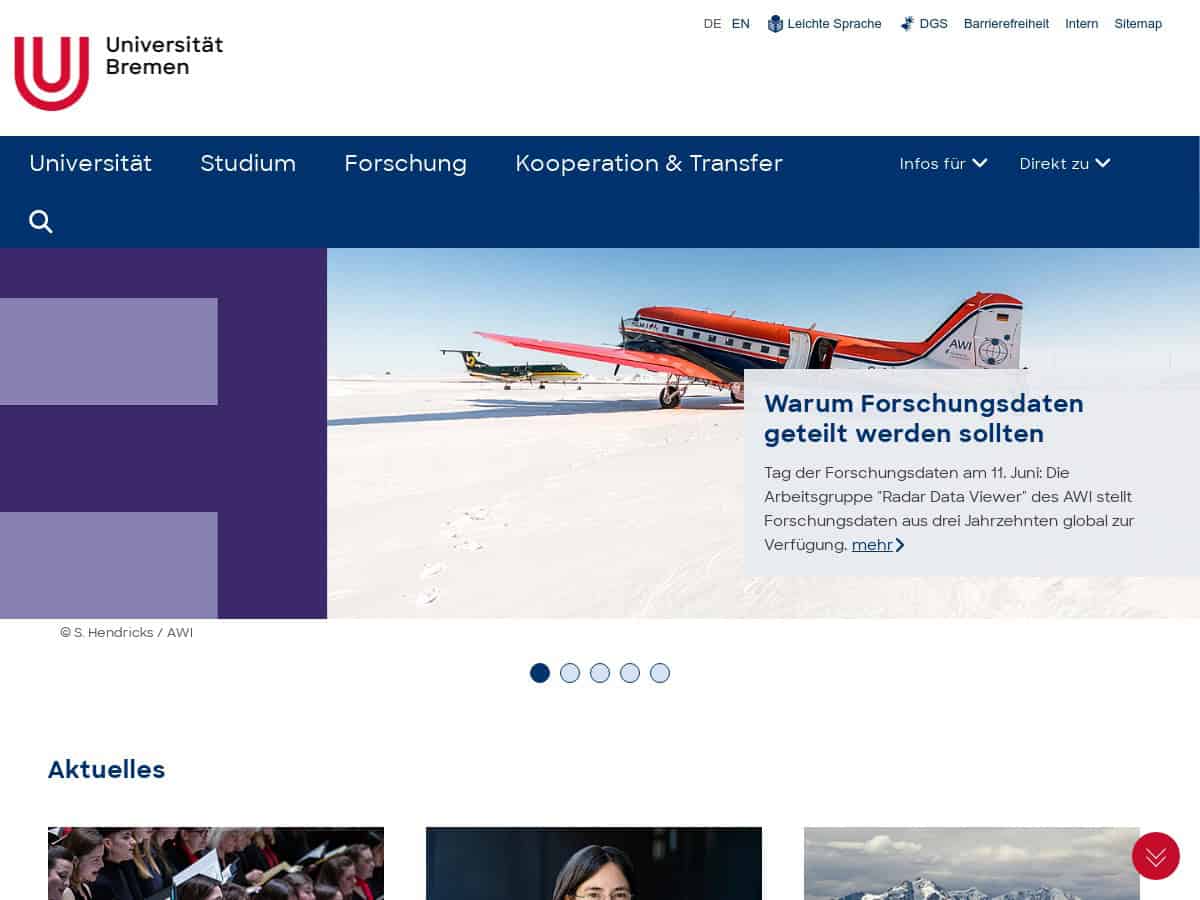
Marine & Environmental Sciences, Materials Science & Production Engineering, Computer Science & Digital Media
Universität Bremen, known in English as the University of Bremen, opened in 1971 and describes itself as one of the youngest universities in Germany. It is a public university in the city of Bremen, and its teaching is spread across 12 faculties that offer more than 100 degree programmes.
The faculties range from Physics and Electrical Engineering, Biology and Chemistry, Mathematics and Computer Science and Production Engineering to Geosciences, Law, Business Studies and Economics, Social Sciences, Cultural Studies, Language and Literary Studies, Human and Health Sciences, and Pedagogy and Educational Sciences. The university sets its research priorities in five profile areas: marine, polar and climate research; social change, social policy and the state; materials science and its technologies; minds, media and machines; and health sciences. The marine research faculty MARUM, the Center for Marine Environmental Sciences, is part of this structure.
Bremen has been one of eleven German universities funded in the Excellence Initiative since 2012. The campus sits next to a technology park that houses companies and several non-university research institutes. Published figures give about 18,400 students and more than 2,200 academic staff. Information on semester contributions and admission is published on the official website.
Domains taught:
Aerospace, AI and Machine Learning, Automation, Bioengineering, Bioinformatics, Chemistry, Civil Engineering, Computer Vision, Data Analytics, Ecology and Sustainability, Electrical and Electronics, Engineering, Fluid Dynamics, Geotechnics, Industrial Design, Life Sciences, Manufacturing, Marine Science, Materials, Mathematics, Mechanical Engineering, Microbiology and Genetics, Nanotechnologies, Optics, Physics, Process Control, Project Management, Robotics, Signal Processing, Software Engineering, Statistics, Structural Engineering, Telecommunications, Thermodynamics, Transportations
Diplomas*:
Bachelor, Doctor, Master
Status:
Public
Partnerships:
Member of YUFE (Young Universities for the Future of Europe). Strong collaborations with research institutes in Bremen (e.g., MARUM, Fraunhofer IFAM).
Research:
Ocean and climate research, Advanced materials and manufacturing, AI and robotics, Digital media and communication.
Famous Alumnis:
N/A
International recognition**:
Number of staff***:
2500
Current students***:
19000
Foreign students***:
10%
Cumulative former students***:
N/A
Pros
Leading research university in marine and environmental sciences, strong in materials science and computer science, innovative and interdisciplinary.
Cons
Relatively young university, campus located outside city center.
Best For
Research university strong in marine sciences, materials science, and computer science.
Carl von Ossietzky Universität Oldenburg, the neighbouring university in Lower Saxony, works on renewable energy, environmental physics and marine and environmental sciences.
Christian-Albrechts-Universität zu Kiel is a public university on the Baltic coast with marine sciences and nanoscience and materials science as main fields.
Universität Rostock combines maritime systems and ocean technology with life sciences and electrical engineering, a coastal profile like that of Bremen.
Universität Hamburg, a public university in a neighbouring northern city, covers climate and earth system science and in physics and nanoscience.
Universität Kassel offers environmental engineering and nanoscience as well as electrical engineering and computer science, a technical mix with a social-science side.
Most Similar Schools Abroad
Università degli Studi di Genova (Italy) is a public port-city university with naval and maritime engineering, robotics and computer science.
Universiteit Twente (Netherlands), in Enschede, focuses on nanotechnology, biomedical engineering and robotics, a technology-driven profile comparable to Bremen's.
Linnaeus University (Sweden) lists maritime science and forestry and wood technology alongside entrepreneurship in its main fields.
Oregon State University (United States), in Corvallis, is a public university listing oceanography, forestry and agricultural sciences.
Université de Rennes (France) is a public university with computer science and cybersecurity, materials science and environmental and earth sciences.
*our own picks (our criteria: a mix between domains, diploma delivered, reputation and size), but obviously too many criteria for an apple-to-apple ranking.
FAQ
When was the University of Bremen founded?
It was founded in 1971, which makes it one of Germany's younger universities. Its own materials describe it as a young university with a research profile built up since then.
How many faculties does the university have?
There are 12 faculties, running from Physics and Electrical Engineering through Geosciences and Law to Pedagogy and Educational Sciences. In total the university offers more than 100 degree programmes.
What are its main research profile areas?
The university names marine, polar and climate research; social change, social policy and the state; materials science and its technologies; minds, media and machines; and health sciences. These areas bring together groups from several faculties.
What is MARUM?
MARUM is the Center for Marine Environmental Sciences, a research faculty of the university that studies the ocean and the sea floor. It is one of the best-known units in the marine, polar and climate research area.
How big is the university?
Published figures give about 18,400 students and more than 2,200 academic staff. The exact numbers depend on the year and counting method, so the current statistics page is the best reference.
What is the campus like?
The campus borders the Bremen Technology Park, established in 1988, where companies and research institutes are based.
Did Bremen receive Excellence Initiative funding?
Yes, it has been one of eleven German universities counted as successful in the Excellence Initiative since 2012.
*: without any judgment of the quality, readers are strongly encouraged to check the official status of the exact diploma envisioned as many universities have a mix of recognized diplomas, not recognized, “co-delivered,” “equivalent to”, “some pathways” (…), can change over time, and can be named differently from one country to another.
**: international reputation: is based on some criteria that do not mean much in some domains or specialties (number of researchers, of scientific publications, on budget ….). Our approximate 1-4 scale:
known locally
known locally and internationally
is listed in some of the world university’s classifications
is listed among the 20 firsts in some of world university’s classifications
***: estimated numbers, based on online sources and/or feedbacks. The numbers can vary greatly depending on school organisation (ex.: school is part of a group, it employs internal staff or external consultants or has public staff without employing them …). Refer to all the links provided to have accurate and updated numbers.
Innovation.world is not affiliated with this school/university. We recommend to contact them directly on their website for any special request.
To complete or correct any information here or share your opinion, please comment below or > send us a direct message <.