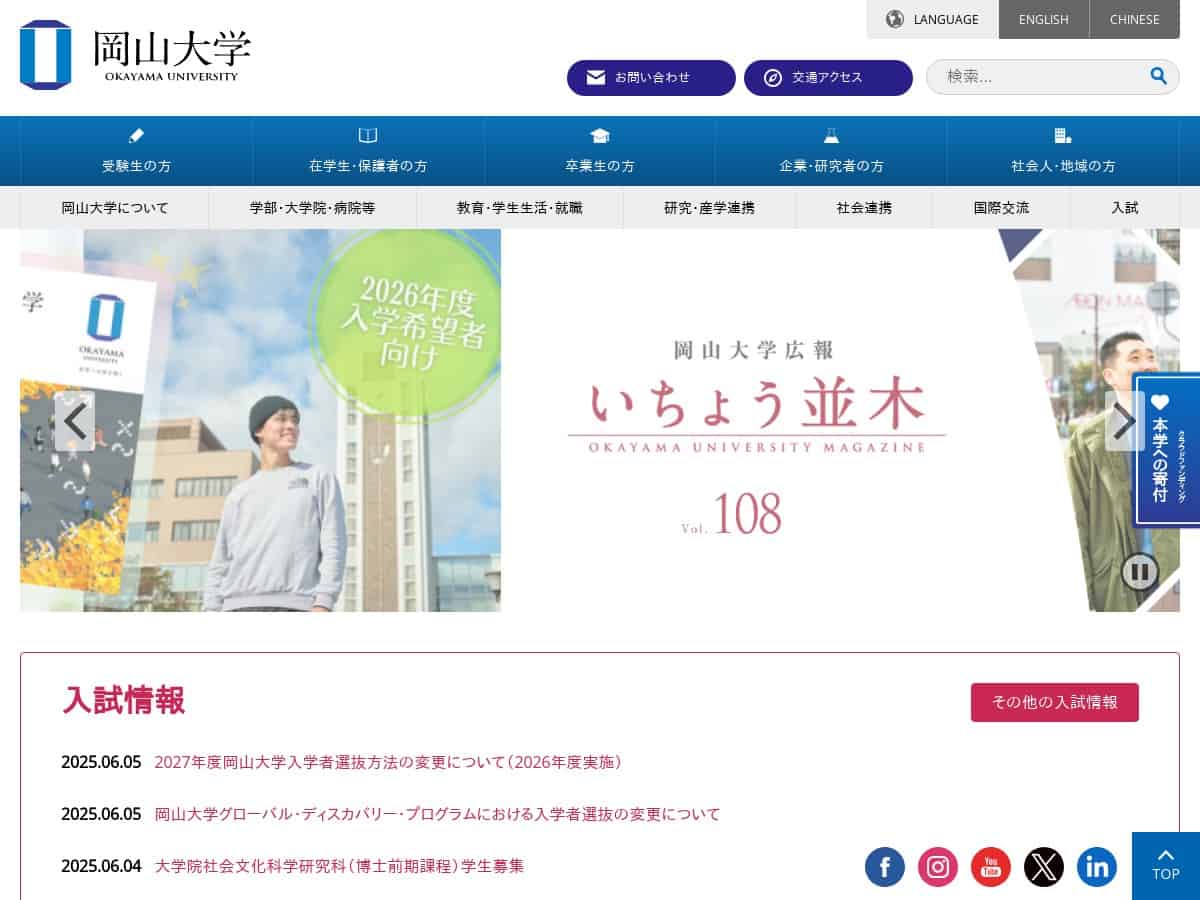
Address: 1-1-1 Tsushima-naka, Kita-ku, 700-8530 Okayama, Okayama, Japan
Engineering (Mechanical; Electrical; Information), Life Sciences & Biotechnology, Environmental Science
Okayama University grew out of a medical training place founded in 1870 under the lord of Okayama, and that medical root is still visible in a structure that includes Medicine, Dentistry and Pharmaceutical Sciences. The institution was established under its present name in 1949, bringing together earlier schools whose predecessors include the Sixth Higher School (1900) and Okayama Medical College (1922). The Ohara Institute for Agricultural Research, founded in 1914, is also counted among its predecessor institutions.
The main Tsushima campus is in Kita-ku, Okayama City, while the Shikata campus is home to the Dental School; the university also operates further sites in the Okayama area. Undergraduate teaching is divided among schools of Letters, Education, Law, Economics, Science, Medicine, Dentistry, Pharmaceutical Sciences, Engineering and Agriculture, and a Discovery Program for Global Learners is listed alongside them. Graduate education includes schools of Education, Humanities and Social Sciences, Health Sciences, and Medicine, Dentistry and Pharmaceutical Sciences.
Enrolment stands at roughly 13,000 students, according to figures published by the university and summarised in encyclopaedic sources, most of them undergraduates. This breadth of subjects, from the humanities to engineering and agriculture, makes Okayama a comprehensive national university in western Japan. Current admission rules, tuition and the programmes open to international students are published on the university’s English pages.
Domains taught:
Aerospace, Agriculture, AI and Machine Learning, Astroscience, Automation, Bioengineering, Bioinformatics, Chemistry, Civil Engineering, Computer Vision, Data Analytics, Ecology and Sustainability, Electrical and Electronics, Engineering, Fluid Dynamics, Food Science, Geotechnics, Industrial Design, Life Sciences, Manufacturing, Materials, Mathematics, Mechanical Engineering, Microbiology and Genetics, Nanotechnologies, Optics, Physics, Process Control, Robotics, Signal Processing, Software Engineering, Statistics, Structural Engineering, Telecommunications, Thermodynamics, Transportations
Diplomas*:
Bachelor, Doctor, Master
Status:
Public
Partnerships:
Regional and international collaborations. Active in UN’s Sustainable Development Goals (SDGs).
Hiroshima University, a public university in the neighbouring Chugoku region, offers engineering in mechanical, electrical and chemical fields and applied biological sciences.
Yamaguchi University is a public university in western Japan whose engineering and science faculties overlap with Okayama's.
Kanazawa University pairs engineering with pharmaceutical sciences, a combination close to Okayama's broad national-university profile.
Kumamoto University is a public university on Kyushu whose engineering departments include mechanical, electrical and materials fields.
Niigata University combines engineering with agricultural sciences, echoing the mix of applied subjects found in Okayama.
Most Similar Schools Abroad
Jeonbuk National University (South Korea), in Jeonju, is a public university teaching engineering, agriculture and life sciences, much like Okayama's applied disciplines.
Università degli Studi di Perugia (Italy) is a public comprehensive university whose agricultural sciences, engineering and chemistry resemble Okayama's range.
University of Nebraska-Lincoln (United States) is a public university listing agriculture and natural resources, business and engineering.
Federal University of Bahia (Brazil), in Salvador, offers engineering, life sciences and food science within a large public university.
Università degli Studi di Parma (Italy) is a public university in which food science and technology, engineering and pharmaceutical sciences stand side by side.
*our own picks (our criteria: a mix between domains, diploma delivered, reputation and size), but obviously too many criteria for an apple-to-apple ranking.
FAQ
How did Okayama University start?
It began in 1870 as a medical training place sponsored by the lord of Okayama. The present university was established in 1949 from several earlier institutions.
Which campuses does Okayama University have?
The main campus is Tsushima, in Kita-ku, Okayama, and the Shikata campus houses the Dental School. The university also lists other sites such as Kurashiki, Misasa and the Ushimado Marine Institute.
What can students study at undergraduate level?
The undergraduate schools cover Letters, Education, Law, Economics, Science, Medicine, Dentistry, Pharmaceutical Sciences, Engineering and Agriculture. A Discovery Program for Global Learners is also listed.
Does the university have graduate schools?
Yes, including schools of Education, Humanities and Social Sciences, Health Sciences, and Medicine, Dentistry and Pharmaceutical Sciences. A professional School of Law is listed as well.
How many students are enrolled?
Published figures give roughly 13,000 students, of whom about three-quarters are undergraduates. Totals shift every year, so the dated statistics on the university website are the safest reference.
Which predecessor institutions are part of its history?
Predecessors include the Sixth Higher School (1900), Okayama Medical College (1922) and the Ohara Institute for Agricultural Research (1914). They were combined in the postwar reorganisation of Japanese higher education.
Where can overseas applicants find admission details?
The English pages of the university website describe programmes for international students and give contact points. Entrance rules and tuition vary by programme and year, so they should be confirmed there.
*: without any judgment of the quality, readers are strongly encouraged to check the official status of the exact diploma envisioned as many universities have a mix of recognized diplomas, not recognized, “co-delivered,” “equivalent to”, “some pathways” (…), can change over time, and can be named differently from one country to another.
**: international reputation: is based on some criteria that do not mean much in some domains or specialties (number of researchers, of scientific publications, on budget ….). Our approximate 1-4 scale:
known locally
known locally and internationally
is listed in some of the world university’s classifications
is listed among the 20 firsts in some of world university’s classifications
***: estimated numbers, based on online sources and/or feedbacks. The numbers can vary greatly depending on school organisation (ex.: school is part of a group, it employs internal staff or external consultants or has public staff without employing them …). Refer to all the links provided to have accurate and updated numbers.
Innovation.world is not affiliated with this school/university. We recommend to contact them directly on their website for any special request.
To complete or correct any information here or share your opinion, please comment below or > send us a direct message <.