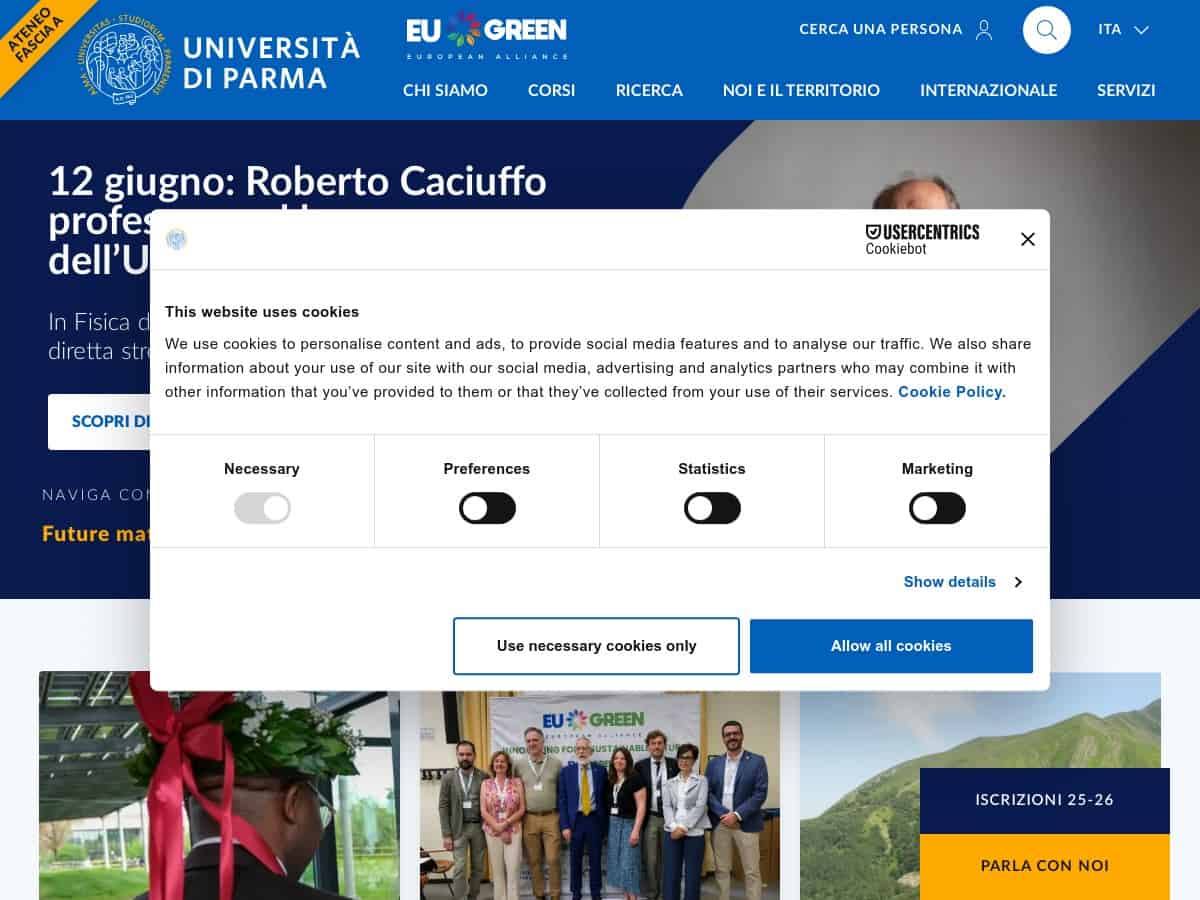
Parma, in Emilia-Romagna, is home to the Università degli Studi di Parma, which describes itself as a state university and one of the oldest in the world. The institution was reorganised in 1601 under Ranuccio I Farnese, a date also given in encyclopaedic accounts of the city of Parma.
Today the university is organised into nine departments. They include Food and Drug, which teaches and researches food science and pharmaceutical subjects, and Veterinary Science. Teaching is spread over several sites in Parma, including a science campus that hosts the engineering and architecture, chemistry and life sciences, and mathematics, physics and computer science departments.
The profile links the city’s food tradition with engineering and pharmacy. Prospective students can see the full list of departments, degree courses and fees on the university’s official site, which has an English version.
Domains taught:
Agriculture, AI and Machine Learning, Automation, Bioengineering, Bioinformatics, Chemistry, Civil Engineering, Computer Vision, Data Analytics, Ecology and Sustainability, Electrical and Electronics, Engineering, Food Science, Industrial Design, Life Sciences, Manufacturing, Materials, Mathematics, Mechanical Engineering, Microbiology and Genetics, Nanotechnologies, Physics, Process Control, Robotics, Software Engineering, Statistics, Structural Engineering, Telecommunications, Thermodynamics
Diplomas*:
Bachelor, Doctor, Master
Status:
Public
Partnerships:
EUA. Strong links with the local food industry (Food Valley”).”
Research:
Food science and human nutrition, Advanced engineering (mechanical, ICT), Drug discovery and development, Environmental sustainability.
Famous Alumnis:
Bernardo Bertolucci (attended)
International recognition**:
Number of staff***:
1500
Current students***:
27000
Foreign students***:
N/A%
Cumulative former students***:
120000
Pros
Excellent reputation in food science, strong industry collaborations in the Food Valley, good quality of life in Parma.
Cons
Some facilities are spread across the city, can be competitive for certain programs.
Best For
Leading university for food science, engineering, and pharmaceutical studies.
Denmark's public Aarhus University covers natural sciences, bioscience and nanoscience.
*our own picks (our criteria: a mix between domains, diploma delivered, reputation and size), but obviously too many criteria for an apple-to-apple ranking.
FAQ
How long has the University of Parma existed?
The university says it is one of the oldest in the world. It was reorganised in 1601 under Ranuccio I Farnese.
How many departments does it have?
Nine departments organise teaching and research. They include Food and Drug and Veterinary Science.
Where can I study food science there?
Food-related teaching belongs to the Department of Food and Drug. It also covers pharmaceutical sciences.
Does Parma have engineering?
Yes, engineering and architecture is one of the nine departments and is housed on the science campus.
Is it a state or private institution?
It is a state university. Fees therefore follow Italian public university rules.
Can I study veterinary medicine there?
The Department of Veterinary Science (medico-veterinary sciences) is one of the university's departments. Check its pages for the degree courses offered.
Where do I find the programmes and fees?
The official university website lists degree courses, admission procedures and contribution tables. Information is updated every academic year.
*: without any judgment of the quality, readers are strongly encouraged to check the official status of the exact diploma envisioned as many universities have a mix of recognized diplomas, not recognized, “co-delivered,” “equivalent to”, “some pathways” (…), can change over time, and can be named differently from one country to another.
**: international reputation: is based on some criteria that do not mean much in some domains or specialties (number of researchers, of scientific publications, on budget ….). Our approximate 1-4 scale:
known locally
known locally and internationally
is listed in some of the world university’s classifications
is listed among the 20 firsts in some of world university’s classifications
***: estimated numbers, based on online sources and/or feedbacks. The numbers can vary greatly depending on school organisation (ex.: school is part of a group, it employs internal staff or external consultants or has public staff without employing them …). Refer to all the links provided to have accurate and updated numbers.
Innovation.world is not affiliated with this school/university. We recommend to contact them directly on their website for any special request.
To complete or correct any information here or share your opinion, please comment below or > send us a direct message <.