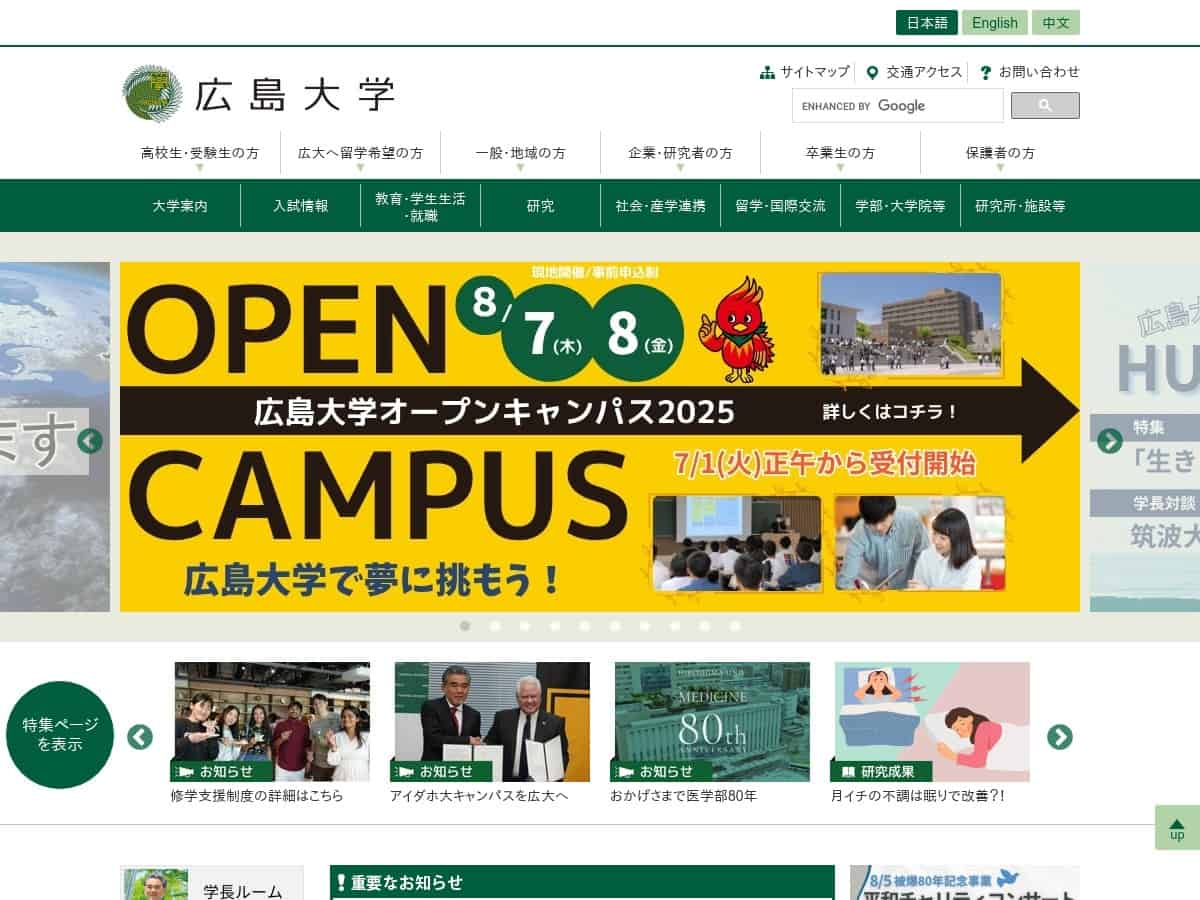
The main campus of Hiroshima University stands in Higashi-Hiroshima, a separate city within Hiroshima Prefecture, and the institution takes its name from the prefectural capital. That capital was the first city in the world to be struck by an atomic bomb, on 6 August 1945, and the university presents Hiroshima as a city dedicated to the quest for international peace. The university itself took its present form in 1949, when earlier institutions in the prefecture were combined into one national university.
Teaching today is organised in twelve undergraduate faculties. They include Letters, Education, Law, Economics, Science, Medicine, Dentistry, Pharmaceutical Sciences, Engineering, Applied Biological Science, and Informatics and Data Science, with graduate schools built on top of these fields. This mix of humanities, natural sciences, engineering and the health professions makes the university a comprehensive one rather than a specialist school.
The student body numbers about 15,000 in 2025, most of them undergraduates and the remainder in master’s and doctoral programmes. Hiroshima University is a national university, a category distinct from private Japanese universities; current fees, admission calendars and the programmes taught in English are published on the university’s official English-language pages.
Domains taught:
Aerospace, AI and Machine Learning, Astroscience, Automation, Bioengineering, Bioinformatics, Chemistry, Civil Engineering, Computer Vision, Data Analytics, Ecology and Sustainability, Electrical and Electronics, Engineering, Fluid Dynamics, Food Science, Geotechnics, Industrial Design, Life Sciences, Manufacturing, Marine Science, Materials, Mathematics, Mechanical Engineering, Microbiology and Genetics, Nanotechnologies, Optics, Physics, Process Control, Project Management, Robotics, Signal Processing, Software Engineering, Statistics, Structural Engineering, Telecommunications, Thermodynamics, Transportations
Diplomas*:
Bachelor, Doctor, Master
Status:
Public
Partnerships:
Member of a consortium of Asian universities. Regional and international partnerships.
Okayama University is a public university in Okayama whose profile lists mechanical, electrical and information engineering alongside life sciences, a spread that parallels Hiroshima's engineering and science base.
Yamaguchi University, a public institution in Yamaguchi, offers engineering fields including mechanical, electrical and applied chemistry, making it a regional counterpart in western Honshu.
Kobe University combines maritime sciences and engineering with mechanical disciplines in Kobe, as a public university of comparable breadth.
Kyushu University in Fukuoka is a public university with engineering in its mechanical, electrical and chemical branches plus materials research.
Kanazawa University is a public university in Kanazawa pairing mechanical, electrical and civil engineering with pharmaceutical sciences, much as Hiroshima links engineering with the health fields.
Most Similar Schools Abroad
Université de Liège (Belgium) is a public university whose listed strengths include aerospace engineering, materials science and life sciences, giving it a multi-field science profile similar to Hiroshima's.
Università degli Studi di Bologna (Italy) is a public comprehensive university with engineering and technology, natural sciences and further fields under one roof.
Fudan (China) is a public university with physics, chemistry and materials science, offering a broad natural-science base comparable to Hiroshima's.
Vrije Universiteit Amsterdam (Netherlands) is a public university covering neurosciences, artificial intelligence and environmental fields, so it shares the comprehensive public-university model.
Università degli Studi di Padova (Italy) is a public university where engineering, physics and life sciences sit side by side, matching the science-and-engineering mix found in Hiroshima.
*our own picks (our criteria: a mix between domains, diploma delivered, reputation and size), but obviously too many criteria for an apple-to-apple ranking.
FAQ
Where is Hiroshima University located?
The main campus is in Higashi-Hiroshima, a city in Hiroshima Prefecture that is separate from Hiroshima City itself. The university is named after the prefectural capital, which lies in south-western Honshu.
When did the university take its current form?
It was established in its present form in 1949, when earlier educational institutions in Hiroshima Prefecture were merged into a national university.
How many faculties does it have?
There are twelve undergraduate faculties, covering fields such as law, economics, science, medicine, dentistry, pharmaceutical sciences, engineering, applied biological science and informatics and data science. Graduate schools are organised separately from these faculties.
How large is the student population?
About 15,000 students were enrolled in 2025, counting undergraduate and graduate programmes together. Undergraduates make up the bulk of the total.
Is Hiroshima University a public or a private institution?
It is a national university, which sets it apart from private Japanese universities. Fee schedules and admission rules therefore follow the national-university framework and are listed by the university each year.
What connection does the university have with the 1945 bombing of Hiroshima?
The city of Hiroshima, after which the university is named, was struck by an atomic bomb on 6 August 1945. The university describes the city as dedicated to the quest for international peace.
Where can prospective students find tuition and admission details?
The most reliable source is the university's own English website, which lists application periods, fees and degree programmes. Because requirements change from year to year, applicants should check the current page for their intended faculty.
Automotive, Engineering, Environmental Engineering, Innovation, Product Development
*: without any judgment of the quality, readers are strongly encouraged to check the official status of the exact diploma envisioned as many universities have a mix of recognized diplomas, not recognized, “co-delivered,” “equivalent to”, “some pathways” (…), can change over time, and can be named differently from one country to another.
**: international reputation: is based on some criteria that do not mean much in some domains or specialties (number of researchers, of scientific publications, on budget ….). Our approximate 1-4 scale:
known locally
known locally and internationally
is listed in some of the world university’s classifications
is listed among the 20 firsts in some of world university’s classifications
***: estimated numbers, based on online sources and/or feedbacks. The numbers can vary greatly depending on school organisation (ex.: school is part of a group, it employs internal staff or external consultants or has public staff without employing them …). Refer to all the links provided to have accurate and updated numbers.
Innovation.world is not affiliated with this school/university. We recommend to contact them directly on their website for any special request.
To complete or correct any information here or share your opinion, please comment below or > send us a direct message <.