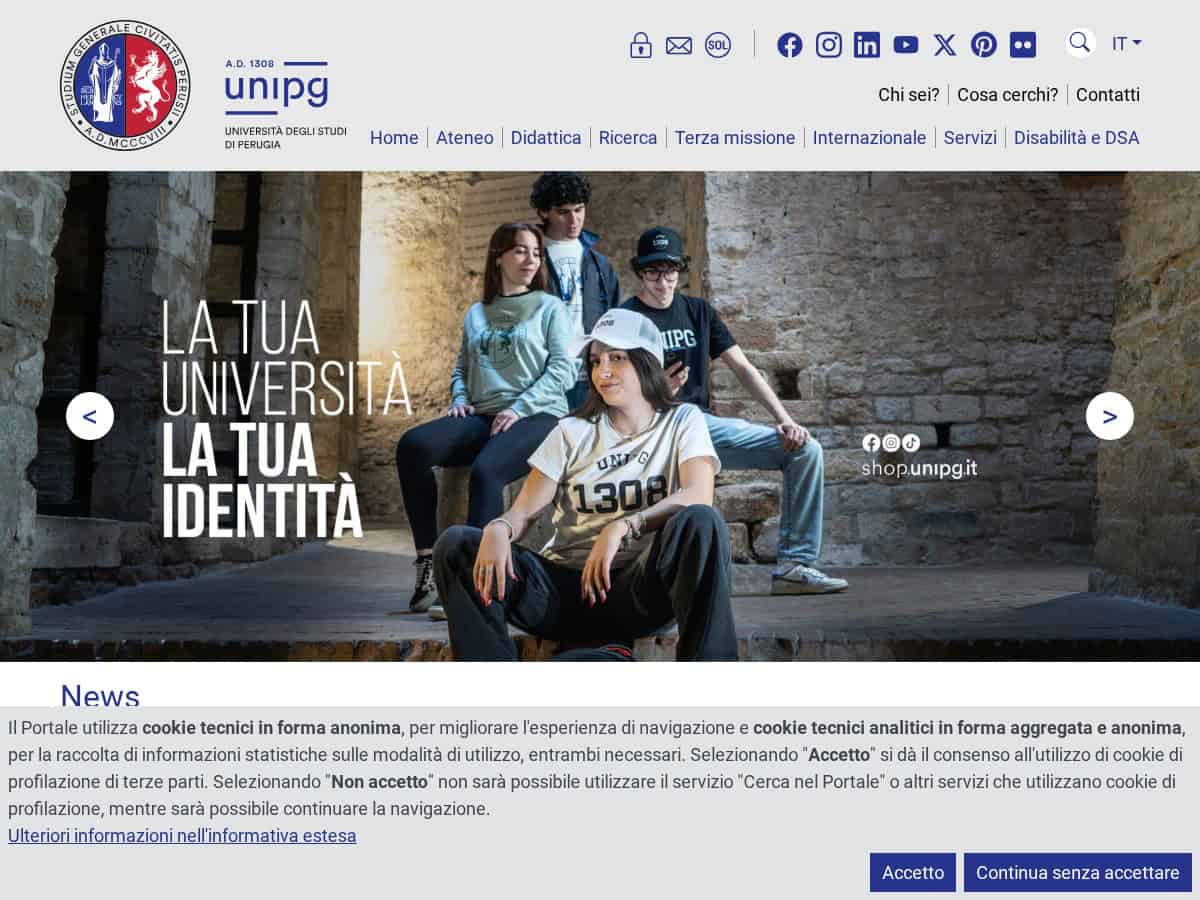
Perugia, the capital of Umbria, has hosted a university since the Middle Ages. Teaching in law and medicine is recorded there from around 1200, and on 8 September 1308 Pope Clement V issued the bull Super specula, which gave the school the rank of studium generale. Today it is the state-run Università degli Studi di Perugia, a coeducational university whose rectorate and most of its departments are located in the city.
Teaching and research are organised in departments rather than traditional faculties. They cover fields such as Law, Medicine and Surgery, Engineering, Economics and Veterinary Medicine, together with agricultural and other natural-science subjects. Most departments are based in Perugia itself, while the university also runs courses in Terni and has decentralised sites in Assisi, Foligno and Narni, so that its activity is spread across several towns of the region.
For students and researchers the university offers a broad, multidisciplinary environment in central Italy. Its medieval origins place it among the older universities of the country, and the institution itself presents its history as going back to 1308. The current degree programmes, admission calls and tuition rules are published on the official university portal, which also has a section for international enquiries.
Domains taught:
Agriculture, AI and Machine Learning, Automation, Bioengineering, Bioinformatics, Chemistry, Civil Engineering, Computer Vision, Data Analytics, Ecology and Sustainability, Electrical and Electronics, Engineering, Food Science, Geotechnics, Industrial Design, Life Sciences, Manufacturing, Materials, Mathematics, Mechanical Engineering, Microbiology and Genetics, Nanotechnologies, Physics, Process Control, Robotics, Software Engineering, Statistics, Structural Engineering, Telecommunications, Thermodynamics
Diplomas*:
Bachelor, Doctor, Master
Status:
Public
Partnerships:
Coimbra Group (observer), EUA. Regional and international collaborations.
Research:
Sustainable agriculture and food quality, Materials science and chemistry, Renewable energy, ICT, Veterinary and biomedical sciences.
Famous Alumnis:
Monica Bellucci (attended Law)
International recognition**:
Number of staff***:
1800
Current students***:
26000
Foreign students***:
N/A%
Cumulative former students***:
100000
Pros
Historic university located in a beautiful medieval city, comprehensive range of programs.
Cons
Bureaucracy, some facilities are spread out and could be modernized.
Best For
Historic comprehensive university with strong agricultural and engineering sciences.
Università degli Studi di Firenze in Florence is comparable for its mix of Engineering, Agriculture and Physics & Astronomy within one large Italian state university.
Università degli Studi di Parma shares the agricultural and food orientation, with Food Science & Technology, Engineering and Pharmaceutical Sciences.
Università degli Studi di Catania, in Sicily, offers a similar blend of Engineering, Physics and Computer Science in a comprehensive public university.
Università degli Studi di Pavia is a long-established northern university combining Engineering, Physics and Life Sciences.
Most Similar Schools Abroad
University College Dublin in Ireland is a good point of comparison for its Agriculture, Food Science and Engineering departments.
Hokkaido University in Japan combines Agricultural Sciences, Environmental & Earth Sciences and Engineering, much like Perugia's mix of farming-related and technical fields.
São Paulo State University in Brazil, a public institution, covers Agriculture, Mechanical Engineering and Biotechnology across several campuses.
Newcastle University in the United Kingdom pairs Medicine and Engineering with Agriculture.
Texas A&M University in the United States brings together Engineering, Agriculture and Veterinary Medicine, three areas that are also present at Perugia.
*our own picks (our criteria: a mix between domains, diploma delivered, reputation and size), but obviously too many criteria for an apple-to-apple ranking.
FAQ
When was the University of Perugia founded?
Teaching in law and medicine existed in the city from around 1200. The decisive step came on 8 September 1308, when Pope Clement V granted the school the status of studium generale through the bull Super specula.
Is the University of Perugia a public or a private institution?
It is a state university. Tuition rules and any fees are set out each year on the official portal.
Where does teaching take place?
Most departments and the central administration are in Perugia. Courses are also given in Terni, with further decentralised sites in Assisi, Foligno and Narni.
Which subjects can I study there?
The departments include Law, Medicine and Surgery, Engineering, Economics and Veterinary Medicine, along with agricultural and other science subjects. The full list of degree programmes is on the university website.
How is the university organised internally?
Academic work is grouped in departments, rather than faculties. Each department manages its own degree courses and research activity.
How can an international applicant get information?
The official website has an international section with a contact address for enquiries. Applicants should check the current admission calls and any language requirements there before applying.
*: without any judgment of the quality, readers are strongly encouraged to check the official status of the exact diploma envisioned as many universities have a mix of recognized diplomas, not recognized, “co-delivered,” “equivalent to”, “some pathways” (…), can change over time, and can be named differently from one country to another.
**: international reputation: is based on some criteria that do not mean much in some domains or specialties (number of researchers, of scientific publications, on budget ….). Our approximate 1-4 scale:
known locally
known locally and internationally
is listed in some of the world university’s classifications
is listed among the 20 firsts in some of world university’s classifications
***: estimated numbers, based on online sources and/or feedbacks. The numbers can vary greatly depending on school organisation (ex.: school is part of a group, it employs internal staff or external consultants or has public staff without employing them …). Refer to all the links provided to have accurate and updated numbers.
Innovation.world is not affiliated with this school/university. We recommend to contact them directly on their website for any special request.
To complete or correct any information here or share your opinion, please comment below or > send us a direct message <.