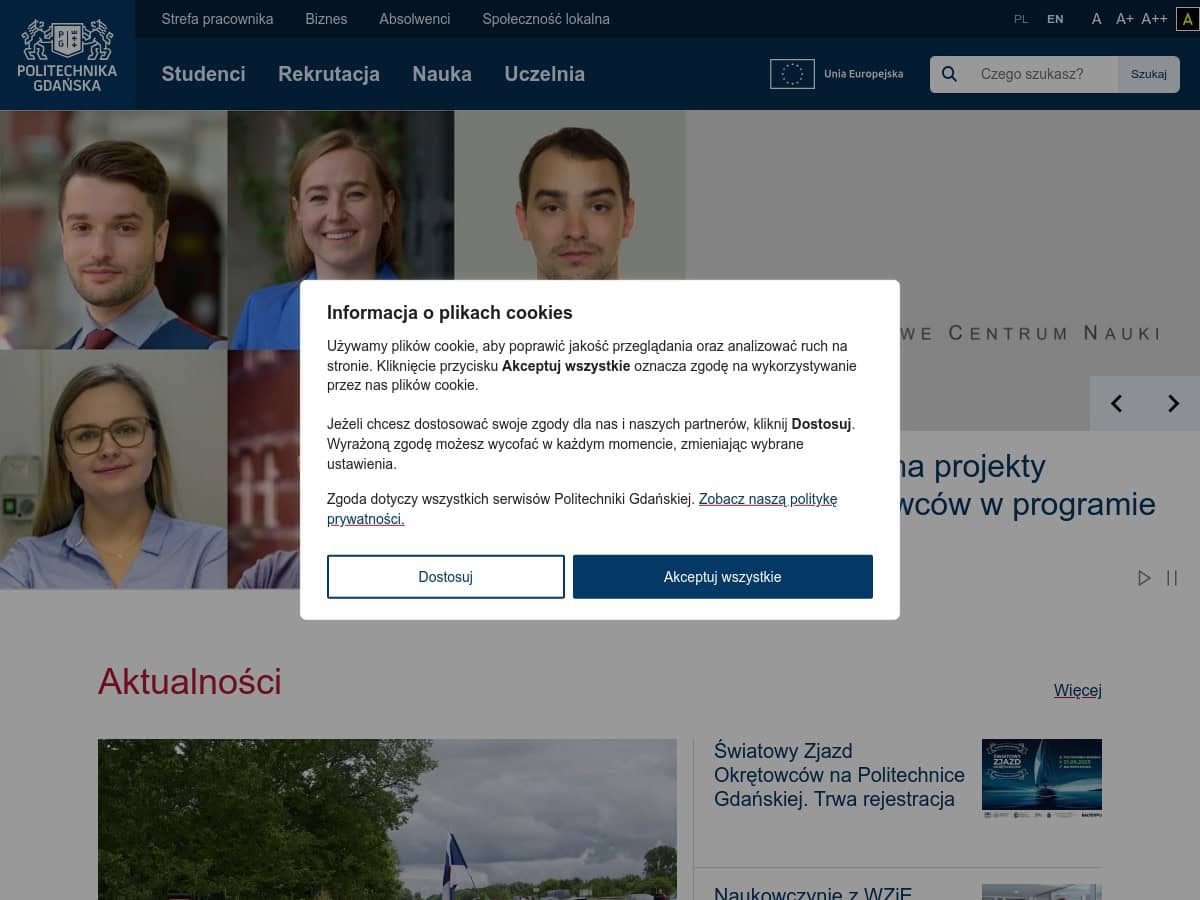
Gdańsk University of Technology, known in Polish as Politechnika Gdańska, is a public technical university in the northern Polish city of Gdańsk. It was inaugurated on 6 October 1904 as the Royal University of Technology in Gdańsk, in German Königliche Technische Hochschule zu Danzig, at a time when the city belonged to the German Empire. Albert Carsten was the chief designer of the university’s buildings, which were erected between 1900 and 1904.
The present Polish institution dates from 1945, when a decree of 24 May turned the former German university into a Polish state academic school; its official inauguration in that form followed on 9 April 1946. Today the university has eight faculties: architecture; electronics, telecommunications and informatics; electrical and control engineering; applied physics and mathematics; civil and environmental engineering; mechanical engineering; ocean engineering and ship technology; and management and economics.
Growth has been steady since the early years. Some 189 students enrolled in 1904, there were 675 regular students in 1914, and the winter semester of 1922 counted 1,651. Today more than 14,000 students study at the university, which covers 14 scientific disciplines. The faculty of ocean engineering and ship technology reflects the maritime character of the city.
Domains taught:
Aerospace, AI and Machine Learning, Automation, Bioengineering, Bioinformatics, Chemistry, Civil Engineering, Computer Vision, Data Analytics, Ecology and Sustainability, Electrical and Electronics, Engineering, Fluid Dynamics, Geotechnics, Industrial Design, Life Sciences, Manufacturing, Marine Science, Materials, Mathematics, Mechanical Engineering, Metrology, Nanotechnologies, Optics, Physics, Process Control, Project Management, Robotics, Signal Processing, Software Engineering, Statistics, Structural Engineering, Telecommunications, Thermodynamics, Transportations
Diplomas*:
Bachelor, Doctor, Master
Status:
Public
Partnerships:
Member of CESAER, EUA, BUP (Baltic University Programme). Strong ties with maritime and ICT industries in the Pomeranian region.
Warsaw University of Technology is the capital's public technical university, with mechanical, electrical and computer engineering and architecture among its main fields.
Poznań University of Technology offers computer science and AI, mechanical engineering and robotics, and logistics as a public institution.
Silesian University of Technology in Gliwice is a public university focused on mechanical engineering, robotics and automation.
Cracow University of Technology is a public university whose fields include architecture, civil engineering and mechanical engineering, matching Gdańsk's architecture and civil engineering faculties.
Most Similar Schools Abroad
Universität Rostock in Germany is a public university on the Baltic coast with maritime systems and ocean technology among its main fields, close to the ship and ocean engineering side of Gdańsk.
Chalmers University of Technology in Sweden is a private technical university in Gothenburg, working in nanotechnology, materials science and sustainable energy.
Norwegian University of Science and Technology in Norway is a public university covering engineering, technology and natural sciences.
Technical University of Denmark is a public university whose main fields are engineering, wind energy and biotechnology, in Denmark.
Technische Universiteit Delft in the Netherlands is a public university with aerospace, civil engineering and computer science, relevant to the civil engineering faculty in Gdańsk.
*our own picks (our criteria: a mix between domains, diploma delivered, reputation and size), but obviously too many criteria for an apple-to-apple ranking.
FAQ
When did the university open and under what name?
Its ceremonial inauguration took place on 6 October 1904 under the name Königliche Technische Hochschule zu Danzig, the Royal University of Technology in Gdańsk. 189 regular students enrolled in the first year.
How did the university change after the Second World War?
A decree of 24 May 1945 transformed it into a Polish state academic school, and the official inauguration took place on 9 April 1946 in the Auditorium Maximum. Since then it has operated as a Polish technical university.
Which faculties does it have today?
There are eight, including architecture, mechanical engineering, civil and environmental engineering, electrical and control engineering, and ocean engineering and ship technology. The others cover electronics, telecommunications and informatics, applied physics and mathematics, and management and economics.
How large is the university?
Recent published figures put enrolment above 14,000 students. Its work is organised in 14 scientific disciplines.
Who was the main designer of the original buildings?
Albert Carsten was the main designer, with construction beginning in 1900 and the buildings erected within about four years. The ceremonial inauguration was held on 6 October 1904.
How quickly did enrolment grow in the early decades?
From 189 regular students in 1904 the number rose to 675 in 1914 and to 1,651 in the winter semester of 1922. Numbers then stayed near 1,600 through 1929.
Where can international applicants find admission information?
Entry requirements and fees differ by programme and are published on the English pages of the official university website at pg.edu.pl. Applicants should consult the page of the programme they want.
Additive Manufacturing, Civil Engineering, Cybersecurity, Electronics, Information Technology (IT)
*: without any judgment of the quality, readers are strongly encouraged to check the official status of the exact diploma envisioned as many universities have a mix of recognized diplomas, not recognized, “co-delivered,” “equivalent to”, “some pathways” (…), can change over time, and can be named differently from one country to another.
**: international reputation: is based on some criteria that do not mean much in some domains or specialties (number of researchers, of scientific publications, on budget ….). Our approximate 1-4 scale:
known locally
known locally and internationally
is listed in some of the world university’s classifications
is listed among the 20 firsts in some of world university’s classifications
***: estimated numbers, based on online sources and/or feedbacks. The numbers can vary greatly depending on school organisation (ex.: school is part of a group, it employs internal staff or external consultants or has public staff without employing them …). Refer to all the links provided to have accurate and updated numbers.
Innovation.world is not affiliated with this school/university. We recommend to contact them directly on their website for any special request.
To complete or correct any information here or share your opinion, please comment below or > send us a direct message <.