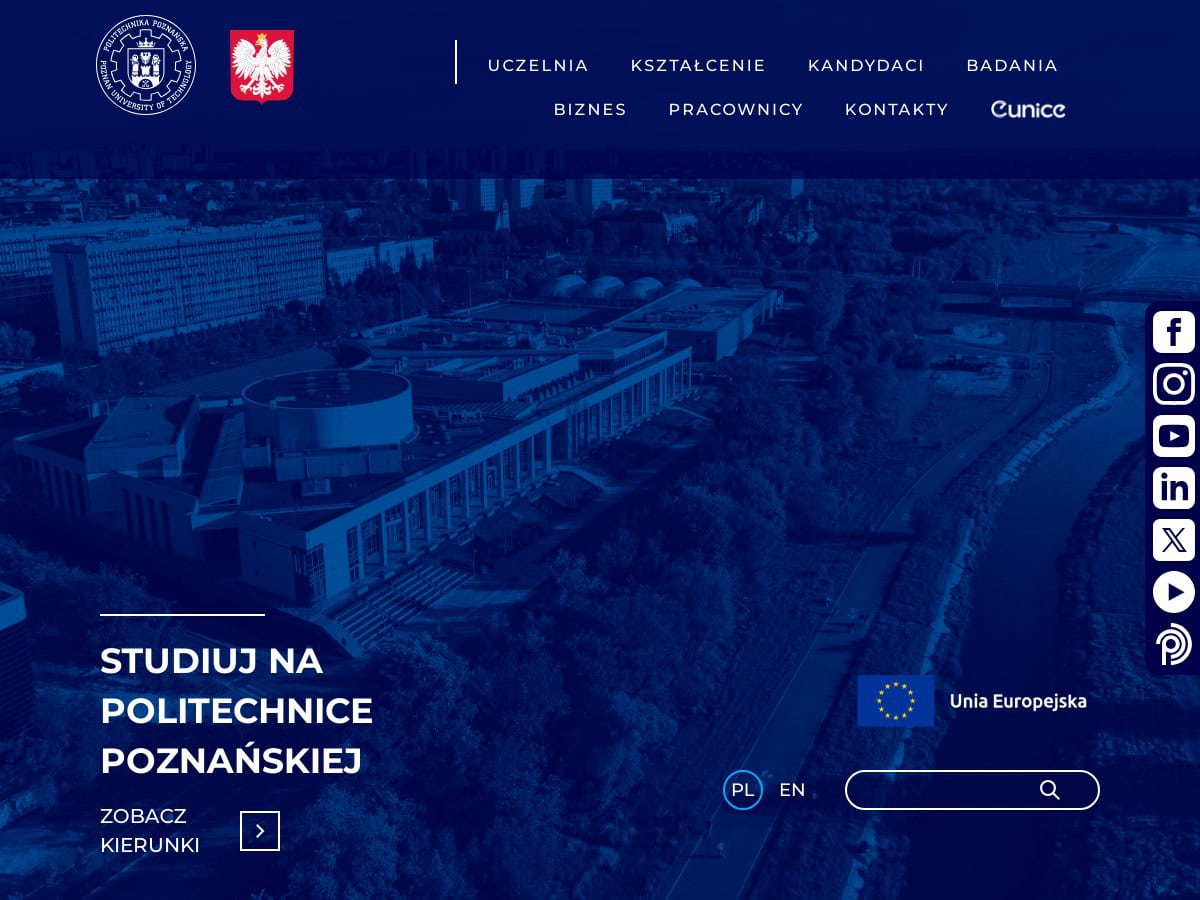
Poznań University of Technology (PUT) is a public technical university in Poznań, Poland. Its roots go back to 1919, when the State Higher School of Mechanical Engineering was founded in the city.
After the Second World War the school resumed work in 1945 as a School of Engineering, and in 1955 it became Poznań University of Technology by ministerial ordinance. The university is organised in nine faculties, whose fields include architecture, chemical technology, civil engineering, computing and telecommunications, electrical engineering and mechanical engineering.
The university’s sites include the Piotrowo campus in Poznań. In 1995 the university became the first Polish technical university to join CESAER, the Conference of European Schools for Advanced Engineering Education and Research. It reports more than 1,000 academic staff.
Domains taught:
Aerospace, AI and Machine Learning, Automation, Bioengineering, Bioinformatics, Chemistry, Civil Engineering, Computer Vision, Data Analytics, Ecology and Sustainability, Electrical and Electronics, Engineering, Fluid Dynamics, Food Science, Geotechnics, Industrial Design, Life Sciences, Logistics, Manufacturing, Materials, Mathematics, Mechanical Engineering, Metrology, Nanotechnologies, Optics, Physics, Process Control, Project Management, Quality, Robotics, Signal Processing, Software Engineering, Sound Engineering, Statistics, Structural Engineering, Telecommunications, Thermodynamics, Transportations
Diplomas*:
Bachelor, Doctor, Master
Status:
Public
Partnerships:
Member of CESAER, EUA. Strong collaborations with manufacturing, IT, and logistics companies in the Wielkopolska region.
Research:
AI & Data science, Robotics & Automation, Advanced manufacturing & Materials, Logistics & Supply chain management, Chemical technology.
Famous Alumnis:
Jan Węglarz
International recognition**:
Number of staff***:
2000
Current students***:
16000
Foreign students***:
N/A%
Cumulative former students***:
130000
Pros
Top technical university with strong focus on IT and industrial engineering, good industry links in a major business hub (Poznań).
Cons
Large university, competitive environment.
Best For
Leading technical university strong in computer science, mechanical engineering, and logistics.
Warsaw University of Technology is a public technical university in Warsaw, listed for mechanical, electrical and computer engineering and architecture.
Karlsruher Institut für Technologie, a public German institution, is listed for mechanical engineering and computer science.
In Ukraine, Lviv Polytechnic National University is public and covers information technology and civil engineering.
Royal Institute of Technology is a public Swedish institution listed for engineering, technology and natural science.
Italy's Politecnico di Torino, public, is listed for automotive and aerospace engineering.
*our own picks (our criteria: a mix between domains, diploma delivered, reputation and size), but obviously too many criteria for an apple-to-apple ranking.
FAQ
When was the university founded?
Its roots go back to 1919 with the State Higher School of Mechanical Engineering in Poznań. It became a university of technology in 1955.
What happened to the school after 1945?
It resumed work as a School of Engineering in 1945, and a ministerial decision of 1955 turned it into Poznań University of Technology.
How many faculties does it have?
Nine, whose fields include architecture, chemical technology, civil engineering, computing and telecommunications, electrical engineering and mechanical engineering.
Where is the university based?
One of its sites is the Piotrowo campus in Poznań.
Is it part of international networks?
In 1995 it became the first Polish technical university to join CESAER, the Conference of European Schools for Advanced Engineering Education and Research.
How large is its academic staff?
It reports more than 1,000 academic staff.
Where can foreign candidates find admission details?
Admission details for foreign candidates are published on the university's official website, and fees and requirements should be checked there for the current year.
*: without any judgment of the quality, readers are strongly encouraged to check the official status of the exact diploma envisioned as many universities have a mix of recognized diplomas, not recognized, “co-delivered,” “equivalent to”, “some pathways” (…), can change over time, and can be named differently from one country to another.
**: international reputation: is based on some criteria that do not mean much in some domains or specialties (number of researchers, of scientific publications, on budget ….). Our approximate 1-4 scale:
known locally
known locally and internationally
is listed in some of the world university’s classifications
is listed among the 20 firsts in some of world university’s classifications
***: estimated numbers, based on online sources and/or feedbacks. The numbers can vary greatly depending on school organisation (ex.: school is part of a group, it employs internal staff or external consultants or has public staff without employing them …). Refer to all the links provided to have accurate and updated numbers.
Innovation.world is not affiliated with this school/university. We recommend to contact them directly on their website for any special request.
To complete or correct any information here or share your opinion, please comment below or > send us a direct message <.