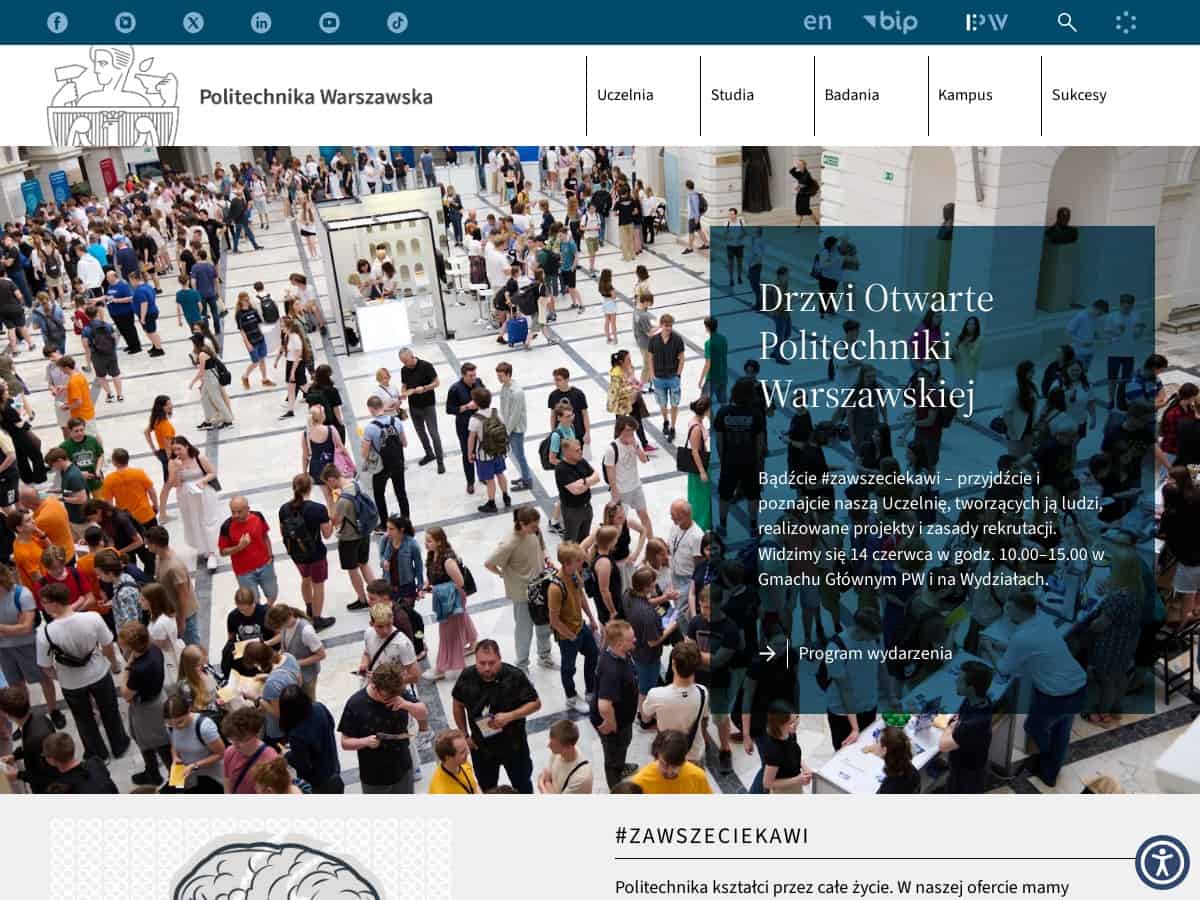
Founded in 1826, WUT is one of the leading and largest technical universities in Poland and Central Europe, offering a wide range of engineering and science programs.
Warsaw University of Technology, WUT, is one of the largest and oldest technical universities in Poland. Its origins go back to 1826, when the Preparatory School for the Polytechnic Institute opened in Warsaw, and the Russian authorities closed several earlier institutions. The modern Polish university was established in 1915. It has about 32,000 students and 5,000 staff, and around one student in ten comes from abroad. The Main Building on Plac Politechniki, finished in 1901, is a landmark of the city centre.
The university has around twenty faculties, including architecture, chemistry, civil engineering, electrical engineering, electronics and information technology, mechanical engineering, physics, geodesy and cartography, materials science, mathematics and information science, power and aeronautical engineering, and administration and business. A branch campus in Płock teaches several engineering programmes. Computer science and electronics graduates are in particularly strong demand with Warsaw’s technology companies.
Students at WUT have built satellites. The PW-Sat1 and PW-Sat2 projects, run by student teams with the support of the university, were launched into orbit in 2012 and 2018, and PW-Sat2 tested a deorbit sail. Research strengths include aeronautics, automation and robotics, photonics, materials, chemistry, civil engineering and telecommunications. The Warsaw University of Technology Business School offers management programmes, and the Science and Technology Park hosts start-ups.
Public universities in Poland teach full-time studies in Polish without tuition for Polish citizens, while programmes in English and studies for foreign students are normally paid, and fees vary by programme. Check the current tariff. Polish applicants use the national online recruitment system with results from the secondary school exam, and international students apply through the university’s own portal. Scholarships are available through national agencies.
Warsaw offers high-quality internships but higher rents than the rest of the country. Dormitories are cheap but limited, and the metro connects the main campus to the centre.
Domains taught:
Aerospace, AI and Machine Learning, Automation, Bioengineering, Bioinformatics, Chemistry, Civil Engineering, Computer Vision, Data Analytics, Ecology and Sustainability, Electrical and Electronics, Engineering, Fluid Dynamics, Geotechnics, Industrial Design, Life Sciences, Manufacturing, Materials, Mathematics, Mechanical Engineering, Metrology, Nanotechnologies, Optics, Physics, Process Control, Project Management, Quality, Robotics, Signal Processing, Software Engineering, Statistics, Structural Engineering, Telecommunications, Thermodynamics, Transportations
Diplomas*:
Bachelor, Doctor, Master
Status:
Public
Partnerships:
Member of ENHANCE, CESAER, EUA. Numerous international exchange programs (e.g., Erasmus+) and partnerships with companies like Airbus, KGHM, Microsoft.
Research:
Advanced materials & Nanotechnology, AI & Robotics, Sustainable energy & Environment, Aerospace engineering, Biomedical engineering.
Famous Alumnis:
Jan Czochralski, Marian Rejewski, Michał Kalecki
International recognition**:
Number of staff***:
5000
Current students***:
32000
Foreign students***:
10%
Cumulative former students***:
250000
Pros
Top-ranked technical university in Poland, strong research output, wide range of English-taught programs, vibrant student life in Warsaw.
Cons
Large institution, can be bureaucratic, some facilities are older.
Best For
Comprehensive engineering education and research with strong international links.
University of Warsaw takes a similar route through bioinformatics, geotechnics and nanotechnologies, and it covers astroscience and microbiology and genetics as well, and is slightly larger, at about 40,000 students against roughly 32,000 here.
Among national alternatives, Wrocław University of Science and Technology stands out for its focus on metrology, aerospace and transportations, and it is also a public institution, and runs the same bachelor's, master's and doctoral programmes.
Another national school that puts metrology, aerospace and transportations at the centre is AGH University of Science and Technology, and it covers sound engineering and marine science as well, and is slightly smaller, at about 25,000 students against roughly 32,000 here.
Military University of Technology shares the core fields of this institution, namely metrology, aerospace and transportations; it runs the same bachelor's, master's and doctoral programmes, and covers military as well.
University of Rzeszów overlaps with this institution on aerospace, transportations and bioinformatics, so the two are easy to compare, and it teaches at the same levels, namely bachelor's, master's and doctoral, and covers food science and microbiology and genetics as well.
Most Similar Schools Abroad
Students considering a move abroad can look at Politecnico di Milano in Italy, where aerospace, bioinformatics and nanotechnologies also form the core, and it also offers graduate certificate programmes, and is slightly larger, at about 47,000 students against roughly 32,000 here.
Students considering a move abroad can look at Harbin Institute of Technology in China, where aerospace, transportations and quality also form the core, and it has almost the same size, at about 35,000 students, and is also a public institution.
Technische Universität Berlin in Germany pursues a similar profile in aerospace, transportations and quality, and it has almost the same size, at about 35,000 students, and is also a public institution.
Nihon University brings a Japan setting to the same core fields, metrology, aerospace and transportations, and it is private, whereas this institution is public, and runs the same bachelor's, master's and doctoral programmes.
If this university is on your list for aerospace, transportations and bioinformatics, Osaka University in Japan deserves a comparison, because it is slightly smaller, at about 23,000 students against roughly 32,000 here, and is also a public institution.
*our own picks (our criteria: a mix between domains, diploma delivered, reputation and size), but obviously too many criteria for an apple-to-apple ranking.
FAQ
Where is Warsaw University of Technology?
The Main Building is at Plac Politechniki 1 in Warsaw, Poland.
When did it start?
Its origins go back to 1826, and the modern Polish university was established in 1915.
How large is it?
About 32,000 students and 5,000 staff.
What does it teach?
Engineering, architecture, chemistry, physics, mathematics, information technology, geodesy and business.
What are PW-Sat1 and PW-Sat2?
Student satellites launched in 2012 and 2018, with PW-Sat2 testing a deorbit sail.
Does it have a campus outside Warsaw?
Yes. A branch campus in Płock teaches several engineering programmes.
What does it cost?
Full-time studies in Polish are free for Polish citizens, while programmes in English and studies for foreign students are normally paid. Check the current tariff.
How do you apply?
Polish applicants use the national online recruitment system. International students apply through the university's own portal.
Are there courses in English?
Yes, in many programmes, mostly at paid tuition.
Is Warsaw good for internships?
Yes. The city has many technology companies, but rents are higher than in the rest of the country.
*: without any judgment of the quality, readers are strongly encouraged to check the official status of the exact diploma envisioned as many universities have a mix of recognized diplomas, not recognized, “co-delivered,” “equivalent to”, “some pathways” (…), can change over time, and can be named differently from one country to another.
**: international reputation: is based on some criteria that do not mean much in some domains or specialties (number of researchers, of scientific publications, on budget ….). Our approximate 1-4 scale:
known locally
known locally and internationally
is listed in some of the world university’s classifications
is listed among the 20 firsts in some of world university’s classifications
***: estimated numbers, based on online sources and/or feedbacks. The numbers can vary greatly depending on school organisation (ex.: school is part of a group, it employs internal staff or external consultants or has public staff without employing them …). Refer to all the links provided to have accurate and updated numbers.
Innovation.world is not affiliated with this school/university. We recommend to contact them directly on their website for any special request.
To complete or correct any information here or share your opinion, please comment below or > send us a direct message <.