The triple point of water and how to move around this point is a must in engineering (I had a recent conversation where obviously it was not known… so here is a fun illustrated recap, reason why it is in the “fun” section, rather than technologies). A must know.
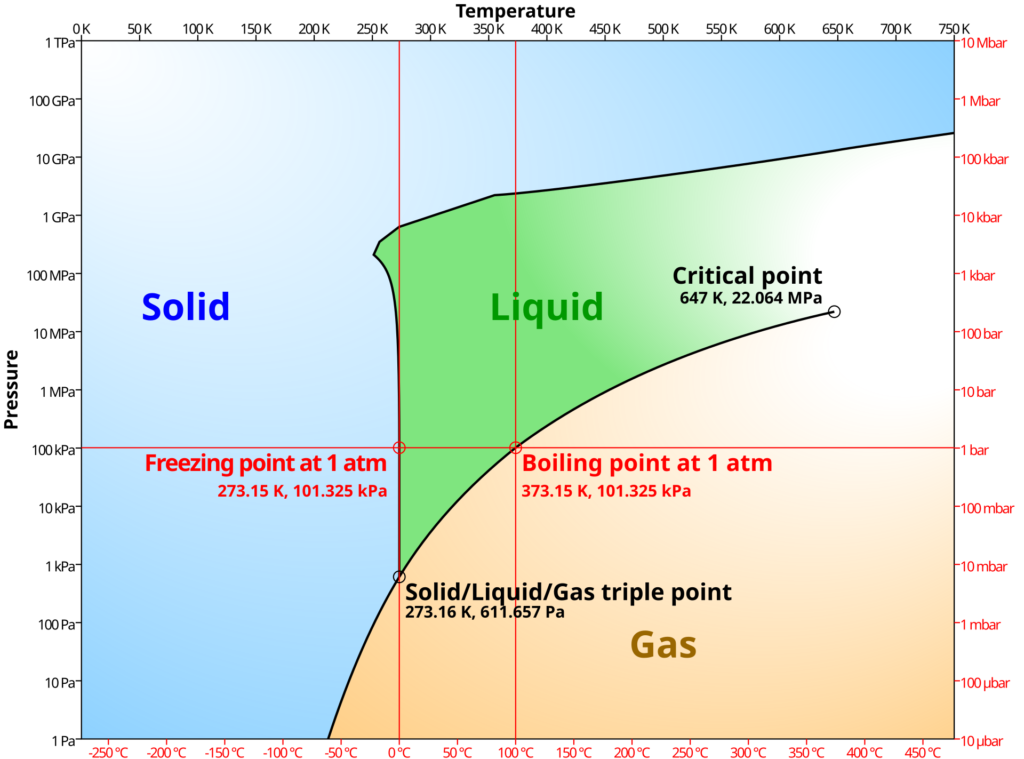
Most people only learn about water’s behavior at the everyday level: heat ice and it melts into liquid water, heat that liquid and it boils into steam—a simple, linear progression most of us take as the whole story; this is only the red horizontal line in the diagram below, moving on the line from left to right.
But under a very specific set of conditions, this orderly sequence breaks down entirely. At a temperature of 0.01°C (273.16 K) and a pressure of just 611.657 pascals—about 0.6% of normal atmospheric pressure—water reaches what’s called its triple point, where ice, liquid water, and water vapor all exist at once, in stable equilibrium, with none of them winning out over the others. Molecules at this point are constantly freezing, melting, evaporating, and condensing simultaneously, yet the relative amounts of each phase stay perfectly constant rather than collapsing into a single state.
This isn’t just a scientific curiosity:
- in science, because the triple point occurs at one exact, reproducible temperature and pressure, it has served as a fixed anchor point for defining temperature scales, with 273.16 K once serving as the literal definition of the kelvin before the 2019 redefinition based on the Boltzmann constant.
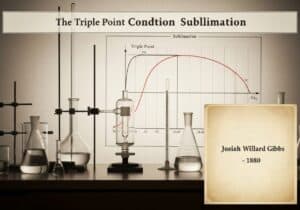
- it also permits to move from one state to another, at low pressure, without passing necessary in the liquid phase, with many industrial applications (ex.: sublimation used in the lyophilization -freeze drying-).
That converts into the very useful phase-diagram of water (source: Wikipedia, by “Cmglee” under CC BY-SA 3.0) :
And the related experience where all 3 phases coexist:
Refer to Wikipedi’a full article, especially its triple point table of other materials than water: https://en.wikipedia.org/wiki/Triple_point