Product Design, Manufacturing & Innovation Resources
Lar » Temperatura de Curie

Temperatura de Curie

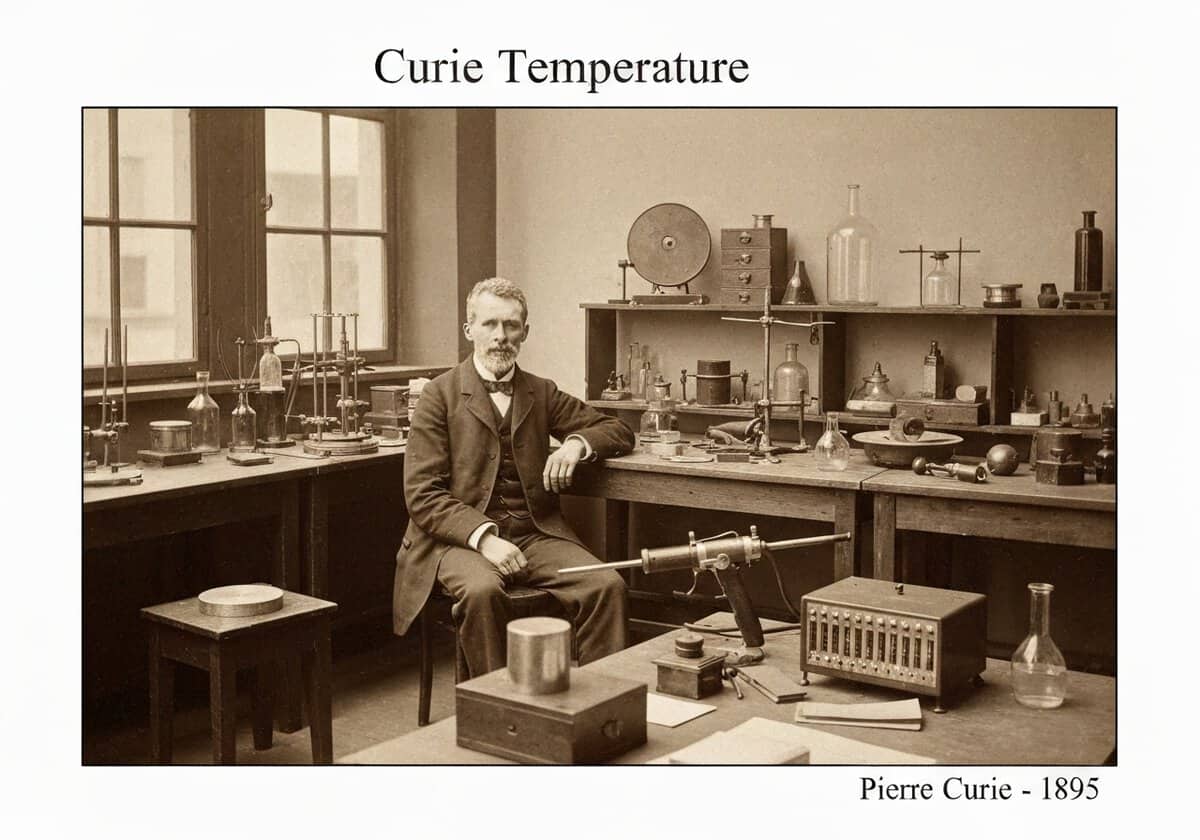
1895
  • Pierre Curie
Laboratory scene with Pierre Curie studying magnetic properties in 1895.

(Imagem gerada apenas para fins ilustrativos)

The Curie temperature ([latex]T_c[/latex]), or Curie point, is the temperatura crítica above which certain materials lose their permanent magnetic properties. For ferromagnetic materials, they become paramagnetic above [latex]T_c[/latex]. This transition is a phase transition where thermal energy becomes strong enough to overcome the quantum mechanical exchange interactions that cause spontaneous magnetic ordering of atomic moments.
Pierre Curie discovered that a material’s magnetism changed at a specific temperature, a finding that was crucial for understanding the nature of magnetism. Below the Curie temperature ([latex]T_c[/latex]), the exchange interaction dominates, forcing adjacent atomic magnetic moments to align, creating the spontaneous magnetization characteristic of ferromagnetismo. As the temperature increases, thermal agitation causes the moments to fluctuate more randomly. At the Curie temperature, the thermal energy is sufficient to completely disrupt this long-range ordering. The material undergoes a second-order phase transition, and its spontaneous magnetization drops to zero. Above [latex]T_c[/latex], the material is paramagnetic; an external magnetic field can still induce a weak alignment of the atomic moments, but this alignment disappears once the field is removed.

Cada material ferromagnético possui uma temperatura de Curie única. Por exemplo, a Tc do ferro é 770 °C (1043 K), a do cobalto é 1130 °C (1403 K) e a do níquel é 358 °C (631 K). Essa propriedade é explorada em diversas tecnologias. Por exemplo, discos magneto-ópticos utilizam um laser para aquecer uma pequena área de material magnético acima de seu ponto de Curie, permitindo que um campo magnético fraco altere sua orientação magnética para gravar dados. Em paleomagnetismo, a temperatura de Curie é fundamental para o estudo do campo magnético da Terra no passado, pois minerais magnéticos em rochas vulcânicas em resfriamento se alinham com o campo da Terra e mantêm essa orientação ao esfriarem abaixo de sua Tc.

UNESCO Nomenclature: 2211
Física do estado sólido

Tipo

Propriedade física

Interrupção

Substancial

Uso

Uso generalizado

Precursores

  • compreensão do calor e da temperatura
  • Observações iniciais de ímãs perdendo força quando aquecidos
  • desenvolvimento da termodinâmica
  • teoria atômica da matéria

Aplicações

  • desmagnetização térmica de materiais
  • armazenamento de dados termomagnéticos (discos magneto-ópticos)
  • sensores de temperatura
  • pistolas de solda com controle de temperatura
  • Estudos paleomagnetistas da história da Terra

Patentes:

NA

Ideias de Inovação Potencial

  • self-regulating magnetic hyperthermia for cancer treatment
  • curie point engines for low-grade heat energy harvesting
  • reconfigurable magnetic circuits that change properties with temperature
  • fail-safe magnetic latches that release at a specific temperature
  • high-sensitivity thermal switches for aerospace applications
  • data erasure devices using controlled thermal cycling
  • phase-change materials for armazenamento de energia térmica coupled with magnetic sensors
  • advanced catalisadores where magnetic state influences reactivity
  • smart materials with temperature-dependent magnetic shielding
  • pyromagnetic generators for converting waste heat to electricity
Relacionado a: temperatura de Curie, ponto de Curie, ferromagnetismo, paramagnetismo, transição de fase, energia térmica, interação de troca, Pierre Curie, magnetismo, física do estado sólido.

Contexto histórico

Temperatura de Curie

1890
1890
1895
1895
1896
1900
1900
1889
1890
1890
1895
1895
1899
1900
1900

(Caso a data seja desconhecida ou irrelevante, por exemplo, "mecânica dos fluidos", é fornecida uma estimativa aproximada de seu surgimento notável)

10º ano aniversário

Imagens em tamanho real e downloads estão disponíveis apenas, 100% gratuitos, para membros registrados.