Product Design, Manufacturing & Innovation Resources
Lar » Linhas de Fraunhofer

Linhas de Fraunhofer

1814
  • William Hyde Wollaston
  • Joseph von Fraunhofer
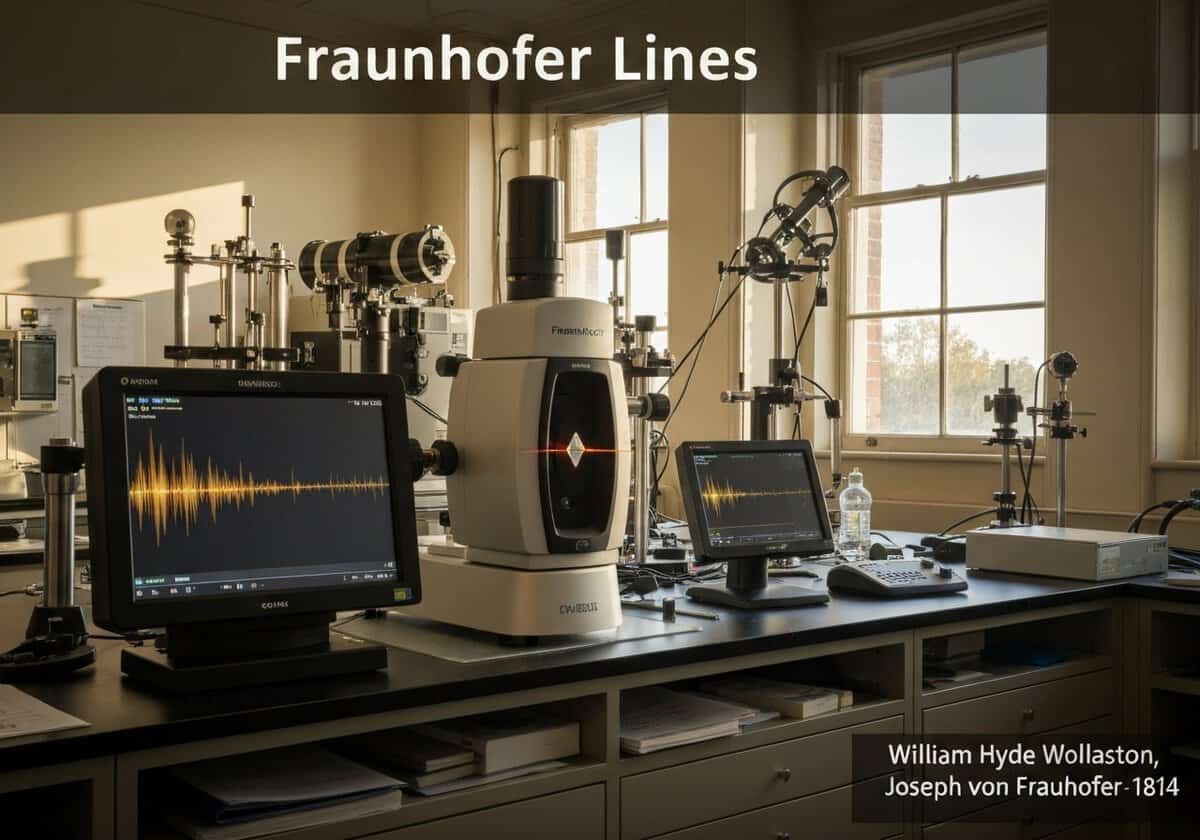
Solar spectrum analysis setup revealing Fraunhofer lines in stellar physics.

(Imagem gerada apenas para fins ilustrativos)

As linhas de Fraunhofer são um conjunto de linhas de absorção escuras no espectro óptico do Sol. Elas resultam da absorção de comprimentos de onda específicos da luz proveniente do interior quente do Sol por átomos e íons mais frios em sua fotosfera. Cada linha corresponde a uma transição eletrônica específica em um elemento específico, permitindo a determinação da composição química do Sol a partir da Terra.


In 1802, William Hyde Wollaston first noted the existence of dark lines in the solar spectrum. However, it was Joseph von Fraunhofer who, in 1814, independently rediscovered and systematically studied these lines using a high-quality prism and telescope, mapping over 570 of them. He labeled the most prominent lines with letters from A to K, a notation still used today. The profound significance of these lines was not understood until 1859, when Gustav Kirchhoff and Robert Bunsen established that the pattern of lines was unique to each chemical element. They realized that the dark lines in the solar spectrum matched the bright emission lines of known elements when heated. This led to the groundbreaking conclusion that the Fraunhofer lines are absorption spectra. Light from the Sun’s continuous spectrum, produced by its hot, dense core (photosphere), passes through the cooler, less dense outer layers (chromosphere). Atoms in the chromosphere absorb photons at the precise frequencies corresponding to their allowed electronic transitions, re-emitting them in random directions. This process effectively removes those specific frequencies from the light reaching Earth, creating the dark lines. This discovery transformed astronomy from a science of position and motion to one of astrofísica, enabling the study of the physical nature and chemical makeup of distant stars.

UNESCO Nomenclature: 2101
Astronomia

Tipo

Fenômeno Natural

Interrupção

Revolucionário

Uso

Uso generalizado

Precursores

  • O trabalho de Isaac Newton sobre a dispersão da luz (1672)
  • Desenvolvimento do spectroscope
  • Teoria atômica que propõe que a matéria é composta de elementos discretos.

Aplicações

  • Descoberta do hélio no espectro solar antes de sua descoberta na Terra.
  • Determinação da composição química de estrelas e outros objetos celestes.
  • Medição das velocidades radiais estelares por meio do efeito Doppler.
  • Estudando atmosferas e temperaturas estelares

Patentes:

NA

Ideias de Inovação Potencial

  • exoplanet atmosphere analysis by observing starlight filtered through it (transit espectroscopia)
  • remote sensing of planetary atmospheres within our solar system
  • doppler imaging of stellar surfaces to map starspots
  • monitoring industrial emissions by analyzing absorption lines in smokestack plumes
  • high-precision gps corrections by modeling atmospheric absorption effects on satellite signals
  • non-invasive medical diagnosis by analyzing absorption spectra of light passed through tissue
  • detection of trace gases for environmental monitoring or security screening
  • studying interstellar medium composition by analyzing light from distant stars passing through it
  • cosmological redshift measurements to determine the expansion of the universe
  • magneto-optical traps for cooling atoms using lasers tuned to specific absorption lines
Relacionado a: linhas de Fraunhofer, espectro de absorção, espectro solar, composição estelar, astrofísica, Kirchhoff, Bunsen, fotosfera, cromosfera, análise espectral.

Contexto histórico

10º ano aniversário

Imagens em tamanho real e downloads estão disponíveis apenas, 100% gratuitos, para membros registrados.
















