Product Design, Manufacturing & Innovation Resources
Lar » Do berço ao berço (C2C)

Do berço ao berço (C2C)

2002
  • William McDonough
  • Michael Braungart
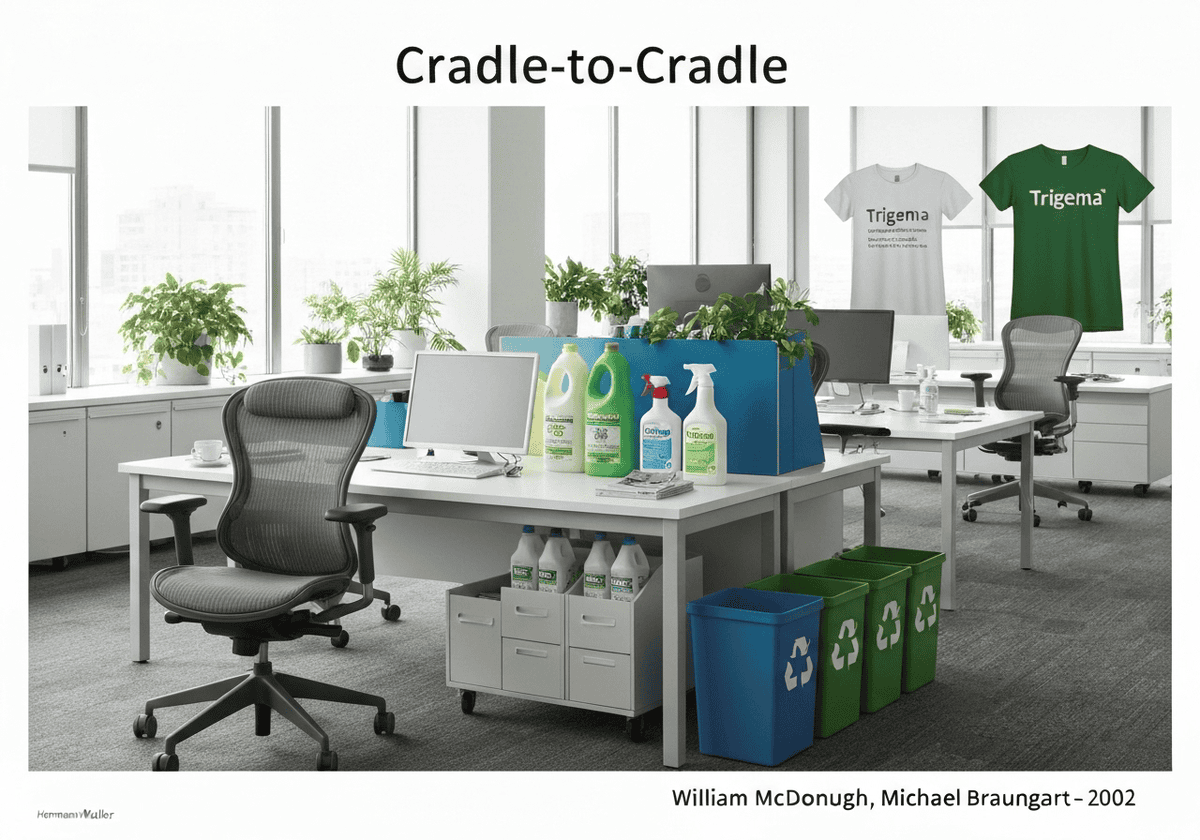
Escritório sustentável com produtos certificados pelo programa Cradle-to-Cradle, incluindo cadeiras e materiais de limpeza.

(Imagem gerada apenas para fins ilustrativos)

Do berço ao berço (C2C) is a design philosophy that models human industry on nature’s processes. It views materials as “nutrients” circulating in closed-loop systems. The framework distinguishes between two cycles: the biological cycle, for biodegradable materials that can safely return to the soil, and the technical cycle, for materials that are continuously reused or reciclado em processos industriais sem perda de qualidade. Os polímeros superabsorventes mostram por que o rótulo é importante: a alegação de comportamento biodegradável do poliacrilato de sódio deve ser verificada antes que esse material seja inserido no ciclo biológico.


The Cradle-to-Cradle framework fundamentally challenges the traditional “cradle-to-grave” industrial model, which results in a one-way flow of materials to landfills or incinerators. C2C proposes a circular economy where waste is eliminated by design. This is achieved by meticulously selecting materials based on their human and environmental health characteristics, avoiding toxic substances altogether. Products are designed for desmontagem, allowing their components to be easily separated and returned to their respective cycles at the end of their use phase.

In the biological cycle, materials like natural fibers, certain bioplásticos, and organic pigments are designed to be consumed by microorganisms and return to the biosphere as biological nutrients, enriching the soil. In the technical cycle, synthetic materials like polymers, metals, and alloys are designed to be high-quality “technical nutrients.” These materials are intended to be perpetually upcycled into new products of the same or higher quality, never becoming waste. This contrasts with conventional recycling, which often results in downcycling, where the material quality degrades with each cycle.

A implementação do C2C exige uma mudança de mentalidade, passando de simplesmente ser "menos ruim" (ecoeficiência) para ser "mais bom" (ecoeficácia). Ela incentiva a inovação na ciência dos materiais, no design de produtos e nos modelos de negócios. O Programa de Produtos Certificados C2C™ oferece um sistema de verificação independente que avalia os produtos com base na saúde dos materiais, na reutilização de materiais, na energia renovável e na gestão de carbono, na gestão da água e na justiça social.

UNESCO Nomenclature: 3308
Tecnologia industrial

Tipo

Sistema abstrato

Interrupção

Revolucionário

Uso

Uso generalizado

Precursores

  • O trabalho de Walter R. Stahel sobre a economia de desempenho e sistemas de circuito fechado na década de 1970
  • The concept of industrial ecology, which emerged in the late 1980s
  • O sistema alemão de reciclagem de embalagens “Ponto Verde” (1991)
  • Princípios gerais de biomimética

Aplicações

  • Cadeiras de escritório com certificação C2C da Herman Miller (ex: Aeron)
  • Produtos de limpeza doméstica Method com ingredientes biodegradáveis ​​e embalagens recicladas.
  • As placas de carpete Eco-Worx da Shaw Industries são projetadas para desmontagem e reciclagem.
  • Camisetas compostáveis ​​com certificação C2C da trigema
  • Materiais de construção com certificação C2C da van houten

Patentes:

NA

Ideias de Inovação Potencial

  • self-disassembling electronics triggered by a specific signal at end-of-life
  • edible packaging for food products that becomes a biological nutrient
  • modular building components that can be reconfigured for different uses over centuries
  • 3d printing filaments made from technical nutrients that can be returned and reprinted indefinitely
  • “material passports” using blockchain to track a component’s composition and history through the technical cycle
  • urban farming systems that use compostable product waste as direct fertilizer input
  • clothing made from fibers that can be either biologically composted or technically re-spun into new yarn
  • service models where manufacturers retain ownership of products, leasing them to users and ensuring their return for upcycling
Related to: cradle-to-cradle, C2C, economia circular, william mcdonough, michael braungart, upcycling, closed-loop system, design industrial.

Contexto histórico

Do berço ao berço (C2C)

2000
2000
2000
2002
2010
2013
2000
2000
2000
2000
2003
2010
2013-09-24

(Caso a data seja desconhecida ou irrelevante, por exemplo, "mecânica dos fluidos", é fornecida uma estimativa aproximada de seu surgimento notável)

10º ano aniversário

Imagens em tamanho real e downloads estão disponíveis apenas, 100% gratuitos, para membros registrados.