Product Design, Manufacturing & Innovation Resources
집 » 자외선 스펙트럼의 하위 구분 (UVA, UVB, UVC)

자외선 스펙트럼의 하위 구분 (UVA, UVB, UVC)

1932
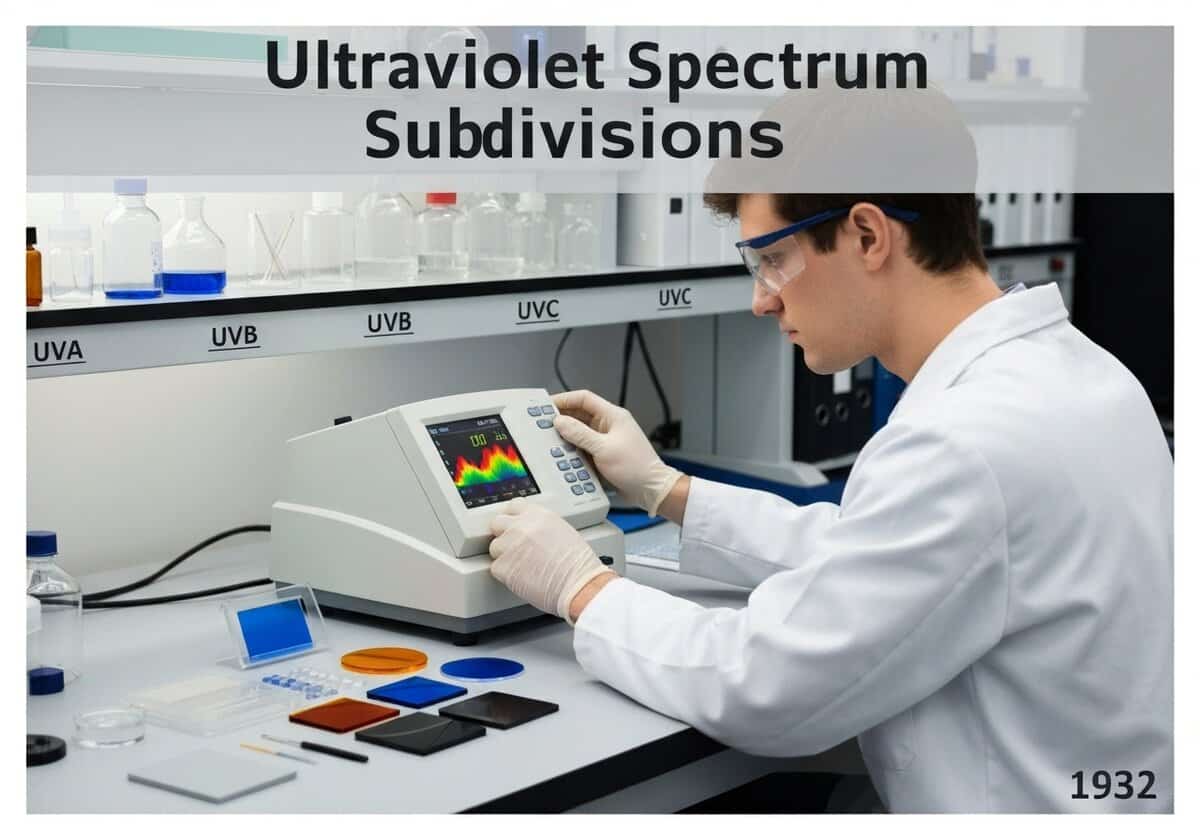
광도 측정 애플리케이션을 위한 자외선 스펙트럼 세분화에 대한 실험실 분석.

(설명을 위한 생성된 이미지입니다)

The ultraviolet spectrum is commonly subdivided into UVA (400–315 nm), UVB (315–280 nm), and UVC (280–100 nm). UVA, or long-wave UV, is the least energetic and penetrates the skin deepest. UVB, or medium-wave UV, causes sunburn and is crucial for vitamin D synthesis. UVC, or short-wave UV, is the most energetic and germicidal but is completely absorbed by Earth’s atmosphere.
The division of the 자외선 spectrum into distinct bands is based on their wavelength and corresponding biological effects. This classification, standardized by bodies like the International Commission on Illumination (CIE), is crucial for understanding UV’s impact on living organisms and materials. UVA (long-wave) is the most prevalent UV radiation reaching the Earth’s surface (~95%), as it is less affected by the ozone layer. It penetrates into the deeper layers of the skin (dermis) and is primarily responsible for skin aging (photoaging) and can contribute to skin cancer. UVB (medium-wave) is partially absorbed by the ozone layer. It primarily affects the outer layer of the skin (epidermis), causing sunburn, DNA damage, and is the main driver for most skin cancers, but it is also the specific wavelength range that initiates 비타민 D production. UVC (short-wave) has the highest energy and is extremely dangerous to living organisms. Its photons have enough energy to break molecular bonds, making it a potent mutagen and germicide. Fortunately, UVC from the sun is entirely absorbed by oxygen and ozone in the stratosphere and does not reach the Earth’s surface. A further category, Vacuum UV (VUV), spans from 100 to 200 nm and is so named because it is strongly absorbed by air (specifically molecular oxygen), requiring a vacuum for it to propagate. These subdivisions are not just academic; they are fundamental to fields ranging from public health and dermatology to industrial applications like sterilization and polymer curing.

UNESCO Nomenclature: 2210
광학

유형

분류 체계

분열

상당한

용법

널리 사용됨

전구체

  • Discovery of 자외선 by Johann Ritter
  • 개발 분광학 정확한 파장 측정
  • 빛의 생물학적 효과에 대한 초기 연구(광생물학)
  • 오존층의 발견과 그 특성

응용 프로그램

  • 자외선 차단제 제형 (UVA/UVB 차단)
  • 자외선 살균 조사 (uvc)
  • 피부 질환에 대한 광선 치료(UVB)
  • 태닝 베드(UVA)
  • 자외선 열화 시험을 위한 재료 과학
  • 비타민 D 합성 연구

특허:

NA

잠재적 혁신 아이디어

  • multi-spectral sunscreens that adapt their protection level based on the detected uva/uvb ratio
  • smart clothing with integrated fibers that change color to indicate cumulative uv exposure
  • uvc-based autonomous robots for hospital and public transport disinfection
  • selective uvb emitters for indoor vertical farms to optimize vitamin d content in produce
  • drones equipped with uv spectrometers to monitor atmospheric ozone layer health in real-time
  • uv-a led arrays for curing 3d printed biological tissues without damaging cells
  • home water systems with integrated uvc-leds for point-of-use sterilization
  • cosmetics containing uva-activated compounds for anti-aging treatments
  • uvb-based therapy devices for home treatment of psoriasis and vitiligo
  • uv-filtering contact lenses that also monitor intraocular pressure
관련 용어: UVA, UVB, UVC, 자외선 스펙트럼, 파장, 광생물학, 피부과, 오존층, 살균제, 비타민 D.

역사적 맥락

자외선 스펙트럼의 하위 구분 (UVA, UVB, UVC)

1930
1930
1931
1932
1933
1937
1940
1930
1930
1930
1931
1932
1936-01-01
1938
1940

(날짜를 알 수 없거나 관련이 없는 경우, 예를 들어 "유체역학"의 경우, 주목할 만한 등장 시기를 대략적으로 추정하여 제공합니다.)

10년차 기념일

고화질 이미지 및 다운로드는 등록된 회원에게만 100% 무료로 제공됩니다.

> 로그인 <