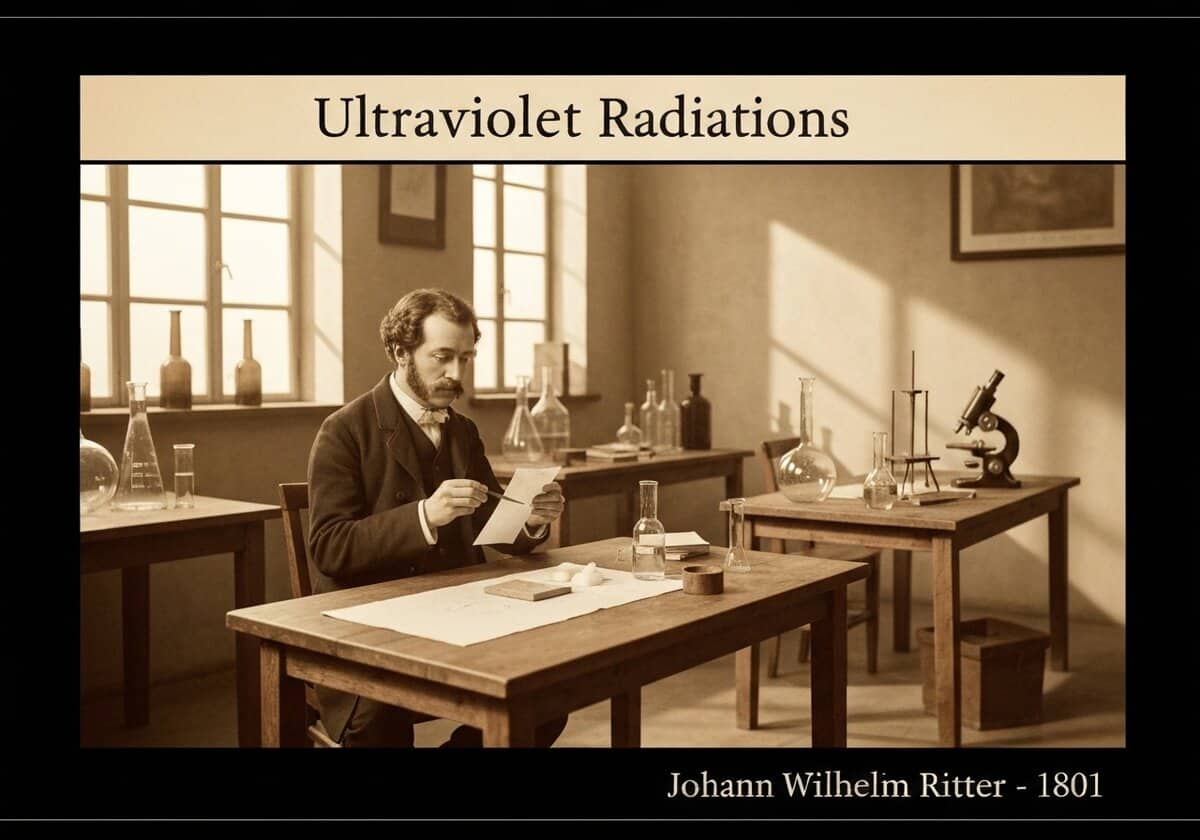
1801년, 요한 빌헬름 리터는 태양 스펙트럼의 보라색 끝 너머에 있는 보이지 않는 광선이 보라색 빛 자체보다 염화은에 적신 종이를 더 빨리 어둡게 한다는 것을 관찰했습니다. 이는 가시광선 스펙트럼 너머에 존재하는 빛의 형태를 보여주는 것이었고, 그는 이를 전년도에 발견된 '열선'(적외선)과 대비하여 '산화 광선'이라고 명명했습니다.
(설명을 위한 생성된 이미지입니다)
1801년, 요한 빌헬름 리터는 태양 스펙트럼의 보라색 끝 너머에 있는 보이지 않는 광선이 보라색 빛 자체보다 염화은에 적신 종이를 더 빨리 어둡게 한다는 것을 관찰했습니다. 이는 가시광선 스펙트럼 너머에 존재하는 빛의 형태를 보여주는 것이었고, 그는 이를 전년도에 발견된 '열선'(적외선)과 대비하여 '산화 광선'이라고 명명했습니다.
Johann Wilhelm Ritter’s experiment was a direct follow-up to William Herschel’s discovery of infrared radiation in 1800. Herschel had used a prism to split sunlight and placed thermometers beyond the red end of the spectrum, noting a temperature increase. Ritter, intrigued by this, decided to test the other end of the spectrum. He knew that silver chloride decomposed in the presence of light, and that this effect was more pronounced in violet light. He exposed strips of paper soaked in silver chloride to the 태양광 spectrum produced by a prism. As expected, the paper darkened in the visible spectrum, with the effect increasing from red to violet. Crucially, he placed a strip just beyond the violet end, in a region where no visible light was present, and found that this strip darkened even more rapidly than the one in the violet light. This confirmed the existence of radiation with chemical activity stronger than visible light, located beyond the violet. His initial name, “oxidizing rays,” highlighted its chemical properties, which was later replaced by “chemical rays” and eventually “ultraviolet rays.” This discovery fundamentally expanded the known electromagnetic spectrum, proving that human vision perceives only a small fraction of it.
자외선
(날짜를 알 수 없거나 관련이 없는 경우, 예를 들어 "유체역학"의 경우, 주목할 만한 등장 시기를 대략적으로 추정하여 제공합니다.)

고화질 이미지 및 다운로드는 등록된 회원에게만 100% 무료로 제공됩니다.
> 로그인 <