Product Design, Manufacturing & Innovation Resources
» 注目の » 産業革新のための巡回セールスマン問題

産業革新のための巡回セールスマン問題

Traveling salesman problem

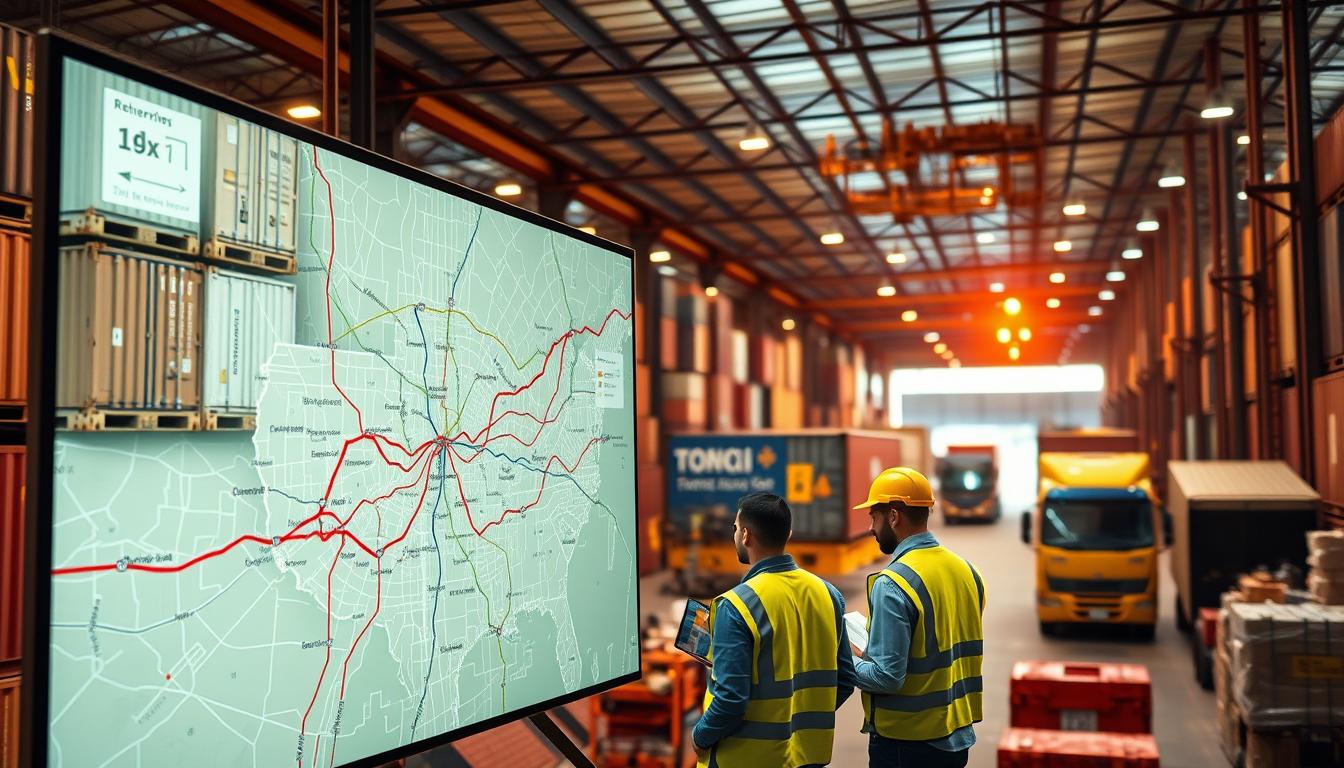
機械と作業員が各作業場所と保管場所の間を最適に移動している、活気のある配送センターを想像してみてください。厳しい時間制限を守り、コストやその他の要素を低く抑えるためには、ルートを綿密に計画する必要があります。この課題こそが、歴史的に巡回セールスマン問題(TSP)と呼ばれる問題の核心です。これは物流分野に限った話ではありません。この記事では、巡回セールスマン問題が実生活や製造業でどのように活用できるかを探ります。あらゆる産業において、ルート計画をどのように改善できるかを見ていきます。

この問題は純粋数学やアルゴリズム研究における古典的な問題であり、物流分野でもより実践的なアプローチで研究されているが、他の産業や製造分野ではほとんど知られていない。

この記事では、以前投稿した「エンジニアリングで知っておくべき10の主要なアルゴリズムと手法」の中から、特に1つのアルゴリズムに焦点を当てています。

主なポイント

  • 巡回セールスマン問題(TSP)とは、複数の地点間の最適な経路を見つける問題である。
  • この問題は1930年代から1940年代にかけて注目を集め始めた。
  • これは、組織が業務における効率性を高め、コストを削減し、資源を有効活用し、サービス提供を改善するのに役立ちます。
  • この問題は、物流や輸送だけでなく、さまざまな分野や産業に広く当てはまる。
  • 12~20ポイントを超えると、問題は複雑になりすぎて、完全な解を計算することができなくなります。
  • 良い近似値を見つけるためのアルゴリズムがいくつか考案されているが、完璧なものはない。

巡回セールスマン問題とは何ですか?

巡回セールスマン問題: 営業担当者が複数の都市を訪問し、出発地点に戻るための最も効率的な方法を見つける。各都市への訪問は1回のみとし、総移動距離を可能な限り短縮することを目指す。

TSPの定義を理解するには、都市の数が増えるにつれて経路の数も増えることを知っておく必要があります。例えば、4つの都市がある場合、可能な経路は24通りになります。都市の数が増えると難易度が上がり、考慮すべき経路が多すぎることになります。

物流、通信、製造業など、多くの企業がこの問題に頻繁に直面しています。巡回セールスマン問題に対する適切な解決策は、コスト削減と効率向上につながるでしょう。 これは、理論的な数学研究が現実世界の諸問題の解決にどのように役立つかを示している。

なぜ難しい問題なのか?


n個の都市がある場合、(n-1)!/2個のユニークなツアーが存在します(/2はツアーがサイクルであり、方向が関係ない場合に発生します)。

  • nが小さい場合(例えばn≦20)、正確なアルゴリズム(総当たり法、動的計画法)が有効です。
  • 近似/ヒューリスティック手法:最近傍法、クリストフィデスアルゴリズム、遺伝的アルゴリズムは、より大規模なインスタンスでよく使用されます。
  • しかし、一般的に、あらゆる状況において確実に最適な答えが得られるような高速な方法は存在しない。

さらに、入力値のわずかな変更(例えば、距離や新たな都市の追加など)によって最適な経路が完全に変わってしまうため、この問題は非常に敏感で、解決が複雑になります。

訪れた都市 考えられるルート/組み合わせ
3 6
4 24
5 120
6 720
7 5040
… …
20 6 × 10¹⁶ (各経路計算にマイクロ秒かかると仮定すると、ほぼ2000年かかる計算になる)
25 各経路計算にマイクロ秒かかるとすれば、宇宙の年齢よりも長い時間

巡回セールスマン問題の歴史

A vast expanse of historical knowledge, the journey of the traveling salesman problem unfolds before us. In the foreground, a sprawling map adorned with lines and routes, tracing the evolution of this iconic optimization challenge. In the middle ground, a collection of analytical diagrams and mathematical equations, the tools that have shaped our understanding of this problem over time. In the background, a collage of significant milestones and key figures, each contributing to the rich tapestry of the traveling salesman problem's history. Illuminated by a warm, vintage-inspired lighting, this scene captures the depth and complexity of a problem that continues to captivate and inspire researchers, logisticians, and problem-solvers alike.
巡回セールスマン問題の旅は、膨大な歴史的知識の広がりを見せます。巡回セールスマン問題の産業および物流における実際の応用。配送計画

巡回セールスマン問題は、1900年代初頭に優秀な数学者たちによって考案されました。ウィリアム・ローワン・ハミルトンとカール・メンガーは、複雑な経路をたどる方法を理解する上で大きな貢献をした著名な数学者です。彼らは、最適な経路を見つけやすくすることに特に力を注ぎました。

1930年代になると、巡回セールスマン問題(TSP)の定義がより明確になり始めた。ウィーン大学とハーバード大学の研究者たちが協力してこの問題に取り組み、スクールバスの運行ルート改善など、現実の問題解決にTSPがどのように役立つかを認識し始めた。これにより、TSPの解決に関心を持つ人が増えた。

TSPは、特に海運・輸送業界の企業にとって非常に有用なものとなった。1950年代から1960年代にかけて、ランド研究所が積極的に取り組み、TSPへの対処法を考案した。これらの方法は、物流業務を円滑に進める上で重要な要素となった。

Why is it an NP-Hard Problem?

A complex web of intertwined paths represents the intricate traveling salesman problem, a np-hard conundrum. In the foreground, a solitary figure ponders the challenge, their expression one of deep contemplation. The background is a kaleidoscope of geometric shapes and lines, symbolizing the problem's computational complexity. Muted tones convey the serious nature of the task, while strategic lighting casts dramatic shadows, emphasizing the problem's depth. The overall scene evokes a sense of analytical tension, inviting the viewer to delve into the complexities of this iconic optimization challenge.
A complex web of intertwined paths represents the intricate traveling salesman problem a. The traveling salesman problem real applications in the industry and logistics. Delivery planning

The Traveling Salesman Problem is a tough puzzle in computer science. It’s marked famous as an NP-hard problem because it’s really hard to solve as it grows exponentially faster than any computer can handle if there are a lot of cities.

What is an “NP-hard” problem: in computer science and computational complexity theory, “NP” stands for Non-deterministic Polynomial time. An NP-hard problem is at least as hard as the hardest problems in NP, meaning every problem in NP can be polynomial-time reduced to it. Unlike NP-complete problems that can be verified in polynomial time, there is no known algorithm that solves NP-hard problems in polynomial time.

Because of this, experts use special shortcuts and smart guesses. These tricks help them find pretty good paths without needing impossible amounts of computing power to get a decent solution that works well enough in real life. See chapter below some of these approaches to help them deal with the huge number of possible paths.

Industrial Applications

The Traveling Salesman Problem helps different industries making things like routes and processes better. Many areas like logistics, transportation, and manufacturing use TSP to make their work easier. TSP approximate solutions and their variants are used in:

交通機関

The most similar usages to the original salesman problem:

  • Vehicle Routing and Logistics Optimization: delivery truck route planning
  • Tourism Route Planning: sightseeing tour optimization
  • Airline Flight Scheduling: minimizing flight route distances
  • Garbage Collection Route Optimization: municipal waste collection
  • ドローン Delivery Route Planning: UAV fleet logistics
  • Ride-Sharing and Taxi Dispatch Optimization: optimal passenger pick-up and drop-off sequencing
  • Emergencies: police, medical, firemen …
  • Museum/Gallery Tour Planning: designing visitor paths through all exhibits with minimal walking.

Routing 

  • Cable Laying and Wiring in Construction: routing of cables/wires with minimal material
  • Networks and electronics hubs
  • VLSI Chip Design: minimizing total wire length when laying out circuits in VLSI (Very Large Scale Integration) chips.
  • Data Clustering: assigning data points to clusters by minimizing intra-cluster path distance, sometimes solved as TSP.
A vast, interconnected network of warehouses, trucks, and distribution centers against a backdrop of a bustling city skyline. In the foreground, a complex web of supply chains and logistics processes, highlighted by intricate data visualizations and digital dashboards. The scene is bathed in a warm, golden light, conveying a sense of efficiency and optimization. Crisscrossing lines and arrows represent the flow of goods, information, and resources, while the city beyond suggests the far-reaching impact of supply chain management on the broader economy and urban landscape. The overall composition emphasizes the scale, complexity, and technological innovation that define modern supply chain operations.
A vast interconnected network of warehouses trucks and distribution centers against a. The traveling salesman problem real applications in the industry and logistics. Delivery planning

Firms can set up their network nodes in the best way to cut down on signal loss and boosts performance in network design.

Manufacturing & Machines

  • Electronic: Manufacturing and 回路基板 Drilling: minimizing distance in automated drilling machines or in PCB pin-control
  • ロボット工学 Path Planning: route optimization for warehouse robots, or robot arm paths
  • Astronomy: as huge telescopes move very slowly, the order of pointing it to the desired stars in the same night is key
  • 3D Printing/Plotting: determining the optimal order for a print head or plotter to move between various print points.

In-house Logistics

  • Supply Chain Network Design: optimal arrangement of warehouses and delivery points

It helps plan paths smartly for equipment and lines. This means machines and assembly lines are laid out better, saving time, making things fast and helping 人間工学.


Science & Research

  • Genome Sequencing: arranging DNA fragments and sequences in the shortest possible order, aiding in genomics assembly.
  • Protein Folding: modeling the optimal spatial sequence to achieve minimum energy conformation (a variant of TSP).
  • Microarray Processing in Biotechnology: optimizing the sequence for ロボット pipettes to deposit samples.
Prompt a highly detailed, photorealistic image of a robotic system solving the traveling salesman problem. In the foreground, a sleek, industrial robot arm meticulously calculates the optimal route, its movements precise and efficient. The robot is surrounded by a complex network of sensors and cameras, meticulously monitoring the environment. In the middle ground, a 3d visualization of a map is displayed, with cities and delivery points represented as nodes, and the optimal path highlighted in a vibrant color. The background features a clean, modern industrial setting, with high ceilings, gleaming metal surfaces, and the faint glow of screens and displays. The lighting is bright and directional, creating sharp shadows and highlights that emphasize the technological complexity of the scene. The overall mood is one of sophisticated automation, with the robot system seamlessly optimizing logistics and transportation.
Prompt a highly detailed photorealistic image of a robotic system solving the traveling. The traveling salesman problem real applications in the industry and logistics. Delivery planning


Methods of Approximating the Best Answer Quickly

Branch and bound algorithm for solving a 7 nodes tsp
Solution of a tsp with 7 nodes, using a simple branch and bound algorithm. The number of permutations is much less than brute force search which would require 360 combinations (credit: wikipedia / saurabh. Harsh cc by-sa 3. 0)

While this is out of the scope of this post to list and provide all details of almost 100 years of science research on this topic, here below some methods currently used.

These methods do not always find the best solution, but they get pretty close without taking a lot of time.

  1. Nearest Neighbor (NN) Heuristic
    • Process: start at a random city; repeatedly visit the nearest unvisited city until all are visited.
    • Pros: fast, simple, but not always close to optimal.
  2. Christofides’ Algorithm
    • Process: builds a tour using minimum spanning trees and perfect matching (guarantees a solution within 1.5 times the optimal for metric TSP).
    • Pros: best-known performance guarantee for metric TSP.
  3. Greedy Algorithm
    • Process: at each step, pick the shortest available edge that does not form a cycle (except the final edge).
    • Pros: fast, but usually not optimal.
  4. 2-opt and k-opt Local Search
    • Process: iteratively replace k edges in the tour with different edges to reduce total length (2-opt, 3-opt are common).
    • Pros: significantly improves initial heuristics, widely used for post-processing.
  5. Genetic Algorithms (GA)
    • Process: use population-based search with crossover and mutation to evolve better solutions over generations.
    • Pros: flexible, can escape local minima.
  6. Simulated Annealing (SA)
    • Process: probabilistically accepts worse solutions occasionally to avoid local optima, gradually reducing “temperature”.
    • Pros: effective for complex search spaces.

Other notable methods: ant colony optimization, Tabu Search, Lin-Kernighan heuristic.

Conclusion on the TSP

The Traveling Salesman Problem (TSP) is crucial for many industries, while still unknown for some. It shows how important it is for improving efficiency and saving costs. Many organizations already use TSP solutions to make their routes and work plans better.

Finding new ways to solve this old problem shows its lasting value. The TSP solving is still a challenge with potential new options thanks to advancements in technology such as algorithms improved by artificial intelligence and machine learning will open new ways to solve this tough challenges. This progress will literally open new routes, make operations strategies better and help organizations streamline their processes more efficiently.

Related Readings

  • Combinatorial Optimization Algorithms: exact and heuristic methods like Genetic Algorithms, Simulated Annealing
  • Graph Theory and Network Analysis: ハミルトニアン cycles, shortest path algorithms
  • Operations Research: linear programming, integer programming
  • Computational Complexity Theory: NP-hardness characterization
  • Meta Heuristics and Swarm Intelligence: ant colony pptimization, particle swarm optimization in solving TSP

よくある質問

巡回セールスマン問題(TSP)とは何ですか?

巡回セールスマン問題(TSP)は重要なパズルです。これは、各地点を一度だけ訪れて出発点に戻る最短経路を見つける問題です。効率的なルート計画が必要な企業にとって、これは非常に重要です。最大の課題は、新たな地点が増えるごとに増える膨大な数の経路です。さらに、交通渋滞や納期といった現実世界の課題も、計画をより困難にしています。

なぜ巡回セールスマン問題はNP困難問題とみなされるのか?

TSP(巡回セールスマン問題)は、都市が追加されるごとに潜在的な経路の数が指数関数的に増加するため、非常に難しい問題です。そのため、特に20以上の地点が追加されると、最適な経路を迅速に見つけることが非常に困難になります。

TSPの一般的な応用例にはどのようなものがありますか?

TSPは、配送ルートの効率化やサプライチェーンの管理など、多くの分野で活用されています。また、医療分野では診察スケジュールの調整、ロボット工学分野では動作の誘導、製造業では小型部品や銅配線の位置決めやテストなどにも役立ちます。

グラフ理論とヒューリスティックアルゴリズムは、TSP(巡回セールスマン問題)とどのように関連しているのでしょうか?

グラフ理論は、巡回セールスマン問題(TSP)の背後にある数学です。都市を点(頂点)で、都市間の経路を線(辺)で表します。これにより、TSP問題を効果的に解決するための手法を開発することができます。ヒューリスティックアルゴリズムは、TSPを解くための賢い近道です。完璧ではないにしても、十分な経路を迅速に見つけるのに役立ちます。最近傍法や貪欲法などがその代表例です。焼きなまし法や遺伝的アルゴリズムなどの手法も、大規模な問題に特に有効です。

TSPはサプライチェーンの効率性にどのような影響を与えるのか?

TSPは輸送ルートを最適化することでサプライチェーンの効率性を向上させます。これによりコスト削減、資源の有効活用、関係者間の連携強化が実現します。医療分野では、TSPは在宅医療や救急医療サービスの提供方法を​​最適化します。医療物資の迅速な配送を保証し、患者ケアと患者満足度の向上に貢献します。

用語集

Deoxyribonucleic Acid (DNA): 二重らせん構造を形成する2本の鎖からなる分子で、アデニン、チミン、シトシン、グアニンの4種類の塩基配列によって遺伝情報がコード化されたヌクレオチドから構成される。ほとんどの生物において遺伝物質として機能する。

Printed Circuit Board (PCB): 絶縁材料で作られた平らな基板で、導電経路(通常は銅板からエッチング加工されたもの)を通して電子部品を支持・接続する。回路の組み立ての基礎となり、部品間の電気接続を容易にする。

Unmanned Aerial Vehicle (UAV): 監視、偵察、輸送など、さまざまな用途向けに設計された、操縦士が搭乗しない遠隔操縦または自律飛行型の航空機。地上管制ステーションまたは機上自動化システムを介して運用され、データ収集用のセンサーやカメラが搭載されていることが多い。

Very-large-scale Integration (VLSI): 数千から数百万個のトランジスタを単一のチップ上に集積することで集積回路を製造する技術であり、複雑な電子システムの小型化を可能にし、コンピュータやスマートフォンなどの機器の性能、電力効率、および機能性を向上させる。


取り上げるトピック: 巡回セールスマン問題、最適化、経路計画、ロジスティクス、アルゴリズム、効率性、コスト削減、ヒューリスティック手法、動的計画法、NP困難、組み合わせ最適化、近似アルゴリズム、ISO 9001、ISO 14001、ISO/IEC 27001、ISO 31000、およびISO 50001。

歴史的背景

1829
1850
1854
1854
1895
1899
1900
1828
1848
1850
1854
1884
1896
1900
1903

(日付が不明または関連性がない場合、例えば「流体力学」などでは、その注目すべき出現時期の概算値が提示されます。)

フルサイズの画像とダウンロードは、登録会員のみが100%無料で利用できます。