Product Design, Manufacturing & Innovation Resources
» トップダウン型ナノ材料合成

トップダウン型ナノ材料合成

1970
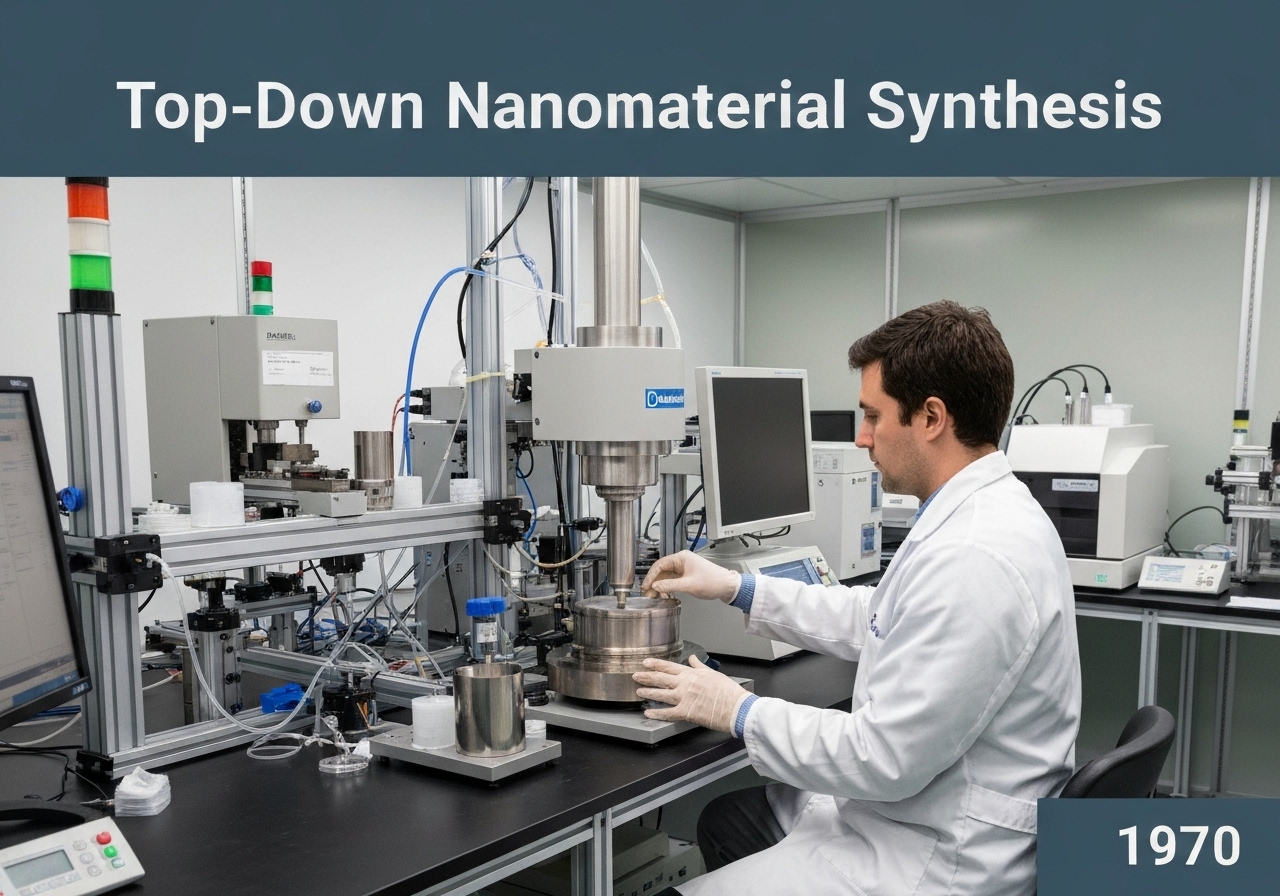
研究者がクリーンルーム内で、トップダウン方式によるナノ材料合成のためにボールミルを操作している。

(画像はイメージです)

トップダウン合成とは、より大きなバルク材料を出発点として、それをナノスケールまで分解またはパターン化することでナノ材料を作製する手法です。主な技術としては、ボールミルなどの機械的方法や、フォトリソグラフィー、電子ビームリソグラフィー、ナノインプリントリソグラフィーなどのリソグラフィー法が挙げられます。これらの方法は、構造化された表面や集積回路の作製によく用いられますが、表面に欠陥が生じる可能性があります。

Top-down approaches are conceptually straightforward: they are an extension of traditional microfabrication techniques to smaller dimensions. The most prominent example is lithography, the cornerstone of the semiconductor industry. In photolithography, a light-sensitive polymer (photoresist) is coated onto a substrate. A mask is used to selectively expose the resist to UV light, causing a chemical change that allows for the selective removal of either the exposed or unexposed regions. The underlying material can then be etched or deposited upon, transferring the pattern from the mask to the substrate. To achieve nanoscale features, shorter wavelength light sources (e.g., extreme ultraviolet, EUV) or alternative patterning sources like electron beams (e-beam lithography) are used. E-beam lithography offers very high resolution but is a slow, serial process, making it unsuitable for mass production but excellent for prototyping and mask making.

Another major class of top-down methods is mechanical attrition. High-energy ball milling, for instance, places a bulk material in a container with hard grinding media (balls). The container is rotated at high speed, causing the balls to collide with and fracture the material, progressively reducing its particle size down to the nanometer scale. This method is simple and scalable for producing large quantities of nanopowders but offers poor control over particle shape and size distribution, and can introduce impurities from the milling media.

トップダウン方式、特にリソグラフィーの主な利点は、集積回路に不可欠な、広範囲にわたって精密に整列した複雑な構造を形成できることである。しかし、大きな欠点は、エッチングやミリング工程中に結晶構造の損傷や表面欠陥が生じ、材料の特性に悪影響を与える可能性があることである。

UNESCO Nomenclature: 2211
固体物理学

タイプ

化学プロセス

混乱

増分

使用法

広く普及している

前駆物質

  • 印刷機の発明と初期の石版印刷
  • 写真技術と感光性薬品の開発
  • the invention of the transistor and the subsequent drive for miniaturization in electronics
  • エッチングプロセスにおける真空技術とプラズマ物理学の進歩

アプリケーション

  • コンピュータ用マイクロプロセッサおよびメモリチップの製造
  • fabrication of microelectromechanical systems (mems)
  • 生体医療用途向けパターン表面の作成
  • セラミックスおよび複合材料用ナノ粉末の製造
  • ナノインプリントリソグラフィー用金型の作製

特許:

NA

潜在的なイノベーションのアイデア

ボットによるトラフィック(現在1日あたり4万件以上)を排除するため、このコンテンツはコミュニティメンバー限定となっています。
> ログイン < または > 登録 < (100%無料)でこれにアクセスできます。他のすべての制限付きコンテンツとツールも同様です。

関連: トップダウン合成、リソグラフィー、フォトリソグラフィー、電子ビームリソグラフィー、ボールミル加工、マイクロファブリケーション、半導体、エッチング、ナノパターニング、MEMS。

歴史的背景

トップダウン型ナノ材料合成

1962
1963
1965
1970
1970
1974-11-15
1980
1962
1963
1964
1968
1970
1970
1975
1980

(日付が不明または関連性がない場合、例えば「流体力学」などでは、その注目すべき出現時期の概算値が提示されます。)

フルサイズの画像とダウンロードは、登録会員のみが100%無料で利用できます。