Product Design, Manufacturing & Innovation Resources
» 추천 » 산업 혁신을 위한 외판원 문제

산업 혁신을 위한 외판원 문제

Traveling salesman problem

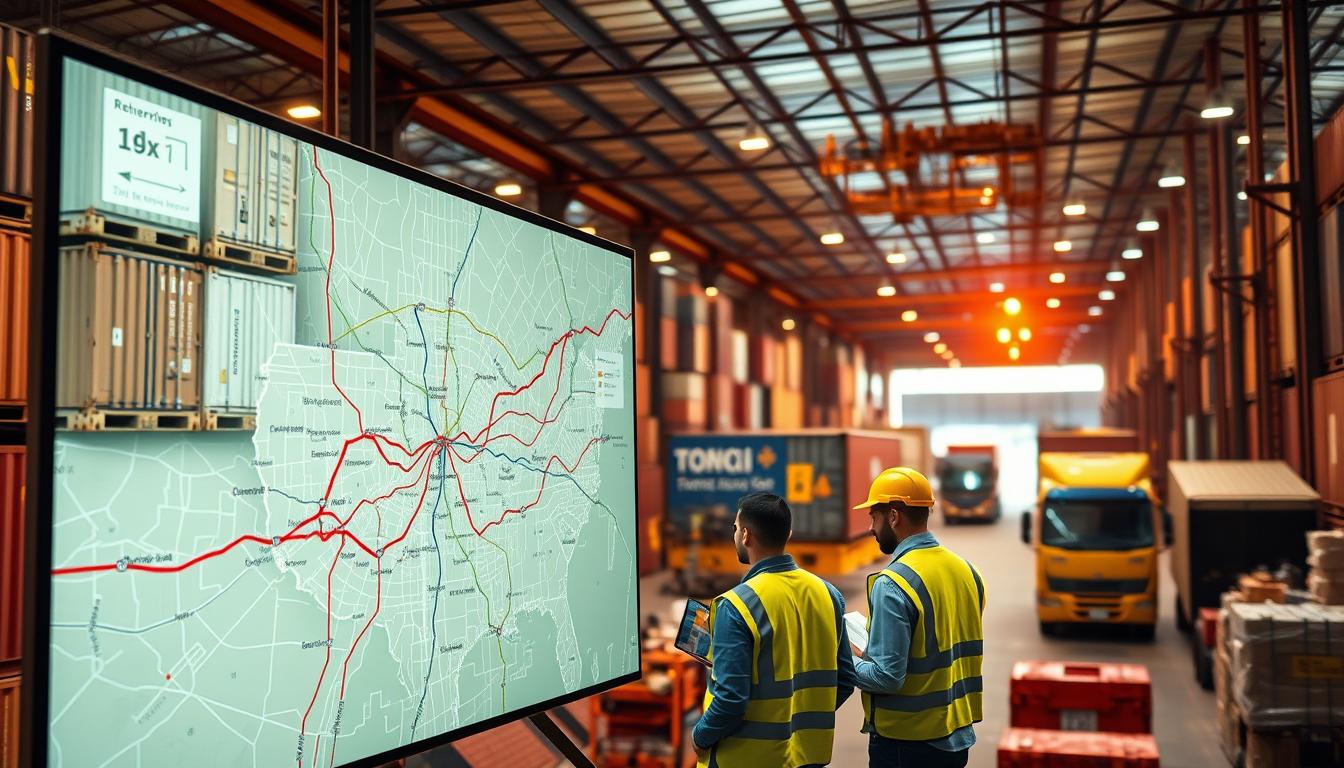
기계와 작업자가 각 작업 및 보관 위치 사이를 최적으로 이동하는 분주한 물류 센터를 상상해 보세요. 엄격한 시간 제한을 준수하고 비용 및 기타 요소를 최소화하려면 경로를 잘 계획해야 합니다. 이러한 과제가 바로 역사적으로 외판원 문제(TSP)라고 불려온 핵심 문제입니다. 하지만 외판원 문제는 물류 분야에만 국한된 것이 아닙니다. 이 글에서는 외판원 문제를 실생활 및 제조업에 어떻게 적용할 수 있는지, 그리고 모든 산업 분야에서 경로 계획을 개선하는 방법을 살펴봅니다.

이 문제는 순수 수학 및 알고리즘 연구 분야에서는 고전적인 문제이며, 물류 분야에서도 보다 실용적인 접근 방식으로 연구되어 왔지만, 다른 산업 및 제조 분야에서는 거의 알려지지 않았습니다.

이번 글에서는 '엔지니어링에서 알아야 할 10가지 주요 알고리즘 및 방법론'이라는 글에 소개된 알고리즘 중 하나를 특별히 집중적으로 다룹니다.

핵심 요약

  • 외판원 문제(TSP)는 여러 지점 사이에서 가장 최적화된 경로를 찾는 문제입니다.
  • 이 문제는 1930년대에서 1940년대에 걸쳐 관심을 끌기 시작했습니다.
  • 이는 조직이 운영 효율성을 높이고 비용을 절감하며, 자원을 제한하고 서비스 제공을 개선하는 데 도움이 됩니다.
  • 이 문제는 물류 및 운송 분야뿐만 아니라 다양한 부문과 산업 전반에 걸쳐 광범위하게 적용될 수 있습니다.
  • 점의 개수가 12~20개를 넘어서면 완벽한 해법을 계산하기에는 문제가 너무 복잡해집니다.
  • 여러 알고리즘이 개발되어 좋은 근사치를 찾을 수 있지만, 완벽한 알고리즘은 없습니다.

외판원 문제란 무엇일까요?

외판원 문제: 영업사원이 여러 도시를 방문하고 출발점으로 돌아오는 가장 효율적인 방법을 찾는 것입니다. 각 도시는 한 번만 방문해야 하며, 총 이동 거리를 최대한 단축해야 합니다.

TSP의 정의를 이해하려면 도시가 추가될수록 경로의 수가 증가한다는 점을 알아야 합니다. 예를 들어, 도시가 네 개라면 가능한 경로는 24개입니다. 도시가 더 추가될수록 난이도가 높아져 고려해야 할 잠재적 경로가 너무 많아지게 됩니다.

물류, 통신, 제조 등 많은 기업들이 이러한 문제에 자주 직면합니다. 외판원 문제에 대한 효과적인 해결책은 비용 절감과 효율성 향상에 도움이 될 수 있습니다. 이는 이론적인 수학 관련 연구가 어떻게 실생활 문제를 해결하는 데 도움이 되는지 보여줍니다.

왜 이것이 어려운 문제일까요?


도시가 n개 있다면 (n-1)!/2개의 고유한 투어가 있습니다(여기서 /2는 투어가 순환 코스이고 방향이 중요하지 않은 경우에 발생합니다).

  • n이 작은 경우(예: n < 20), 정확한 알고리즘(무차별 대입, 동적 프로그래밍)이 작동합니다.
  • 근사/휴리스틱 기법: 최근접 이웃, 크리스토피데스 알고리즘, 유전 알고리즘은 규모가 큰 사례에 자주 사용됩니다.
  • 하지만 일반적으로 모든 경우에 정확하고 최적의 답을 보장하는 빠른 방법은 없습니다.

또한 입력값의 약간의 변화(예: 거리 또는 새로운 도시)로 인해 최적 경로가 완전히 달라지므로 이 문제는 매우 민감하고 해결하기 복잡합니다.

방문한 도시들 가능한 경로/조합
3 6
4 24
5 120
6 720
7 5040
20 6 × 10¹⁶ (각 경로 계산에 마이크로초가 소요된다고 가정하면 거의 2천 년이 걸립니다.)
25 각 경로 계산에 마이크로초가 소요된다면 우리 우주의 나이보다 더 오래 걸릴 것입니다.

외판원 문제의 역사

A vast expanse of historical knowledge, the journey of the traveling salesman problem unfolds before us. In the foreground, a sprawling map adorned with lines and routes, tracing the evolution of this iconic optimization challenge. In the middle ground, a collection of analytical diagrams and mathematical equations, the tools that have shaped our understanding of this problem over time. In the background, a collage of significant milestones and key figures, each contributing to the rich tapestry of the traveling salesman problem's history. Illuminated by a warm, vintage-inspired lighting, this scene captures the depth and complexity of a problem that continues to captivate and inspire researchers, logisticians, and problem-solvers alike.
방대한 역사적 지식을 바탕으로 외판원 문제의 여정이 펼쳐집니다. 산업 및 물류 분야에서 외판원 문제의 실제 적용 사례와 배송 계획에 대해 알아봅니다.

외판원 문제는 1900년대 초, 몇몇 뛰어난 수학자들 덕분에 시작되었습니다. 윌리엄 로완 해밀턴과 칼 멩거는 복잡한 경로를 탐색하는 방법을 이해하는 데 크게 기여한 인물들입니다. 그들은 최적의 경로를 더 쉽게 찾는 데 집중했습니다.

1930년대에 이르러 사람들은 TSP(Traveling Salesperson Problem, 여행 문제)를 더욱 명확하게 정의하기 시작했습니다. 비엔나와 하버드 대학의 학자들이 이 문제에 대해 공동 연구를 진행했고, TSP가 스쿨버스 노선 개선과 같은 실제 문제를 해결하는 데 어떻게 활용될 수 있는지를 보여주기 시작했습니다. 이는 더 많은 사람들이 TSP 해결에 관심을 갖게 되는 계기가 되었습니다.

TSP(운송 시스템 계획)는 특히 해운 및 운송 업계에 매우 유용한 도구가 되었습니다. 1950년대와 1960년대에 RAND Corporation은 TSP 문제를 해결하는 데 있어 탁월한 방법들을 개발했고, 이는 물류 운영을 더욱 원활하게 만드는 데 핵심적인 역할을 했습니다.

Why is it an NP-Hard Problem?

A complex web of intertwined paths represents the intricate traveling salesman problem, a np-hard conundrum. In the foreground, a solitary figure ponders the challenge, their expression one of deep contemplation. The background is a kaleidoscope of geometric shapes and lines, symbolizing the problem's computational complexity. Muted tones convey the serious nature of the task, while strategic lighting casts dramatic shadows, emphasizing the problem's depth. The overall scene evokes a sense of analytical tension, inviting the viewer to delve into the complexities of this iconic optimization challenge.
A complex web of intertwined paths represents the intricate traveling salesman problem a. The traveling salesman problem real applications in the industry and logistics. Delivery planning

The Traveling Salesman Problem is a tough puzzle in computer science. It’s marked famous as an NP-hard problem because it’s really hard to solve as it grows exponentially faster than any computer can handle if there are a lot of cities.

What is an “NP-hard” problem: in computer science and computational complexity theory, “NP” stands for Non-deterministic Polynomial time. An NP-hard problem is at least as hard as the hardest problems in NP, meaning every problem in NP can be polynomial-time reduced to it. Unlike NP-complete problems that can be verified in polynomial time,here is no known algorithm that solves NP-hard problems in polynomial time.

Because of this, experts use special shortcuts and smart guesses. These tricks help them find pretty good paths without needing impossible amounts of computing power to get a decent solution that works well enough in real life. See chapter below some of these approaches to help them deal with the huge number of possible paths.

Industrial Applications

The Traveling Salesman Problem helps different industries making things like routes and processes better. Many areas like logistics, transportation, and manufacturing use TSP to make their work easier. TSP approximate solutions and their variants are used in:

운송

The most similar usages to the original salesman problem:

  • Vehicle Routing and Logistics Optimization: delivery truck route planning
  • Tourism Route Planning: sightseeing tour optimization
  • Airline Flight Scheduling: minimizing flight route distances
  • Garbage Collection Route Optimization: municipal waste collection
  • 무인 비행기 Delivery Route Planning: UAV fleet logistics
  • Ride-Sharing and Taxi Dispatch Optimization: optimal passenger pick-up and drop-off sequencing
  • Emergencies: police, medical, firemen …
  • Museum/Gallery Tour Planning: designing visitor paths through all exhibits with minimal walking.

Routing 

  • Cable Laying and Wiring in Construction: routing of cables/wires with minimal material
  • Networks and electronics hubs
  • VLSI Chip Design: minimizing total wire length when laying out circuits in VLSI (Very Large Scale Integration) chips.
  • Data Clustering: assigning data points to clusters by minimizing intra-cluster path distance, sometimes solved as TSP.
A vast, interconnected network of warehouses, trucks, and distribution centers against a backdrop of a bustling city skyline. In the foreground, a complex web of supply chains and logistics processes, highlighted by intricate data visualizations and digital dashboards. The scene is bathed in a warm, golden light, conveying a sense of efficiency and optimization. Crisscrossing lines and arrows represent the flow of goods, information, and resources, while the city beyond suggests the far-reaching impact of supply chain management on the broader economy and urban landscape. The overall composition emphasizes the scale, complexity, and technological innovation that define modern supply chain operations.
A vast interconnected network of warehouses trucks and distribution centers against a. The traveling salesman problem real applications in the industry and logistics. Delivery planning

Firms can set up their network nodes in the best way to cut down on signal loss and boosts performance in network design.

Manufacturing & Machines

  • Electronic: Manufacturing and Circuit Board Drilling: minimizing distance in automated drilling machines or in PCB pin-control
  • 로봇공학 Path Planning: route optimization for warehouse robots, or robot arm paths
  • Astronomy: as huge telescopes move very slowly, the order of pointing it to the desired stars in the same night is key
  • 3D Printing/Plotting: determining the optimal order for a print head or plotter to move between various print points.

In-house Logistics

  • Supply Chain Network Design: optimal arrangement of warehouses and delivery points

It helps plan paths smartly for equipment and lines. This means machines and assembly lines are laid out better, saving time, making things fast and helping 인간 공학.


Science & Research

  • Genome Sequencing: arranging DNA fragments and sequences in the shortest possible order, aiding in genomics assembly.
  • Protein Folding: modeling the optimal spatial sequence to achieve minimum energy conformation (a variant of TSP).
  • Microarray Processing in Biotechnology: optimizing the sequence for 로봇 pipettes to deposit samples.
Prompt a highly detailed, photorealistic image of a robotic system solving the traveling salesman problem. In the foreground, a sleek, industrial robot arm meticulously calculates the optimal route, its movements precise and efficient. The robot is surrounded by a complex network of sensors and cameras, meticulously monitoring the environment. In the middle ground, a 3d visualization of a map is displayed, with cities and delivery points represented as nodes, and the optimal path highlighted in a vibrant color. The background features a clean, modern industrial setting, with high ceilings, gleaming metal surfaces, and the faint glow of screens and displays. The lighting is bright and directional, creating sharp shadows and highlights that emphasize the technological complexity of the scene. The overall mood is one of sophisticated automation, with the robot system seamlessly optimizing logistics and transportation.
Prompt a highly detailed photorealistic image of a robotic system solving the traveling. The traveling salesman problem real applications in the industry and logistics. Delivery planning


Methods of Approximating the Best Answer Quickly

Branch and bound algorithm for solving a 7 nodes tsp
Solution of a tsp with 7 nodes, using a simple branch and bound algorithm. The number of permutations is much less than brute force search which would require 360 combinations (credit: wikipedia / saurabh. Harsh cc by-sa 3. 0)

While this is out of the scope of this post to list and provide all details of almost 100 years of science research on this topic, here below some methods currently used.

These methods do not always find the best solution, but they get pretty close without taking a lot of time.

  1. Nearest Neighbor (NN) Heuristic
    • Process: start at a random city; repeatedly visit the nearest unvisited city until all are visited.
    • Pros: fast, simple, but not always close to optimal.
  2. Christofides’ Algorithm
    • Process: builds a tour using minimum spanning trees and perfect matching (guarantees a solution within 1.5 times the optimal for metric TSP).
    • Pros: best-known performance guarantee for metric TSP.
  3. Greedy Algorithm
    • Process: at each step, pick the shortest available edge that does not form a cycle (except the final edge).
    • Pros: fast, but usually not optimal.
  4. 2-opt and k-opt Local Search
    • Process: iteratively replace k edges in the tour with different edges to reduce total length (2-opt, 3-opt are common).
    • Pros: significantly improves initial heuristics, widely used for post-processing.
  5. Genetic Algorithms (GA)
    • Process: use population-based search with crossover and mutation to evolve better solutions over generations.
    • Pros: flexible, can escape local minima.
  6. Simulated Annealing (SA)
    • Process: probabilistically accepts worse solutions occasionally to avoid local optima, gradually reducing “temperature”.
    • Pros: effective for complex search spaces.

Other notable methods: ant colony optimization, Tabu Search, Lin-Kernighan heuristic.

Conclusion on the TSP

The Traveling Salesman Problem (TSP) is crucial for many industries, while still unknown for some. It shows how important it is for improving efficiency and saving costs. Many organizations already use TSP solutions to make their routes and work plans better.

Finding new ways to solve this old problem shows its lasting value. The TSP solving is still a challenge with potential new options thanks to advancements in technology such as algorithms improved by artificial intelligence and machine learning will open new ways to solve this tough challenges. This progress will literally open new routes, make operations strategies better and help organizations streamline their processes more efficiently.

Related Readings

  • Combinatorial Optimization Algorithms: exact and heuristic methods like Genetic Algorithms, Simulated Annealing
  • Graph Theory and Network Analysis: 해밀턴ian cycles, shortest path algorithms
  • Operations Research: linear programming, integer programming
  • Computational Complexity Theory: NP-hardness characterization
  • Meta Heuristics and Swarm Intelligence: ant colony pptimization, particle swarm optimization in solving TSP

자주 묻는 질문

외판원 문제(TSP)란 무엇일까요?

외판원 문제(TSP)는 중요한 퍼즐입니다. 각 경유지를 한 번씩만 방문하고 출발점으로 돌아오는 최단 경로를 찾는 문제입니다. 이는 효율적인 경로 계획이 필요한 기업에게 매우 중요합니다. 가장 큰 어려움은 가능한 경로의 수가 엄청나게 많다는 점이며, 새로운 경유지가 추가될 때마다 그 수가 증가합니다. 또한 교통 체증이나 마감일과 같은 현실적인 문제들이 계획 수립을 더욱 어렵게 만듭니다.

TSP가 NP-난해 문제로 여겨지는 이유는 무엇일까요?

TSP(Traveling Salesperson Problem)는 도시가 추가될 때마다 가능한 경로의 수가 기하급수적으로 증가하기 때문에 어렵습니다. 특히 20개 이상의 도시가 추가될 경우 최적의 경로를 신속하게 찾는 것이 매우 어려워집니다.

TSP의 일반적인 응용 사례는 무엇인가요?

TSP는 배송 경로 효율성 향상 및 공급망 관리와 같은 다양한 분야에서 사용됩니다. 또한 의료 분야에서는 진료 예약, 로봇 공학에서는 동작 안내, 전자 제품 제조에서는 소형 부품 및 구리 배선 경로의 위치 지정 및 테스트에 유용하게 활용됩니다.

그래프 이론과 휴리스틱 알고리즘은 TSP(Traveling Salesperson Problem)와 어떤 관련이 있습니까?

그래프 이론은 TSP 문제의 수학적 기반이 됩니다. 그래프 이론에서는 점(정점)으로 도시를 나타내고 선(간선)으로 도시들 사이의 경로를 나타냅니다. 이를 통해 TSP 문제를 효과적으로 해결하는 방법을 개발할 수 있습니다. 휴리스틱 알고리즘은 TSP 문제를 해결하는 데 있어 효율적인 지름길입니다. 이러한 알고리즘은 완벽하지 않더라도 충분히 좋은 경로를 빠르게 찾는 데 도움을 줍니다. 최근접 이웃 알고리즘과 탐욕 알고리즘이 대표적인 예입니다. 시뮬레이티드 어닐링과 유전 알고리즘 같은 기법은 특히 대규모 문제를 해결하는 데 유용합니다.

TSP는 공급망 효율성에 어떤 영향을 미칩니까?

TSP(운송 경로 최적화)는 운송 경로를 개선하여 공급망 효율성을 높입니다. 이는 비용 절감, 자원 활용도 향상, 관련자 간의 협업 증진으로 이어집니다. 의료 분야에서 TSP는 가정 간호 및 응급 서비스 제공 방식을 최적화합니다. 의료 용품의 신속한 배송을 보장하여 환자 치료 및 만족도를 전반적으로 향상시킵니다.

사용된 용어집

Deoxyribonucleic Acid (DNA): DNA는 두 가닥이 이중 나선 구조를 이루는 분자로, 아데닌, 티민, 시토신, 구아닌의 네 가지 염기 서열을 통해 유전 정보를 암호화하는 뉴클레오티드로 구성됩니다. 이는 대부분의 생명체에서 유전 물질 역할을 합니다.

Printed Circuit Board (PCB): 절연 재질로 만들어진 평평한 기판으로, 전도성 경로를 통해 전자 부품을 지지하고 연결합니다. 일반적으로 구리 시트를 에칭하여 제작됩니다. 회로 조립의 기초가 되며 부품 간의 전기적 연결을 용이하게 합니다.

Unmanned Aerial Vehicle (UAV): 조종사가 탑승하지 않고 감시, 정찰, 운송 등 다양한 용도로 설계된 원격 조종 또는 자율 비행 항공기. 지상 관제소 또는 기내 자동화 시스템을 통해 작동하며, 데이터 수집을 위한 센서와 카메라가 장착되어 있는 경우가 많다.

Very-large-scale Integration (VLSI): 집적 회로를 만드는 기술로, 단일 칩에 수천에서 수백만 개의 트랜지스터를 결합하여 복잡한 전자 시스템을 소형화하고 컴퓨터 및 스마트폰과 같은 장치의 성능, 전력 효율성 및 기능을 향상시킵니다.

다룬 주제: 외판원 문제, 최적화, 경로 계획, 물류, 알고리즘, 효율성, 비용 절감, 휴리스틱 방법, 동적 프로그래밍, NP-난해 문제, 조합 최적화, 근사 알고리즘, ISO 9001, ISO 14001, ISO/IEC 27001, ISO 31000, ISO 50001.

역사적 맥락

1829
1850
1854
1854
1895
1899
1900
1828
1848
1850
1854
1884
1896
1900
1903

(날짜를 알 수 없거나 관련이 없는 경우, 예를 들어 "유체역학"의 경우, 주목할 만한 등장 시기를 대략적으로 추정하여 제공합니다.)

고화질 이미지 및 다운로드는 등록된 회원에게만 100% 무료로 제공됩니다.

> 로그인 <