Product Design, Manufacturing & Innovation Resources
家 » 「ビッグファイブ」と呼ばれる5つの大量絶滅

「ビッグファイブ」と呼ばれる5つの大量絶滅

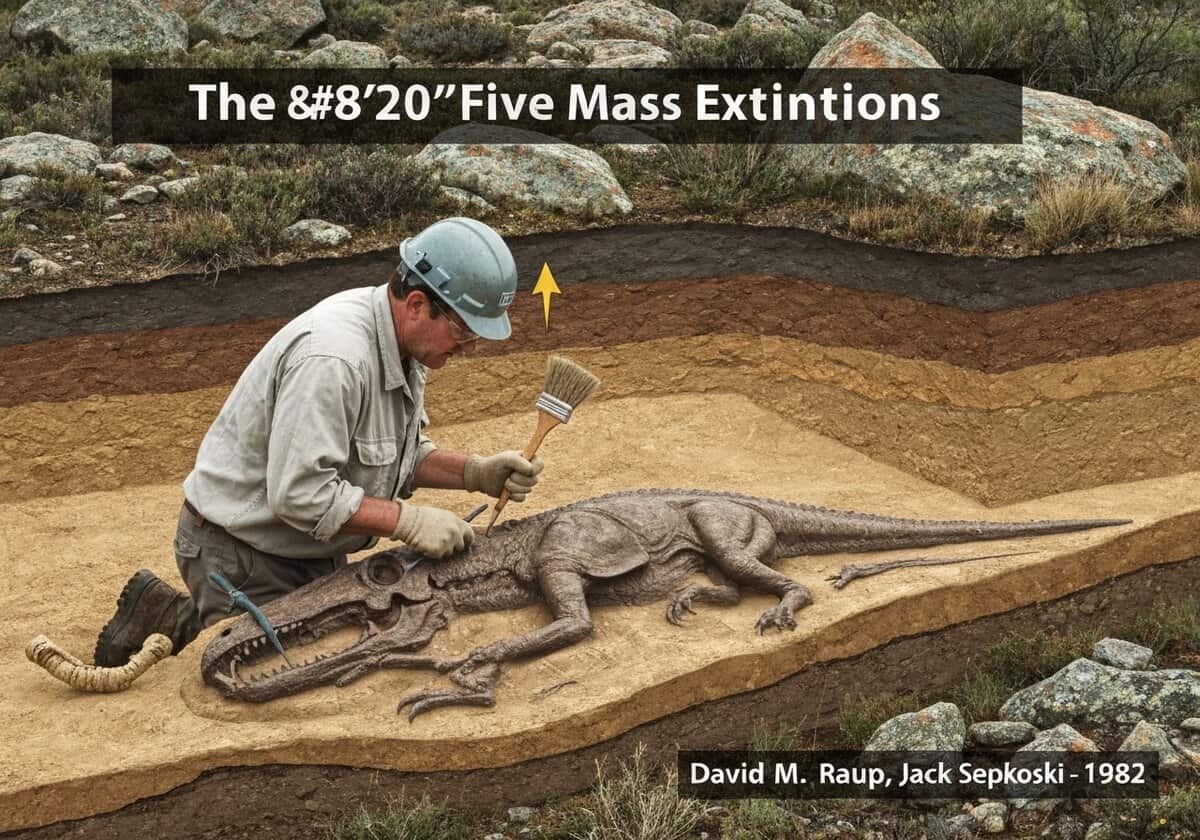
1982
  • David M. Raup
  • Jack Sepkoski
Paleontologist excavating dinosaur fossils in geological layers illustrating mass extinctions.

(画像はイメージです)

The “Big Five” are five major extinction events in Earth’s history where over 75% of species disappeared in a geologically short interval. Identified by Jack Sepkoski and David M. Raup, they are the Ordovician–Silurian, Late Devonian, ペルム紀-三畳紀三畳紀-ジュラ紀、そして 白亜紀-古第三紀 これらの出来事は生物圏を大きく変容させ、新たな生命体が出現する機会を生み出した。

The concept of the “Big Five” mass extinctions emerged from statistical analysis of the fossil record, primarily marine invertebrates, by paleontologists David M. Raup and Jack Sepkoski in a 1982 paper. They compiled a massive database of fossil genera, which allowed them to track biodiversity levels through the Phanerozoic Eon. Their analysis revealed that while extinction is a continuous process (background extinction), there were five distinct intervals where the rate of extinction spiked dramatically. These are: 1) The End-Ordovician (c. 443 Ma), which saw the demise of about 85% of marine species, likely due to rapid glaciation and subsequent sea-level fall. 2) The Late Devonian (c. 372 Ma), a prolonged crisis that eliminated about 75% of species, possibly linked to anoxia and volcanism. 3) The End-Permian or “大いなる死(約2億5200万年前)は最も深刻で、海洋生物種の95%以上と陸生脊椎動物種の70%を絶滅させ、シベリア・トラップ火山活動と強く関連している。 4)三畳紀末(約2億100万年前)は、約80%の種を絶滅させ、恐竜が支配する道を開いた。中央大西洋マグマ岩石区と関連している。 5)白亜紀末(K-Pg(約6600万年前)は、鳥類以外の恐竜と全種の約76%を絶滅させたことで有名で、チクシュルーブ小惑星の衝突が原因とされている。

この枠組みは、生命の歴史を形作る上で、漸進的なダーウィン的競争から破局的出来事の役割へと焦点を移した点で革新的でした。K-Pgイベント後の哺乳類の出現のような主要な進化放散は、大量絶滅によって生み出された生態学的機会に左右されることが多いことを強調しました。「ビッグファイブ」モデルは、しばしば「第六の絶滅」と呼ばれる、現在人類が引き起こしている生物多様性の危機の深刻さを評価するための重要な基準を提供します。

UNESCO Nomenclature: 2508
地質学

タイプ

抽象システム

混乱

基礎

使用法

広く普及している

前駆物質

  • ジョルジュ・キュヴィエの激変説
  • チャールズ・ライエルの斉一説の原理
  • チャールズ・ダーウィンの自然選択による進化論
  • 地質年代尺度の発展
  • 放射年代測定技術の進歩

アプリケーション

  • 大量絶滅の原因と結果を研究するための枠組みを提供する
  • informs modern conservation biology by providing historical context for 生物多様性 loss
  • 生物の交代における重要な期間を強調することで、古生物学研究を導く。
  • 地球システムの転換点を理解するために気候モデリングで使用される

特許:

NA

潜在的なイノベーションのアイデア

  • an ai system to predict future extinction risks based on big five causal patterns
  • a global monitoring network for early detection of tipping points in key ecosystems
  • educational virtual reality simulations of earth during each of the big five events
  • 合成生物学 projects to engineer resilient species capable of surviving predicted future environmental stressors
  • development of geoengineering techniques with built-in ecological safeguards learned from past extinction triggers
  • a public “biodiversity health index” modeled on stock market indices
  • deep-sea robotic missions to search for “living fossils” that survived past extinctions
  • a genetic archive of all known endangered species, cryogenically preserved
  • policy frameworks for international cooperation during global ecological crises
  • advanced climate models that incorporate biotic feedback loops observed during past extinctions
関連: ビッグファイブ、大量絶滅、ラウプ、セプコスキ、顕生代、生物多様性の喪失、古生物学、オルドビス紀、 ペルム紀白亜紀。

歴史的背景

「ビッグファイブ」と呼ばれる5つの大量絶滅

1975
1980
1980
1982
1990
1990
1990
1970
1978
1980
1980
1982
1990
1990
1990

(日付が不明または関連性がない場合、例えば「流体力学」などでは、その注目すべき出現時期の概算値が提示されます。)

10年目 周年

フルサイズの画像とダウンロードは、登録会員のみが100%無料で利用できます。