Product Design, Manufacturing & Innovation Resources
家 » 五大 “大灭绝

五大 “大灭绝

1982
  • David M. Raup
  • Jack Sepkoski
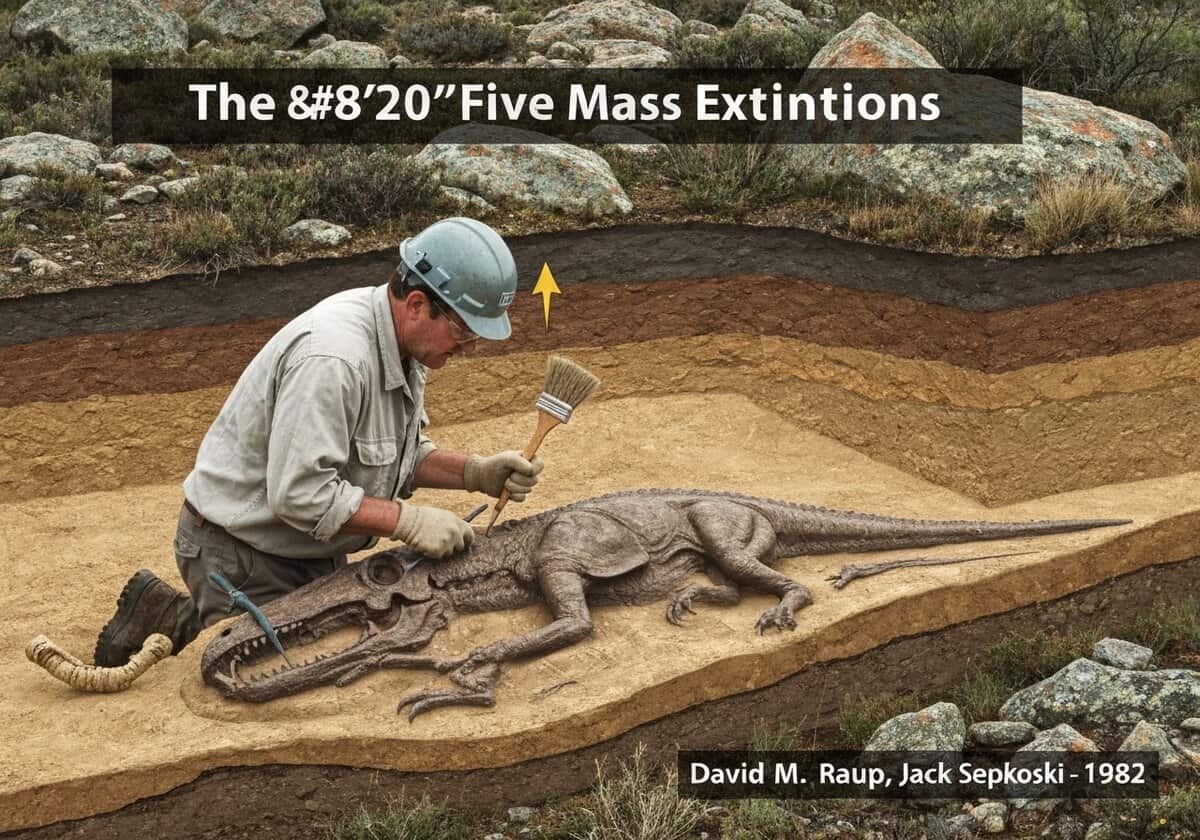
古生物学家在地质层中挖掘恐龙化石,展示恐龙大规模灭绝的过程。.

(图片仅供参考)

The “Big Five” are five major extinction events in Earth’s history where over 75% of species disappeared in a geologically short interval. Identified by Jack Sepkoski and David M. Raup, they are the Ordovician–Silurian, Late Devonian, Permian–Triassic, Triassic–Jurassic, and 白垩纪-古近纪 事件。这些事件深刻地重塑了生物圈,为新生命形式的辐射创造了机会。.

The concept of the “Big Five” mass extinctions emerged from statistical analysis of the fossil record, primarily marine invertebrates, by paleontologists David M. Raup and Jack Sepkoski in a 1982 paper. They compiled a massive database of fossil genera, which allowed them to track biodiversity levels through the Phanerozoic Eon. Their analysis revealed that while extinction is a continuous process (background extinction), there were five distinct intervals where the rate of extinction spiked dramatically. These are: 1) The End-Ordovician (c. 443 Ma), which saw the demise of about 85% of marine species, likely due to rapid glaciation and subsequent sea-level fall. 2) The Late Devonian (c. 372 Ma), a prolonged crisis that eliminated about 75% of species, possibly linked to anoxia and volcanism. 3) The End-Permian or “Great Dying” (c. 252 Ma), the most severe, wiping out over 95% of marine species and 70% of terrestrial vertebrate species, strongly associated with the Siberian Traps volcanism. 4) The End-Triassic (c. 201 Ma), which eliminated around 80% of species, paving the way for dinosaurs to dominate, linked to the Central Atlantic Magmatic Province. 5) The End-Cretaceous (开伯尔-普朗克(约 6600 万年前),著名的希克苏鲁伯小行星撞击导致非鸟类恐龙灭绝,约 76% 的物种灭绝。

这一框架是革命性的,因为它将重点从达尔文式的渐进竞争转移到灾难性事件在塑造生命历史中的作用。它强调,重大的进化辐射,如 K-Pg 事件后哺乳动物的崛起,往往取决于大规模灭绝所创造的生态机会。五大灭绝 “模式为评估当前由人类造成的生物多样性危机(通常被称为 ”第六次灭绝“)的严重性提供了一个重要基准。”

UNESCO Nomenclature: 2508
- 地质学

类型

抽象系统

中断

基础

用法

广泛使用

前体

  • 乔治-库维尔的灾变理论
  • 查尔斯-莱伊尔的均变论原则
  • 查尔斯-达尔文的自然选择进化论
  • 地质年代表的制定
  • 放射性测年技术的进展

应用程序

  • 为研究大规模灭绝的原因和后果提供了一个框架
  • informs modern conservation biology by providing historical context for 生物多样性 loss
  • 通过强调生物更替的关键间隔来指导古生物学研究
  • 用于气候建模以了解地球系统的临界点

专利:

NA

潜在创新理念

  • 基于五大因果模式预测未来灭绝风险的人工智能系统
  • 建立全球监测网络,及早发现关键生态系统的临界点
  • 五大事件期间地球的教育虚拟现实模拟
  • 合成生物学 projects to engineer resilient species capable of surviving predicted future environmental stressors
  • 借鉴过去物种灭绝的诱因,开发内置生态保护措施的地球工程技术
  • a public “biodiversity health index” modeled on stock market indices
  • deep-sea robotic missions to search for “living fossils” that survived past extinctions
  • 所有已知濒危物种的基因档案,低温保存
  • 全球生态危机期间国际合作的政策框架
  • 先进的气候模型,结合了过去物种灭绝期间观察到的生物反馈回路
相关内容: 五大生物 大灭绝 劳普 塞普科斯基 新生代 生物多样性丧失 古生物学 奥陶纪, 二叠纪, 白垩纪。.

历史背景

五大 “大灭绝

1975
1980
1980
1982
1990
1990
1990
1970
1978
1980
1980
1982
1990
1990
1990

(如果日期未知或不相关,例如“流体力学”,则提供其显著出现的近似估计)

第十年 周年纪念日

只有注册会员才能免费获得 100% 的全尺寸图片和下载。.

> 登录 <