Product Design, Manufacturing & Innovation Resources
家 » シニョール=リップス効果

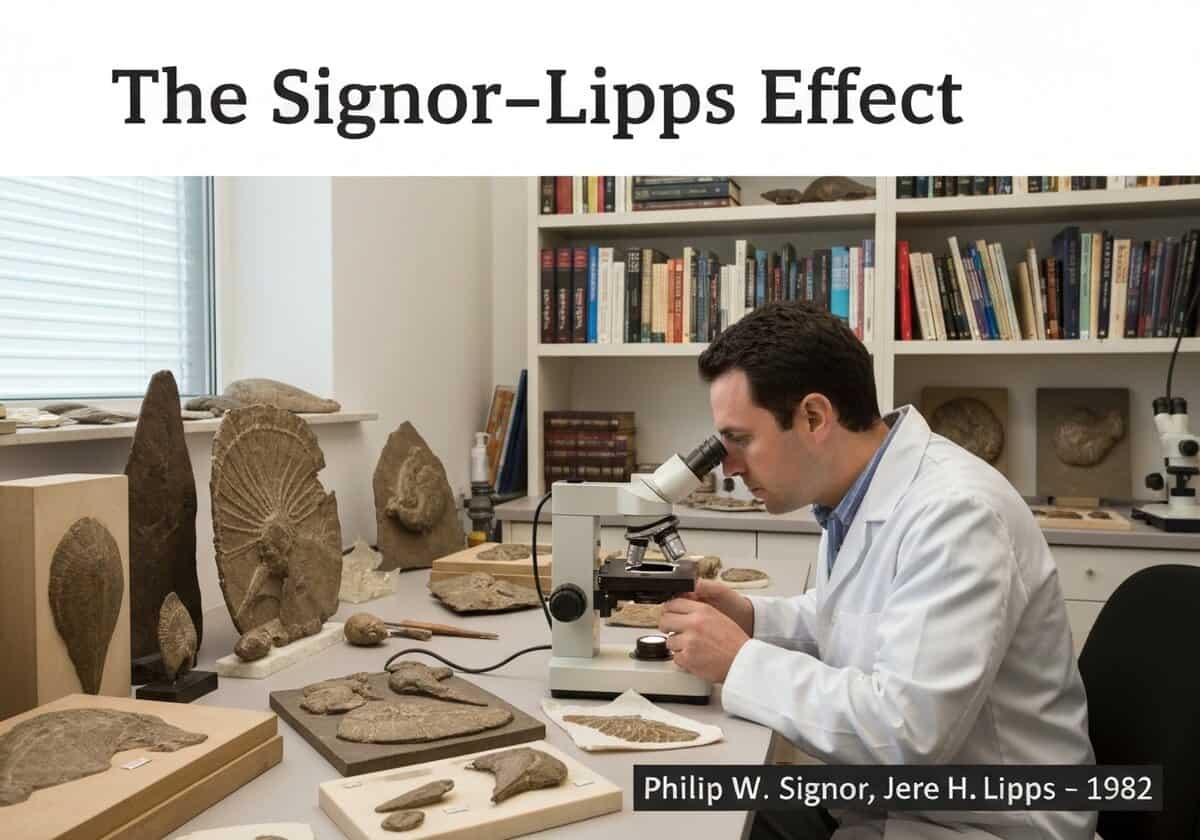
シニョール=リップス効果

1982
  • Philip W. Signor
  • Jere H. Lipps
Paleontologist analyzing fossil specimens in a laboratory setting, focusing on extinction events.

(画像はイメージです)

The Signor–Lipps effect is a paleontological principle stating that, because the fossil record is incomplete, the last known fossil of a species will almost certainly predate the actual extinction of that species. This artifact can make abrupt mass extinctions appear gradual in the fossil record, as the last appearances of different species are smeared backward in time.


Proposed by Philip W. Signor and Jere H. Lipps in 1982, the Signor–Lipps effect addresses a fundamental challenge in interpreting the fossil record: its inherent incompleteness. The chance of any individual organism being fossilized is extremely low, and the chance of paleontologists finding that fossil is even lower. Consequently, the known fossil range of a taxon (its first to last appearance) is almost always shorter than its true temporal range. The effect is particularly significant when analyzing extinction events. For a group of species that went extinct simultaneously in a catastrophic event, their last known fossils will not be found in the same rock layer. Instead, due to random sampling (fossilization and discovery), their last appearances will be scattered through the rock layers leading up to the event.

This creates an illusion of a gradual decline in biodiversity, even if the extinction was geologically instantaneous. For example, before the Alvarez hypothesis gained wide acceptance, many scientists argued that the fossil record showed dinosaurs dwindling in diversity for millions of years before the K-Pg boundary, suggesting a gradual cause. The Signor–Lipps effect provides a powerful counter-argument: this apparent decline could simply be an artifact of an incomplete fossil record approaching a sudden termination point. To counteract this effect, paleontologists now use statistical confidence intervals to estimate the true extinction horizon and prioritize searching for fossils in the layers immediately preceding a suspected mass extinction boundary, a practice known as “ground-truthing” the last appearance data.

UNESCO Nomenclature: 2508
地質学

タイプ

科学的原理

混乱

増分

使用法

広く普及している

前駆物質

  • 層序学と重層性の原理
  • チャールズ・ダーウィンが『種の起源』の中で「地質記録の不完全性」について論じた箇所。
  • 岩石層の年代測定のための生物層序学の開発
  • 統計的サンプリング理論
  • タフォノミーとは、生物がどのように腐敗し、化石化していくかを研究する学問である。

アプリケーション

  • 古生物学者が絶滅事象の速度を厳密に評価するために使用する
  • 不完全な化石データから真の絶滅時期を推定するための統計的手法について解説する。
  • 絶滅境界を横断する高解像度サンプリング(例えばセンチメートルスケール)の重要性を強調する
  • 保全生物学において、現在生きている種の「絶滅負債」を理解するために応用されている。

特許:

NA

潜在的なイノベーションのアイデア

  • bayesian statistical models to estimate true extinction dates from sparse fossil data
  • AI-powered image recognition for automated fossil identification in the field
  • dna sequencing of ancient sediments (sedaDNA) to detect species presence without fossils
  • high-resolution 3d scanning of rock outcrops to digitally map fossil distributions
  • predictive modeling to identify geographic areas with high potential for preserving fossils across extinction boundaries
  • citizen science projects using mobile apps to crowdsource fossil discoveries
  • non-invasive subsurface imaging techniques to locate fossil beds
  • robotic micro-excavation tools for delicate fossil recovery
  • chemical “biomarker” analysis to trace the presence of extinct organisms
  • development of a global, open-access fossil occurrence database to improve statistical power
関連: シニョール・リップス効果、化石記録、古生物学、タフォノミー、絶滅、サンプリングバイアス、 k-pg 境界、漸進主義、激変説、化石の範囲。

歴史的背景

シニョール=リップス効果

1978
1980
1980
1982
1990
1990
1990
1975
1980
1980
1982
1990
1990
1990
1990

(日付が不明または関連性がない場合、例えば「流体力学」などでは、その注目すべき出現時期の概算値が提示されます。)

10年目 周年

フルサイズの画像とダウンロードは、登録会員のみが100%無料で利用できます。