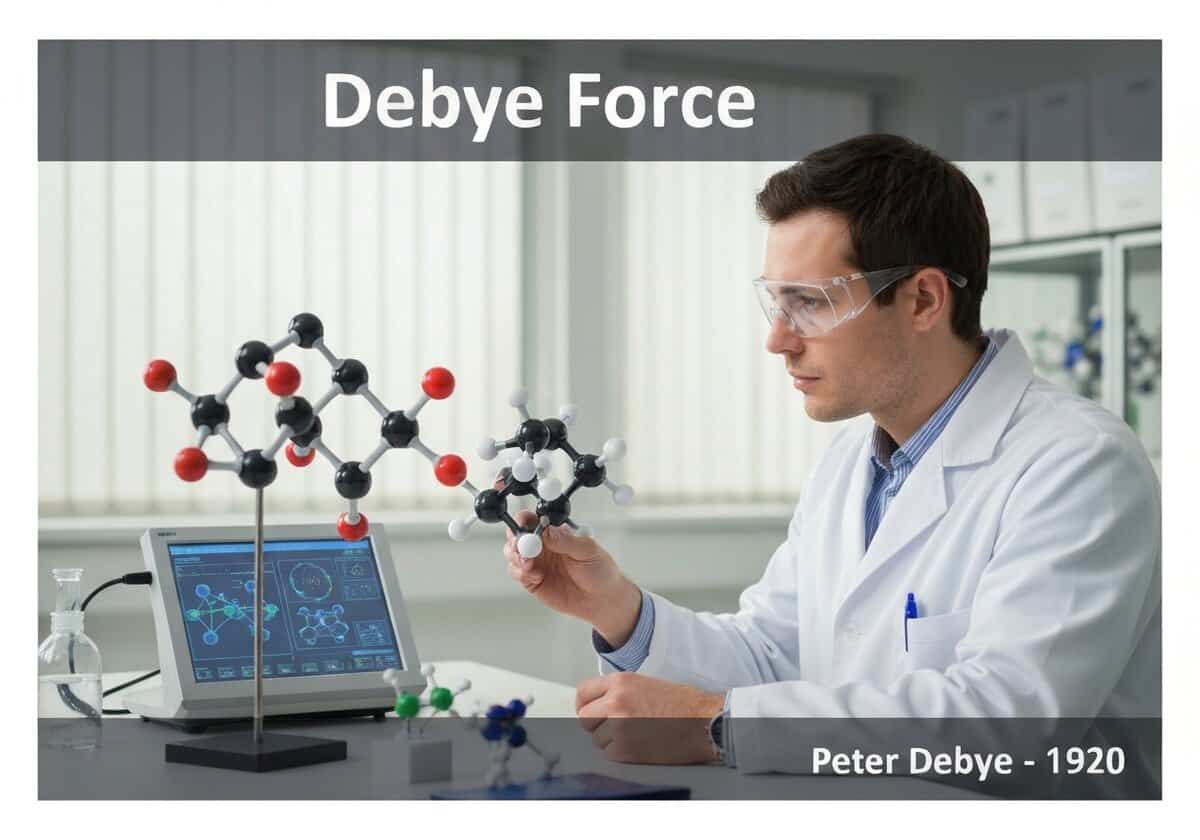
極性分子(永久磁石)間の魅力的な分子間力 双極子)と非極性分子。永久双極子からの電場は非極性分子の電子雲を歪ませ、その中に一時的な双極子を誘起する。すると、2つの双極子は互いに引き合う。相互作用ポテンシャルエネルギーは[latex]V propto -frac{alpha mu^2}{r^6}[/latex]で表され、[latex]alpha[/latex]は分極率、[latex]mu[/latex]は永久双極子モーメントである。 双極子モーメント.

(画像はイメージです)
極性分子(永久磁石)間の魅力的な分子間力 双極子)と非極性分子。永久双極子からの電場は非極性分子の電子雲を歪ませ、その中に一時的な双極子を誘起する。すると、2つの双極子は互いに引き合う。相互作用ポテンシャルエネルギーは[latex]V propto -frac{alpha mu^2}{r^6}[/latex]で表され、[latex]alpha[/latex]は分極率、[latex]mu[/latex]は永久双極子モーメントである。 双極子モーメント.
デバイ力(誘導力とも呼ばれる)は、極性分子が非極性分子を引き付ける仕組みを説明する。極性分子は永久電気双極子を持ち、その周囲に電場を生成する。非極性分子がこの電場に入ると、電子雲が歪み、電子は双極子の負の端から押し出され、正の端に向かって引き寄せられる。この電荷の分離によって、非極性分子に一時的な「誘導」双極子が生じる。誘導双極子は常に、それを生成した永久双極子に対して好ましい方向に配向するため、この相互作用は常に引力となる。
Unlike the Keesom force, the Debye force is not dependent on temperature. This is because the induced dipole is created by the permanent dipole and follows its orientation instantaneously, so thermal tumbling of the permanent dipole does not average out the attraction. The strength of the Debye force depends on two factors: the magnitude of the permanent dipole moment ([latex]\mu[/latex]) of the polar molecule and the polarizability ([latex]\alpha[/latex]) of the nonpolar molecule. While generally weaker than dipole-dipole forces, Debye forces are essential for understanding the behavior of mixtures containing both polar and nonpolar components.
ボットによるトラフィック(現在1日あたり4万件以上)を排除するため、このコンテンツはコミュニティメンバー限定となっています。
> ログイン < または > 登録 < (100%無料)でこれにアクセスできます。他のすべての制限付きコンテンツとツールも同様です。
デバイ力(双極子誘起双極子相互作用)
(日付が不明または関連性がない場合、例えば「流体力学」などでは、その注目すべき出現時期の概算値が提示されます。)

フルサイズの画像とダウンロードは、登録会員のみが100%無料で利用できます。
> ログイン <