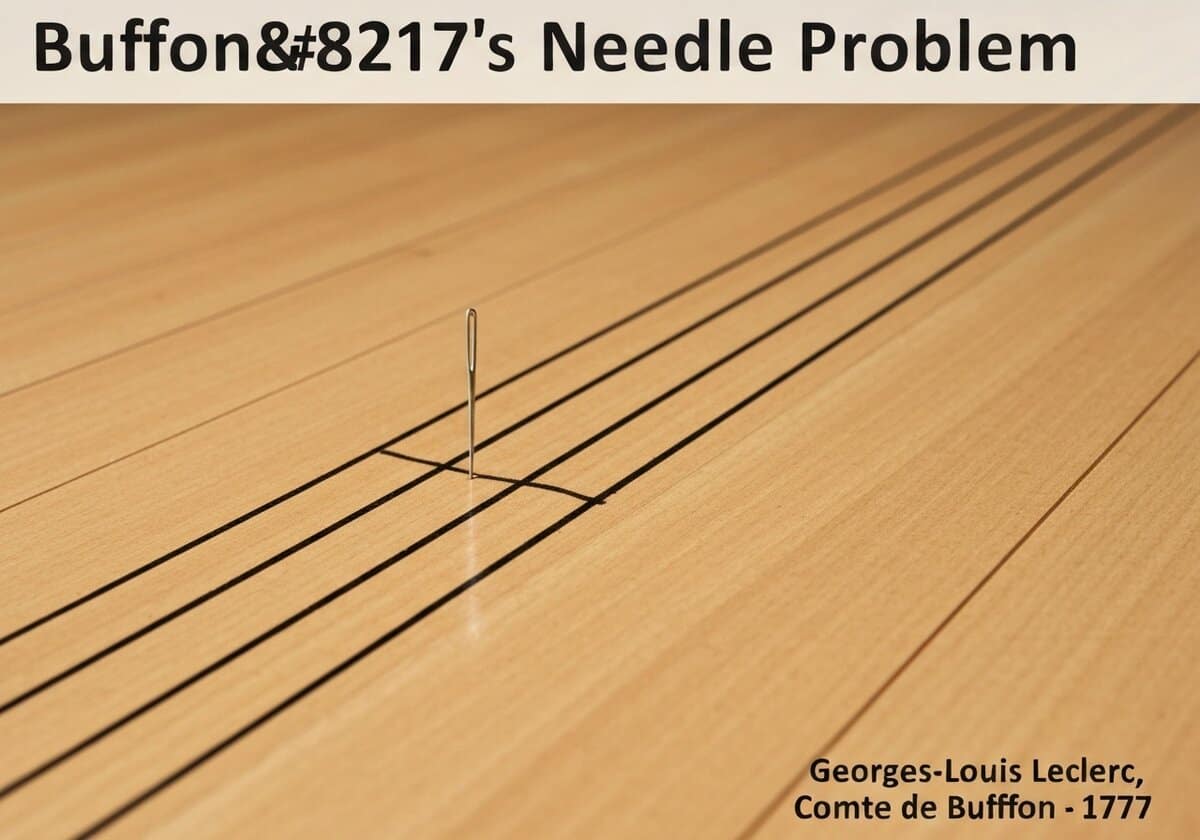
幾何確率論における最も初期の問題の一つであり、 モンテカルロ法これは、長さ[latex]l[/latex]の針を、距離[latex]t[/latex]だけ平行な線が引かれた床に落とすという実験です。針が線を横切る確率は[latex]P = frac{2l}{pi t}[/latex]([latex]l le t[/latex]の場合)です。これは[latex]pi[/latex]を推定するための物理的な実験となります。


(画像はイメージです)
幾何確率論における最も初期の問題の一つであり、 モンテカルロ法これは、長さ[latex]l[/latex]の針を、距離[latex]t[/latex]だけ平行な線が引かれた床に落とすという実験です。針が線を横切る確率は[latex]P = frac{2l}{pi t}[/latex]([latex]l le t[/latex]の場合)です。これは[latex]pi[/latex]を推定するための物理的な実験となります。

1733年、ジョルジュ=ルイ・ルクレール・ド・ビュフォン伯爵は、線が引かれた面に針をランダムに落としたとき、その針が線と交差する確率はどれくらいか、という問題を提起した。1777年に発表されたその解は、幾何確率の古典的な結果である。これを解くには、針の長さを[latex]l[/latex]とし、平行線間の距離を[latex]t ge l[/latex]とする。針の位置は、針の中心から最も近い線までの距離[latex]x[/latex]と、針が線となす角度[latex]theta[/latex]という2つの変数で表すことができる。変数[latex]x[/latex]は[latex][0, t/2][/latex]で一様分布し、[latex]theta[/latex]は[latex][0, pi/2][/latex]で一様分布する。
The needle crosses a line if [latex]x \le \frac{l}{2}\sin\theta[/latex]. The problem is to find the area of this region in the [latex](x, \theta)[/latex] parameter space and divide it by the total area of the parameter space, which is [latex]\frac{t}{2} \times \frac{\pi}{2} = \frac{\pi t}{4}[/latex]. The area of the “favorable” region (where a crossing occurs) is given by the integral [latex]\int_0^{\pi/2} \frac{l}{2}\sin\theta \,d\theta = \frac{l}{2}[-\cos\theta]_0^{\pi/2} = \frac{l}{2}[/latex]. The probability is the ratio of these areas: [latex]P = \frac{l/2}{\pi t/4} = \frac{2l}{\pi t}[/latex]. By performing the experiment many times and observing the frequency of crossings, one can rearrange the formula to estimate [latex]\pi[/latex]: [latex]\pi \approx \frac{2l}{tP}[/latex]. This physical simulation to solve a mathematical problem is a direct intellectual ancestor of modern モンテカルロ methods.
ビュフォンの針の問題
(日付が不明または関連性がない場合、例えば「流体力学」などでは、その注目すべき出現時期の概算値が提示されます。)

フルサイズの画像とダウンロードは、登録会員のみが100%無料で利用できます。
> ログイン <