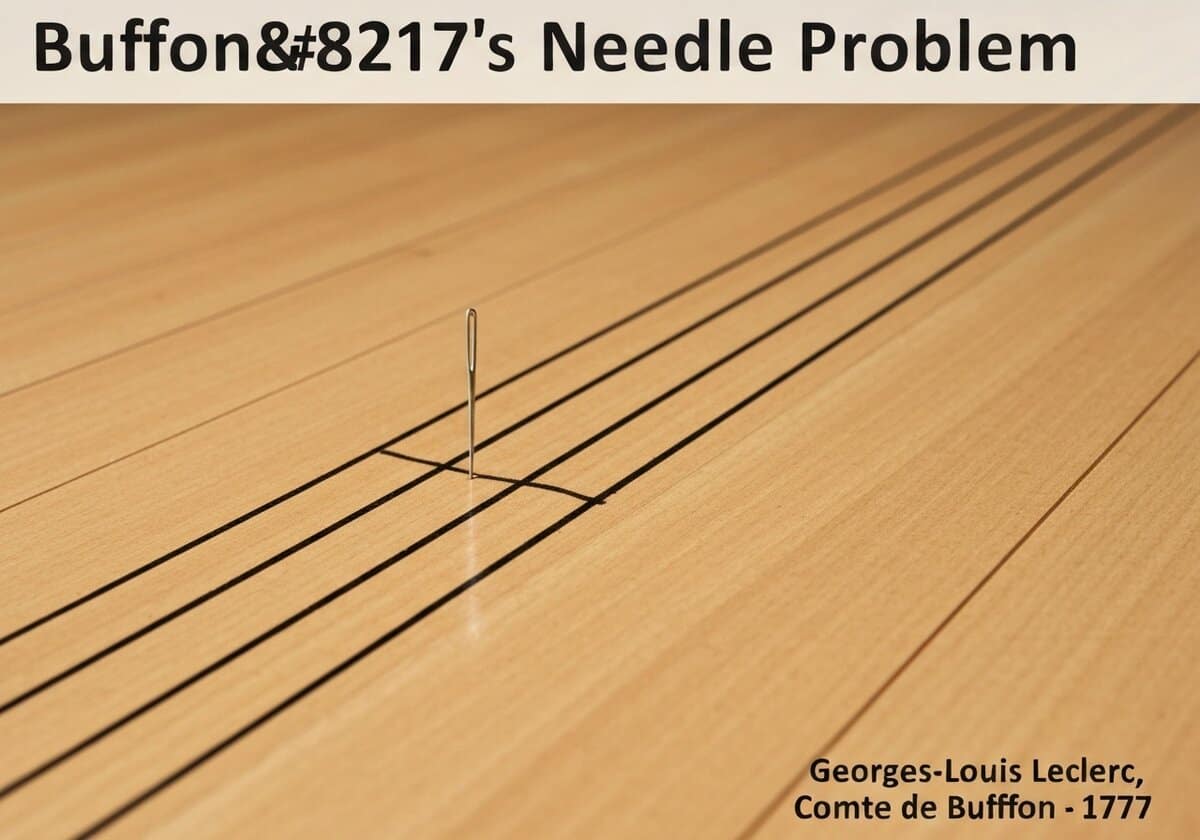
它是几何概率论中最早的问题之一,被认为是几何概率论的先驱。 蒙特卡罗方法. 实验涉及将一根长度为[latex]l[/latex]的细针投掷到地面上,地面上平行排列着间距为[latex]t[/latex]的直线。 针穿过直线的概率为[latex]P = \frac{2l}{\pi t}[/latex](当[latex]l \le t[/latex]时)。该物理实验可用于估算[latex]\pi[/latex]。.


(图片仅供参考)
它是几何概率论中最早的问题之一,被认为是几何概率论的先驱。 蒙特卡罗方法. 实验涉及将一根长度为[latex]l[/latex]的细针投掷到地面上,地面上平行排列着间距为[latex]t[/latex]的直线。 针穿过直线的概率为[latex]P = \frac{2l}{\pi t}[/latex](当[latex]l \le t[/latex]时)。该物理实验可用于估算[latex]\pi[/latex]。.

1733年,乔治-路易·勒克莱尔,布丰伯爵提出了这样一个问题:一根针随机掉落在直纹面上,它与其中一条直线相交的概率是多少?1777年发表的解答是几何概率论中的一个经典结果。为了解决这个问题,设针的长度为l,两条平行线之间的距离为t≥l。针的位置可以用两个变量来描述:针心到最近一条直线的距离x,以及针与直线之间的夹角θ。变量x服从0到t/2的均匀分布,θ服从0到π/2的均匀分布。
The needle crosses a line if [latex]x \le \frac{l}{2}\sin\theta[/latex]. The problem is to find the area of this region in the [latex](x, \theta)[/latex] parameter space and divide it by the total area of the parameter space, which is [latex]\frac{t}{2} \times \frac{\pi}{2} = \frac{\pi t}{4}[/latex]. The area of the “favorable” region (where a crossing occurs) is given by the integral [latex]\int_0^{\pi/2} \frac{l}{2}\sin\theta \,d\theta = \frac{l}{2}[-\cos\theta]_0^{\pi/2} = \frac{l}{2}[/latex]. The probability is the ratio of these areas: [latex]P = \frac{l/2}{\pi t/4} = \frac{2l}{\pi t}[/latex]. By performing the experiment many times and observing the frequency of crossings, one can rearrange the formula to estimate [latex]\pi[/latex]: [latex]\pi \approx \frac{2l}{tP}[/latex]. This physical simulation to solve a mathematical problem is a direct intellectual ancestor of modern Monte Carlo 方法。
布冯的针头问题
(如果日期未知或不相关,例如“流体力学”,则提供其显著出现的近似估计)

只有注册会员才能免费获取完整尺寸的图片和下载内容。
> 登录 <