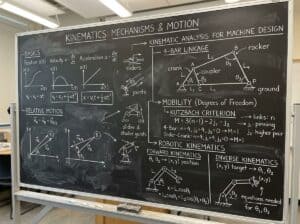
運動学は、運動を引き起こす力に関係なく、運動を記述する学問です。位置、速度、加速度は、直線運動であれ角運動であれ、時間微分によって結び付けられます。相対速度と相対加速度を用いることで、運動する座標系間での運動を解析できます。自由落下や放物運動といった教科書的な事例は、より複雑なメカニズムの基礎となります。
機械設計において、運動学的解析は軌道と可動性を定義します。クッツバッハ基準はリンク機構の自由度を数え、チェビシェフ機構をはじめとする古典的な機構は回転運動をほぼ直線運動に変換します。ロボットやパラレルマニピュレータは、これらの概念を3次元に拡張したものです。逆運動学は制御において中心的な役割を果たします。以下の論文や特許は、最新の手法と応用例を示しています。
運動学は、何が原因かを問わずに動きを記述します。ロボットアームはそれを直接適用します。 ロボット工学車両はそれを使用します 自動運転車 そして 無人航空機 ページ。デザインツール内のモーションシミュレーションは CADソフトウェア移動物体のマッピングは 3D SLAM.
これは、運動学に関する英語の世界中の出版物と特許の最新のセレクションです。多くの科学オンラインジャーナルの中から、運動学、相対速度、相対加速度、軌道、チェビシェフ、クッツバッハ、自由落下、角速度、角加速度、放物運動、平均速度、平均加速度に分類され、焦点を絞っています。
Distributed biomass thermochemical processing system with certified operating regime enforcement
Patent published on the 2026-11-05 in WO under Ref WO2026231627 by TAKACHAR LTD [US] (Kung Kevin [us], Mohan Vidyut [us], Garg Sagar [us])
Abstract: A distributed thermochemical processing system includes one or more thermochemical processing units, each having a reactor configured to convert a carbonaceous feedstock into a solid carbon-containing product. A sensing subsystem associated with each processing unit measures operating conditions including temperature, gas composition, throughput, residence time, or moisture and generates time-series operational data. A supervisory process control system segments reactor operation into temporally[...]
Our summary: A distributed thermochemical processing system converts carbonaceous feedstock into solid products. It utilizes a sensing subsystem to monitor operational conditions and generates time-series data. The supervisory control system ensures compliance with predefined operating regimes and adjusts parameters in response to deviations.
thermochemical processing, biomass conversion, process control, operational monitoring
Patent
Systems and methods for positioning robotic tool with respect to worksurface
Patent published on the 2026-11-05 in WO under Ref WO2026229820 by 3M INNOVATIVE PROPERTIES CO [US] (Thapa Simron [us], Lawler Rudy M [us], Golgouneh Alireza [us], Arthur Jonathan B [us], Knutson Robert A [us], Medley Sarah A [us], Amell Nicholas G [us], Keeler Janna M [us])
Abstract: A robotic repair system includes: a robotic system including an end-of-arm system including an image capturing device configured to capture a deflectometry image of a worksurface at a first position; a deflectometry simulator; a position detection system; and control signal generator. The deflectometry simulator is configured to generate a simulated deflectometry image simulating an image captured by the image capturing device at a target position. The position detection system is configured to,[...]
Our summary: A robotic repair system utilizes an end-of-arm system with an image capturing device to obtain deflectometry images of a worksurface. It employs a deflectometry simulator to create simulated images for comparison with captured images. The position detection system generates a movement trajectory, enabling the robotic system to accurately position an abrasive tool on the worksurface.
robotic positioning, deflectometry imaging, trajectory generation, control systems
Patent
Force and position trajectory recording in hard contact from human demonstration apparatus and method
Patent published on the 2026-11-05 in US under Ref US20260346471 by BOTA SYSTEMS AG [CH] (Lika Klajd [ch], Cruz-oliver Raul [ch], Kotsonis Eleftherios [ch], Wermelinger Martin [ch])
Abstract: An apparatus for force and position trajectory recording for robot device training. A first force torque sensor is mechanically coupled to the robot device and configured to measure a combination of contact force of the robot device and user input force applied to the robot device and to output a first signal representing the combination of contact force of the robot device and user input force applied to the robot device. A second force torque sensor mechanically coupled to the robot device con[...]
Our summary: The apparatus records force and position trajectories for robot training. It uses two force torque sensors to measure user input and contact forces. A controller processes these signals to generate movement commands for the robot device.
force torque sensor, robot device training, contact force measurement, trajectory recording
Patent
Multi-stage gear shifting control system, work machine, program, and multi-stage gear shifting control method
Patent published on the 2026-11-05 in WO under Ref WO2026230189 by KOMATSU LTD [JP] (Ikeda Hiroaki [jp], Minato Masahiro [jp])
Abstract: One embodiment of the present invention provides a multi-stage gear shifting control system comprising at least one processor. The at least one processor: determines, on the basis of a travel command to a work machine comprising a prime mover and a transmission that changes and outputs the rotation speed of the prime mover, and speed information indicating the speed of the work machine or the angular velocity of an output shaft of the transmission, a prime-mover target rotation speed, which is a[...]
Our summary: The invention describes a multi-stage gear shifting control system for work machines. It utilizes a processor to determine target rotation speeds and reduction ratios. The system selects target speed stages based on comparisons of these ratios.
gear shifting, control system, work machine, processor
Patent
Information processing method, information processing device, and computer program
Patent published on the 2026-11-05 in WO under Ref WO2026230485 by TOKYO ELECTRON LTD [JP] (Anzaki Ryoji [jp], Yazaki Yuma [jp], Kitao Toshihiro [jp], Hino Hideitsu [jp])
Abstract: Provided is an information processing method, an information processing device, and a computer program that reduce computational costs required to optimize target trajectories. Provided is a method for performing information processing corresponding to substrate processing using a combination of multiple processing mechanisms that are each for performing the information processing corresponding to a part of the substrate processing, wherein a target trajectory of a first variable controlled by[...]
Our summary: The method optimizes target trajectories while reducing computational costs. It utilizes multiple processing mechanisms for substrate processing. Feedback processing adjusts variables to align outputs with input target trajectories.
information processing, computational costs, target trajectories, feedback processing
Patent
Passive inter-surface cavity device with high-curvature geometric features
Patent published on the 2026-11-05 in US under Ref US20260353610 by ATOMBEAM TECH INC [US] (Galvin Brian [us])
Abstract: [0000] A passive nanoscale cavity device comprising a substrate supporting one or more high-curvature geometric features, such as but not limited to frustums, cones, nanowires, ridges, or graphene edges, positioned opposite an opposing surface across a nanoscale gap. The high-curvature features create a confined cavity region in which electromagnetic mode trajectories differ substantially from those in parallel-plate geometries. The cavity geometry produces geometry-dependent forces and thermal [...]
Our summary: A passive nanoscale cavity device utilizes high-curvature geometric features to create a confined cavity region. This geometry leads to unique electromagnetic mode trajectories and allows for passive thermal energy redistribution. The device can be implemented in various configurations and integrated with electronic systems for effective thermal management.
nanoscale cavity, high-curvature features, passive thermal management, electromagnetic modes
Patent
Attention selectively enhances collision sensitivity in the superficial SC, PBGN and centromedial amygdala to looming stimuli in the upper visual field
Published on 2026-10-29 by @MIT
Abstract: AbstractAccurate detection of impending collisions is essential for survival. While multiple subcortical pathways have been implicated in the detection of looming stimuli, the roles of top-down attention and conscious awareness in this process remain unclear. Using high-resolution fMRI, we investigated how top-down attention and conscious awareness influence subcortical processing of approaching objects on collision versus near-miss trajectories. In healthy participants, the superficial layers o[...]
Our summary: Attention enhances collision sensitivity in the SC-PBGN-CMA pathway for looming stimuli. The study used fMRI to analyze how attention affects subcortical responses to collision trajectories. Findings indicate that attention is crucial for detecting impending collisions in the upper visual field.
attention, collision sensitivity, subcortical processing, fMRI
Publication
Clinical translation and naturalistic neuroscience
Published on 2026-10-29 by @MIT
Abstract: AbstractOptically pumped magnetometer magnetoencephalography (OPM-MEG) has moved beyond proof of principle. The decisive question is no longer whether cryogen-free sensors can detect neuromagnetic fields from the human brain with sufficient sensitivity, but whether complete systems can deliver clinical decision value and interpretable recordings during more naturalistic behaviour. Here we argue that OPM-MEG is developing along two partly overlapping trajectories. One is clinical translation, whe[...]
Our summary: OPM-MEG has advanced beyond initial testing to focus on clinical utility and naturalistic settings. It aims to improve diagnostic decisions through reliable workflows and calibrated source localization. The technology connects neural dynamics to behavior while minimizing movement-related artifacts, requiring robust engineering and evaluation in diverse patient groups.
OPM-MEG, clinical translation, naturalistic neuroscience, neural dynamics
Publication