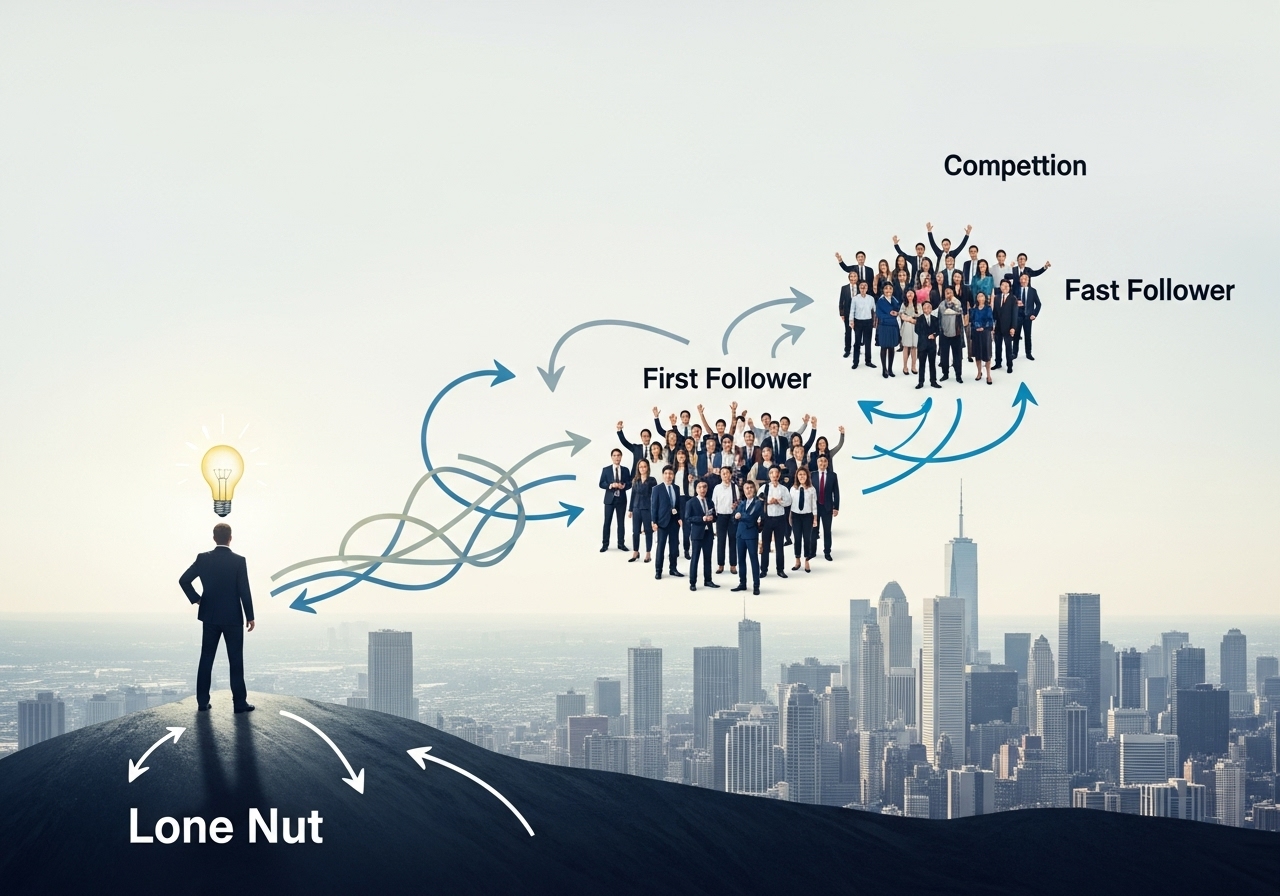
In innovation, we are conditioned to celebrate the pioneer—the visionary who stands alone with a groundbreaking idea. This romantic image, however, overlooks a more critical 触媒 for change. As illustrated by the “ローン・ナット理論上、革新者は単なる 外れ値 最初の追随者が現れるまでは、それは何の意味も持ちません。この重要な第二の人物が、奇妙な個人的行為を運動の始まりへと変える社会的証明を提供するのです。彼らの公的な勇気こそが、他の人々のハードルを下げ、新しいアイデアを正当化し、孤立した奇行から集団行動へと力関係を変化させ、真のリーダーシップとは単に何か新しいことを始めることではなく、他の人々が参加できるように力を与えることにあることを証明するのです。
この後発者の力の原則は、社会力学から企業の役員室に直接及びます。ファストフォロワーこれはビジネス戦略です。ここで重要なのは、ムーブメントに参加することではなく、戦略的に市場を獲得することです。ファストフォロワーは、先駆者が消費者を啓蒙し、新しいコンセプトを証明するための莫大なコストとリスクを負うことを意図的に容認します。先駆者の成功、そしてより重要なことに、その失敗を観察することで、フォロワーは、より優れた、より洗練された製品で、すでに検証済みの市場に参入することができます。このアプローチは、「先駆者優位」という神話に異議を唱え、社会運動と市場競争の両方において、最も永続的な成功は、レースを始めた者ではなく、そこから学び、より良くレースを走った者にこそもたらされることが多いことを示しています。
「孤独な変わり者」と彼の「最初のフォロワー」 ≠ 「ファストフォロワー」
(これらは2つの異なる戦略です)
主なポイント

- 革新者は異例の存在であり、最初の追随者こそがトレンドの始まりである。
- 最初のフォロワーは単に加わるだけではなく、リーダーシップの一形態であり、他の人々にどのように参加するかを示す役割を担っている。
- For a movement to start, the initial act しなければならない be both visible and simple to replicate.
- 先駆者となるには費用がかかる。最初の企業は「市場教育税」を支払い、初期の失敗によるコストをすべて負担する。
- 目標は最初の製品を模倣することではなく、顧客がずっと望んでいたバージョン2.0を発売することだ。
- どちらの戦略も、待つという行為を武器として利用する。最初の追随者は社会的リスクを軽減するためにシグナルを待ち、迅速な追随者は市場リスクを軽減するためにデータを待つ。
- 先駆者にとって最良の防御策は、特許、ブランドロイヤルティ、ネットワーク効果などを通じた地位の確立であり、それによって後発企業の優れた製品を無意味なものにすることができる。
- 成長は 転換点 仲間外れにされることへの恐怖が、目立つことへの最初の恐怖を上回ったとき。
「孤独な変わり者」とその最初の信者
彼の影響力のあるTEDトークでムーブメントの始め方デレク・シヴァーズは、イノベーションと マーケティング の重要な役割に焦点を当てた 最初のフォロワー音楽フェスティバルで一人の男性が熱狂的に踊る映像を用いて、シヴァーズは新しいアイデアが奇妙な個人的行為から集団的な運動へとどのように変化していくかという社会力学を分析している。彼の主張の核心は、最初の追随者の勇気は、革新者の最初のアイデアと同じくらい、あるいはそれ以上に重要だということだ。
「孤独な変わり者」としての革新者

シヴァーズはまず、革新者、つまり新しいアイデアや行動を持つ人物に焦点を当てることから始める。この人物には「一人で立ち向かい、滑稽に見える勇気」が必要だ。当初、この人物は「変わり者」であり、その行動はまだ理解も受け入れられていない異端者である。この革新者がムーブメントを起こすことに成功するためには、シヴァーズは2つの重要な点を強調する。
- 公的な認知度: その行為は公に行われなければならない。人目に触れないイノベーションは決して支持者を集めることはできない。
- シンプルさ: そのアイデアは理解しやすく、そして何よりも重要なのは、実行しやすいものでなければならない。複雑な手順は、潜在的な追随者にとって参入障壁となる。
ヒント: 自分をパフォーマーだと考えるのをやめて、体験そのもののように振る舞い始めよう デザイナー 最初のフォロワーが参加しやすいように、入念に準備を整えましょう。複雑なビジョンをただ公に示すのではなく、それを可能な限りシンプルな要素に分解し、そのシンプルな行動を最も目立ちやすく、繰り返し実行しやすいものにしましょう。これは単に「分かりやすい」というレベルを超え、参加という最初の行動を抗いがたいほどシンプルで心理的に安全なものにするということです。威圧的な完璧さよりも親しみやすさを演出しましょう。なぜなら、あなたの当面の目標は自分の熟練度を誇示することではなく、社会的な障壁を大幅に下げ、最初の一歩を踏み出すことが他の人にとって小さく、簡単で、自然なことのように感じられるようにすることだからです。
最初のフォロワーの変革力
ムーブメントの創出における決定的な瞬間は、最初のフォロワーの出現である。シヴァーズによれば、この人物は過小評価されがちなリーダーシップを発揮する。最初のフォロワーの行動こそが、「孤独な変わり者をリーダーへと変貌させる」のである。この最初の公的な支持がなければ、イノベーターは孤立した個人のままとなる。

最初のフォロワーの重要な機能は以下のとおりです。
- 正当性と社会的証明: 最初の追随者が参加するという行為は、革新者のアイデアがそれほど突飛なものではないかもしれないというシグナルを群衆に送る。それは社会的証明となり、新しい行動様式を正当化する。
- 他者のリスク軽減:最初のフォロワーになるには、リーダーと同様に嘲笑されるリスクがあるため、非常に大きな勇気が必要です。しかし、参加することで、次の人の社会的リスクを大幅に軽減できます。2番目のフォロワーはもはや「孤独な変わり者」に加わるのではなく、小さなグループの一員となるのです。上。
- 参加方法を公に示す:最初の参加者は、他の人に参加方法を示すことで、重要な指導的役割を果たします。これにより、興味はあったものの参加方法が分からなかった後続の参加者にとって、プロセスが簡素化されます。
- 個人からグループへと焦点を移す: シヴァーズが指摘する重要な点は、優れたリーダーは最初のフォロワーを対等な存在として受け入れるということだ。この行為によって、焦点はリーダーから集団、つまり「彼ら」へと即座に移る。運動は、一人の人物を称賛するのではなく、共有された理念を中心に展開されるようになるのだ。
ヒント: 単なる参加者ではなく、翻訳者と増幅器の両方の役割を意識的に果たしましょう。イノベーターは、しばしば奇妙な、生々しい新しいアイデアを提供しますが、あなたの重要な役割は、それを主流向けに再構成し、他の人が理解しやすく、共感でき、安心して参加できるようにすることです。リーダーの行動をただ模倣するのではなく、少しだけ分かりやすいバージョンを示し、あなた自身のソーシャルキャピタルを使って、このムーブメントがなぜ重要なのか、そして他の人がどのように簡単に参加できるのかを公に示しましょう。あなたは「孤立した変わり者」と群衆との間の重要な架け橋であり、あなたの 仕事 その奇妙な合図を、断るにはあまりにも魅力的な、明確で説得力のある招待状に変えることだ。
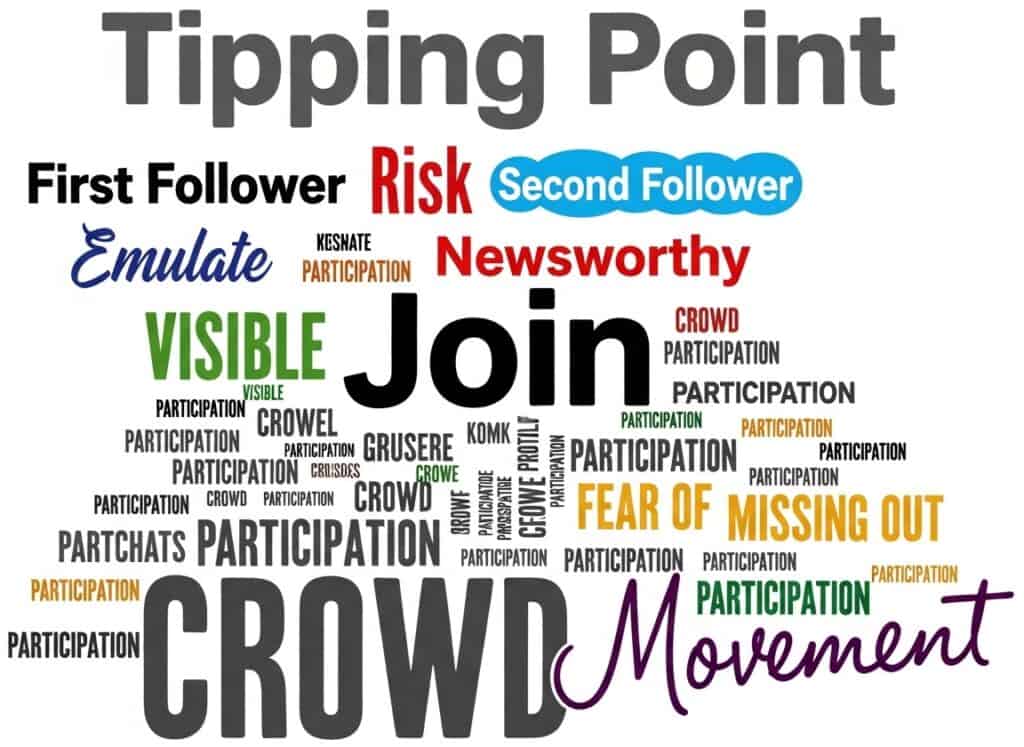
2人から大勢へ:転換点
最初のフォロワーが参加すると、状況は急速に変化する。
- 第二のフォロワー: 2人目のフォロワーの出現は重要な転換点となる。シヴァーズが指摘するように、「それは最初のフォロワーが成功したことの証明だ」。3人が集まれば「群衆」となり、群衆はニュースになる。
- フォロワーはフォロワーを模倣する: 重要な洞察は、新しいフォロワーは主にリーダーではなく、他のフォロワーを模倣するという点である。だからこそ、運動を公にし、フォロワーが目に見える存在であることが不可欠なのだ。
- 転換点に到達する: 参加者が増えるにつれて、リスクが高まる転換点に達する ない 参加すること。仲間外れにされたり、嘲笑されたりすることへの恐怖 ない 参加することで、目立つことへの最初の恐怖心は克服される。
イノベーションとマーケティングにおける重要な教訓
シヴァーズの「最初のフォロワー」戦術は、新製品、サービス、またはアイデアを立ち上げようとしているすべての人にとって、非常に重要な教訓を与えてくれる。
- リーダーシップは過剰に美化されている。 新しいアイデアの成功は、革新者の才能だけに依存するものではない。それと同じくらい、あるいはそれ以上に、最初の数人の採用者の勇気と行動に左右されるのだ。
- 最初のフォロワーを育てましょう: イノベーターやマーケターは、最初のフォロワーを積極的に探し出し、支援する必要があります。これは、アーリーアダプターを対等に扱い、彼らの参加を称賛し、他の人々に彼らの存在を知らせることを意味します。このムーブメントは「私」ではなく「私たち」のためのものであるべきです。
- 勇気を持って従ってください: シヴァーズの究極のメッセージは、他のすべての人への行動喚起です。素晴らしいアイデアを持った「変わり者」を見かけたら、勇気を出して最初に立ち上がり、参加しましょう。最初のフォロワーになることは、変化を起こすための強力な方法であり、独特のリーダーシップの形です。
The “first follower” tactic reframes the launch of an innovation not as a top-down broadcast from a leader, but as a コラボレーション dance that begins when one brave person decides to join the “lone nut” on the dance floor.
最初のフォロワーの架空の完全な例
テクノロジーと「孤独な変わり者」
架空の製品は“です。クロマインクこれは、リアルタイムの生体認証データに基づいて色を変えたり、簡単なアニメーションを表示したりできる、画期的な生体安全タトゥーインクである。その開発者は、天才だが内向的なバイオハッカー、アーサー・フィンチ。彼は「孤独な変わり者」だ。彼は数週間、人気のコワーキングスペースで作業を続け、前腕には複雑な曼荼羅模様が描かれている。 入れ墨 彼がメッセージを受け取ると、その色は微妙に青(焦点)から金色(日光)へと変化したり、光で波打ったりする。
彼は世間の好奇の的であり、ほとんどの人は彼を無視し、他の人からは「#GlowTattGuy」としてひそかに嘲笑されている。彼は自分のアイデアを売り込むのではなく、ただそれを実践することで、その革新性を目に見える形で、しかし奇妙な形で表現しているのだ。
最初のフォロワーと転換点
ユーザーインターフェースデザイナーのマヤは、何週間も彼を観察していた。他の人が彼を変わり者と見る中、彼女は美しく人間中心の新しい言語を見ていた。そして、決定的な行動として、彼女はアーサーのテーブルにまっすぐ歩み寄り、彼の作品を称賛し、コラボレーションを申し出た。この瞬間、彼は孤独な変わり者からリーダーへと変貌を遂げる。彼は彼女を対等な存在として受け入れ、一週間後、マヤは自身のエレガントなクロマインクのタトゥー――手首に一直線に描かれたシンプルな線――を携えてカフェに戻ってきた。こうして、二人の仲間が誕生した。
その効果は即座に現れる。アイデアは正当化され、社会的なリスクは消え去る。これまでアーサーを無視していたテクノロジー系ブロガーが彼らに関する記事を投稿すると、たちまち話題となり、問い合わせが殺到し、ムーブメントが始まる。すべては、たった一人の人物が勇気を出して最初に追随したことから始まったのだ。
The “Fast Follower” Business Strategy
The “Fast Follower” or the “Second-Mover Advantage” business strategy.
This strategy is a calculated and deliberate approach to market entry where a company chooses not to be the first to introduce a new product or service category. Instead, it allows a pioneer (the “first mover”) to bear the costs and risks of creating and educating a new market. The fast follower then enters the now-validated market with a refined, improved, or better-marketed product, aiming to capture a significant market share from the original innovator.
It is not simply about copying; it is a strategy of innovation through iteration.
https://www.youtube.com/watch?v=E0Z0ByCVhDg
The Strategic Logic: Why Be a Follower?

The first mover faces immense challenges:
- High R&D Costs: they must invent the technology from scratch.
- Market Education: they have to teach consumers what the product is, why they need it, and how to use it. This is incredibly expensive.
- Technological Uncertainty: the first version of a product is often buggy, flawed, and based on unproven technology.
- いいえ ロードマップ: they are guessing at the right features, the right price point, and the right marketing strategy.
The fast follower watches the pioneer navigate this minefield and uses their journey as a roadmap of what to do and, more importantly, what ない to do.
Key Advantages of the Fast Follower Strategy

- Dramatically reduced costs: the pioneer pays the “education tax” for the market. The fast follower’s research and development is not focused on pure invention but on refinement, which is significantly cheaper. They can reverse-engineer the pioneer’s product to understand its strengths and weaknesses without the initial investment.
- Learning from the pioneer’s mistakes: this is the most significant advantage. The fast follower gets a free masterclass in market entry. They can analyze:
- Product flaws: did the first product have poor battery life? A confusing ユーザーインターフェース? Was it made of cheap materials? The follower can design their product to fix these specific issues.
- Marketing missteps: did the pioneer target the wrong audience? Was their messaging unclear? The follower can craft a more precise and effective marketing campaign.
- Pricing errors: was the initial product too expensive for the mass market or too cheap to be profitable? The follower can enter with an optimized price point.
- A validated market: the pioneer has already proven that demand exists for this type of product. The fast follower doesn’t have to gamble on whether an audience exists; they only need to focus on capturing that pre-existing audience.
- Superior 価値提案: by combining all these learnings, the fast follower can enter the market with what is effectively a “Version 2.0” product as their initial offering. They can offer a superior design, more of the features customers actually want, better quality, and a more competitive price, creating a compelling reason for consumers to switch.
- Capitalizing on new technology: the pioneer is often locked into their initial technology choices. The fast follower can leverage newer, cheaper, or more efficient technologies that have emerged in the time since the initial launch.
Execution: Key Tactics for a Successful Fast Follower
To succeed, a fast follower must be more than a copycat. They must be agile, intelligent, and aggressive:
| Intense market intelligence: the company must obsessively monitor the pioneer. This includes analyzing customer reviews, tracking sales data, monitoring online forums, and conducting deep competitive analysis. | Rapid and Focused Development: the window of opportunity is often short. The follower must be able to develop and launch their improved product quickly before the pioneer can build an insurmountable lead or release their own “Version 2.0”. |
| Clear and compelling differentiation: the marketing message must be sharp and focused on the points of improvement. It’s not “we have one too”, but “we have the one that works better”, “the one that’s easier to use”, or “the one that you can actually afford”. |  |
| Leveraging existing strengths: successful fast followers often use a pre-existing advantage. This could be a stronger brand name, a massive distribution network, superior manufacturing capabilities, or a large existing customer base they can market to directly. | Aggressive marketing and distribution: the follower must be prepared to out-spend or out-maneuver the pioneer in marketing to overcome their head start in brand recognition. |
Tip: obsess over the pioneer’s customers, not their product. While amateurs focus on reverse-engineering features and competing on a spec sheet, the master fast follower relentlessly studies the first mover’s user base to find the deep, unmet 心理的 need or the core frustration that the pioneer has misunderstood. Your goal is not to launch a “Version 2.0” of their product, but to launch a “Version 1.0” of the product the market actually wanted all along. By solving the problem behind the problem, you don’t just iterate, but you invalidate their entire approach and capture the heart of the market they created.
Risks associated with the Fast Follower strategy
While the Fast Follower strategy can be highly effective, it is fraught with significant risks. Success is not guaranteed, and a miscalculation can be just as costly as pioneering a failed product:
1. The Pioneer Builds an Insurmountable Lead

This is the most significant risk. If the first mover executes well, they can build a lead that is nearly impossible to overcome through:
- Strong brand loyalty: the pioneer’s brand can become synonymous with the product category itself (e.g., “Google” for search, “Xerox” for copying).
- High switching costs: customers may be locked into the pioneer’s 生態系 due to data, learned habits, or integration with other services, making it difficult and costly for them to switch even to a superior product.
- The network effect: for products like social media or コミュニケーション platforms, the value comes from the number of users. A follower’s technically superior platform is useless if no one else is on it.
例: eBay’s network effect. In the late 1990s and early 2000s, numerous companies, including Yahoo Auctions and Amazon Auctions, launched online auction sites to compete with eBay. Some of these fast followers offered lower fees and arguably better features. However, they failed to gain significant traction due to eBay’s powerful network effect. Sellers went to eBay because that’s where the most buyers were, and buyers went there because it had the most sellers. This self-reinforcing loop created an insurmountable lead, making the follower’s superior features irrelevant.
2. The Pioneer is a “Moving Target”
The first mover is not static. They are also learning from their initial launch, gathering customer feedback, and working on their own Version 2.0. A fast follower might spend a year developing a product that leapfrogs the pioneer’s first version, only to launch at the same time the pioneer releases an even better second version, making the follower’s product obsolete on day one.
Example: the iPhone 3G and the App Store. When the first iPhone launched in 2007, competitors began working to create “iPhone killers” that would match its touchscreen and basic internet capabilities. However, just as they were catching up, Apple released the iPhone 3G in 2008, which was not just an incremental hardware update. It launched with the App Store, which fundamentally changed the definition of a smartphone from a device into a platform. Competitors who were busy cloning the first iPhone’s hardware suddenly found themselves competing against an entire ecosystem of software, making their products seem obsolete the moment they launched.
3. Patent and Intellectual Property (IP) Infringement

The pioneer has likely protected their innovation with a wall of patents, trademarks, and copyrights. A fast follower must navigate a legal minefield to create a product that is different enough to avoid costly lawsuits, which can drain resources and halt a launch indefinitely.
Example: Apple versus Samsung. Starting in 2011, Apple engaged in a massive, worldwide legal battle with Samsung, accusing the fast follower of slavishly copying the design and functionality of the iPhone and iPad in its Galaxy line of products. The lawsuits centered on patents for features like “slide-to-unlock”, “pinch-to-zoom”, and the basic grid layout of icons. While Samsung ultimately became also a big player, the litigation cost both companies hundreds of millions of dollars in legal fees and resulted in court-ordered damages against Samsung.
4. The “Copycat” Stigma

Even if the follower’s product is superior, the market may perceive it as a cheap imitation or a “clone”. This can permanently damage brand equity, making it difficult to command a premium price or be seen as an innovative company in the future.
Example: Microsoft Zune versus Apple iPod. Microsoft launched the Zune in 2006 as a direct competitor to the dominant iPod. The Zune was a competent device and even had features the iPod lacked, such as a built-in FM radio and wireless song sharing between devices. Despite this, it could never shake the public perception that it was simply a “me-too” product or an uncool iPod copycat. The iPod was a cultural phenomenon, and the Zune’s identity was so tied to being “not an iPod” that it failed to build its own brand loyalty and was eventually discontinued.
5. Misreading the Market
The follower might misinterpret why the pioneer’s product is successful. They might “fix” problems that users don’t care about or copy features that were not the core reason for the product’s appeal. This leads to a differentiated but ultimately undesirable product.
Example: Google+ versus Facebook. Google launched Google+ in 2011 to compete with Facebook. It was designed to be a “better” social network, fixing perceived flaws in Facebook with features like “Circles” for more granularly organizing friends. Google believed users wanted more control and a more logically structured network. However, they misread the market entirely. Users didn’t want a better-engineered social network; they wanted to be where their friends and family already were. Google+ failed because it solved problems most users didn’t care about, while failing to solve the main one: an empty room is no 楽しい. Many may argue that there was also in this case a strong “The Pioneer Builds an Insurmountable Lead” (point #1) effect.
6. Following a False Positive
Sometimes, a first mover’s initial success is a short-lived fad, not a sustainable market. The fast follower might invest heavily to enter a market that is already collapsing by the time their product is ready, having chased a fleeting trend.

Example: the 3D Television market collapse. Following the massive box office success of the 映画 “Avatar” in 2009, pioneers like Samsung, Panasonic, and LG invested heavily in 3D television technology. Seeing the initial hype and high sales figures, dozens of other fast-follower manufacturers rushed to release their own 3D TV models. However, the initial success was a false positive. Consumers quickly grew tired of the expensive, clunky glasses, a lack of 3D content, and a subpar viewing experience. The entire market collapsed, and by 2017, virtually all major manufacturers had stopped producing 3D TVs, leaving the followers with significant losses on a product category that turned out to be a fad.
7. Underestimating Costs and Execution Challenges
The assumption that a follower can build a better product more cheaply and quickly is not always true. They may underestimate the complexity of the technology or the marketing budget required to challenge an incumbent. A failure in execution can negate all the strategic advantages of following.
Example: Webvan’s logistical failure. In the late 1990s, Webvan was a fast follower in the online grocery delivery space, aiming to perfect the model pioneered by smaller services like Peapod. Their plan was ambitious: build massive, highly automated warehouses and operate a huge fleet of delivery trucks to offer unparalleled service. However, they catastrophically underestimated the logistical complexity and capital required. They spent over $1 billion building infrastructure before their business model was proven, leading to immense operational costs they couldn’t sustain. Webvan went bankrupt in 2001, becoming a poster child for underestimating the challenges of execution at scale.
8. Market Anchoring
The pioneer’s design and ユーザーエクスペリエンス can become the de facto standard in the minds of consumers. Even if a follower creates a demonstrably better or more efficient interface, users may reject it simply because it is unfamiliar and requires them to unlearn their established habits.
例: the Dvorak keyboard versus QWERTY. The Dvorak keyboard layout, patented in 1936, is demonstrably superior to the standard QWERTY layout. It is designed to be more 人間工学に基づいた, increase typing speed, and reduce errors by placing the most commonly used letters on the home row. Despite being a better “product”, it has never achieved mainstream adoption. The reason is market anchoring: the entire world learned to type on the QWERTY layout established by early typewriters almost 60 years before. The cost and effort for millions of people to unlearn this deeply ingrained habit far outweighs the benefits of switching, even to a superior system.
Fast Follower Examples
| Google versus early Search Engines (AltaVista, Lycos): search engines existed, but they were cluttered and their results were often irrelevant. Google followed with a superior PageRank algorithm that delivered better results and a radically simple user interface. They didn’t invent search; they perfected it. | Apple’s iPad versus BlackBerry and Nokia: smartphones with email and clunky browsers existed. Apple followed by completely reimagining the user experience with a multi-touch screen, a full-featured web browser, and later, the App Store. They didn’t invent the smartphone; they redefined what a smartphone should be. |
| Facebook versus MySpace: MySpace pioneered mass-market social networking but became known for its chaotic, customizable profiles and spam issues. Facebook followed with a clean, uniform design and an initial focus on exclusivity (college networks), which created a perception of quality and safety. They improved the user experience and trust. | Apple’s iPhone versus BlackBerry and Nokia: smartphones with email and clunky browsers existed. Apple followed by completely reimagining the user experience with a multi-touch screen, a full-featured web browser, and later, the App Store. They didn’t invent the smartphone; they redefined what a smartphone should be. |
結論

Both the first follower and the fast follower dismantle the myth that success belongs only to the first to act. One validates a social risk, the other exploits a market risk. The first follower is the one who turns the lone innovator into a leader, providing the crucial public endorsement that makes it safe for a crowd to form.
Similarly, the fast follower lets the pioneer absorb the financial and educational costs of breaking new ground, then enters the now-proven market with a product refined by that expensive data.
These two strategies reveal that the most powerful position is often not the lonely vanguard, but the intelligent second who turns observation into decisive advantage.
The initial idea is less important than its adoption. Timing and intelligent iteration often beat pure invention.
Related Readings
- イノベーション普及理論: the classic academic framework by Everett Rogers that categorizes adopters into Innovators, Early Adopters, Early Majority, Late Majority, and Laggards. The “First Follower” is a quintessential Early Adopter.
- 峡谷を越える: ジェフリー・ムーアが提唱した概念で、初期採用者(先見の明のある人々)と初期多数派(実用主義者)の間の決定的なギャップに焦点を当てたものであり、最初の追随者が成功した後に起こる重要なステップである。
- 革新者のジレンマ: クレイトン・クリステンセンの理論は、市場リーダー(パイオニア)が既存顧客に過度に注力することで失敗する可能性があり、その結果、破壊的な速攻型追随企業が見過ごされていたセグメントにサービスを提供する機会が生まれることを説明している。
- 最小実行可能製品 (MVP): 初期採用者を満足させるのに十分な機能だけを備えた新製品を発売するという手法。上記で説明した「ローン・ナット」のシンプルで模倣しやすい行動は、ソーシャルMVPの一形態であり、ファストフォロワーはしばしばパイオニアのMVPを改良する。
- 先発者優位: ファストフォロワー戦略に対する直接的な反論であり、ブランド認知度の確立、市場シェアの獲得、業界標準の設定など、市場に最初に参入することの利点に焦点を当てている。
- ブルーオーシャン戦略: 既存の市場(「レッドオーシャン」)で競争するのではなく、全く新しい、競争のない市場空間(「ブルーオーシャン」)を創造することで、先駆者/追随者の力関係を完全に回避する戦略。
- 破壊的イノベーションと持続的イノベーション: a framework for categorizing innovation. Fast followers often engage in sustaining innovation (making a good product better), but sometimes they are the ones who introduce the truly disruptive version that changes the market’s foundation.
- 競争戦略におけるゲーム理論: 競争状況を分析するために数学モデルを適用すること。競争状況では、ある選択(例えば、今市場に参入するか、後で参入するか)の成功は、他者(先駆者)の選択に依存する。
- 社会的証明と集団心理: 最初の追随者がなぜこれほど効果的なのかを説明する、中核となる心理学的原理。人々は、特に不確実な状況において、他者の行動が特定の状況における正しい行動であると想定する。
- ネットワーク効果: 製品やサービスが、利用者が増えるにつれて価値が高まる現象。これは、先駆者が後発企業に対抗する上で最も強力な防御策となることが多い(例:Facebookと新たなソーシャルネットワーク)。
- 導入の障壁とイノベーションへの抵抗: その裏返しとして、たとえ優れたアイデアであっても、消費者が積極的に抵抗する具体的な心理的、社会的、そして実際的な理由を研究することも重要である。
- 内集団/外集団の力学: 最初の数人のフォロワーが、部外者にとって魅力的な排他的な「内集団」を作り出し、アイデンティティと帰属意識を利用して運動の成長を促進する方法。
- 戦略的なタイミングと市場参入: 市場参入のタイミングを決定し、先行参入、後発参入、あるいは後発参入のそれぞれのメリットとデメリットを分析する、より広範な経営学の分野。
- 技術における断続平衡: 産業は長期間の安定期(均衡期)を経験するが、それが突然新しい技術によって崩され、先駆者と追随者の両方にとって混沌とした好機が生まれるという理論。
- 赤の女王効果: 生物は、優位性を得るためだけでなく、絶えず進化し続ける競合生物に対抗して生き残るためにも、常に適応し進化しなければならないとする進化論的仮説。ビジネスにおいては、これは先駆者と追随者の間の容赦ない競争を表しており、一方の改良が他方の改良を余儀なくさせる。
よくある質問
最初のフォロワー理論とは何ですか?
これは、デレク・シヴァーズが2010年のTEDトーク「ムーブメントの始め方」で述べた考え方です。つまり、孤立した革新者は、最初のフォロワーが公に加わるまでは単なる異端者に過ぎません。そのフォロワーが現れることで、孤立した変わり者はリーダーとなり、他の人々にも参加しても安全であることを示すのです。
この理論における「lone nut」とはどういう意味ですか?
孤高の奇人というのは、何か新しいことを一人で始め、その姿が滑稽に見えるイノベーターのことだ。フォロワーを獲得するには、その行動は人々の目に触れ、かつ模倣しやすいものでなければならない。
最初のフォロワーがなぜそれほど重要なのか?
彼らは社会的証明を提供し、参加に伴う社会的リスクを引き受け、他者に参加方法を示し、リーダーからグループへと注目を移す。こうした最初の公的な支持がなければ、イノベーターは孤立した個人のままとなる。
ムーブメントを起こすには、どれくらいのフォロワーが必要なのか?
2人目のフォロワーが現れることは重要な転換点となる。なぜなら、それは最初のフォロワーが成功したことを証明するからだ。3人集まれば既に群衆が形成され、群衆は注目を集める。そして、参加しないことが参加することよりもリスクが高くなった時、転換点が訪れる。
最初のフォロワーは、アーリーアダプターと同じものですか?
両者は重なり合っている。エベレット・ロジャーズのイノベーション普及モデルでは、アーリーアダプターはイノベーターに最初に追随するグループであり、最初のフォロワーは教科書的な例である。シヴァーズの見解で際立っているのは、最初のフォロワーが果たす公的な、教育的な役割である。
ファストフォロワーとは何ですか?
先駆者の直後に市場に参入し、先駆者の欠点、価格設定、マーケティング上のミスを修正した改良製品を投入する企業。先駆者は市場への啓蒙活動に費用をかけ、後発企業はその恩恵を受ける。
最初のフォロワーと速いフォロワーの違いは何ですか?
最初のフォロワーは社会的な役割であり、誰かが公然とイノベーターに加わることで、他の人々の社会的リスクを軽減する。一方、ファストフォロワーはビジネス戦略であり、企業が市場データを待ってから、より優れた製品を投入することで市場リスクを低減する。どちらも、行動を起こす前に何らかのシグナルを待つという点で共通している。
迅速な追随者であることの利点は何ですか?
先駆者が既にアイデアを検証済みであること、市場が確立されていること、先駆者の製品から得られた教訓、マーケティングや価格設定の失敗、そしてより新しい、あるいはより安価な技術を使用できる選択肢があることから、開発コストが低く抑えられる。
ファストフォロワー戦略のリスクとは何ですか?
先駆者は特許、ブランドロイヤルティ、ネットワーク効果などを通じて優位性を築いたり、あなたが参入する前に改良版をリリースしたりする可能性があり、あなたの製品が先駆者の特許を侵害する恐れがあります。その他のリスクとしては、模倣イメージ、市場動向の誤読、誤った成功事例への追随、コストの過小評価などが挙げられます。
ファストフォロワーは単なる模倣者なのか?
いいえ。模倣品は製品をそのままコピーするだけです。一方、後発企業は、先駆者の顧客が不満に思った点や不足していた点を基に、ブランド力、流通網、製造能力といった独自の強みを活かした改良版を発売します。特許取得済みの機能をコピーすることは、依然として法的リスクを伴います。
ファストフォロワーの例にはどのようなものがありますか?
よく挙げられる例としては、AltaVistaやLycosといった初期の検索エンジンに続くGoogle、MySpaceに続くFacebook、そしてBlackBerryやNokiaといった初期のスマートフォンに続くAppleのiPhoneなどが挙げられる。いずれの場合も、後発の企業がそのカテゴリーを発明したわけではないが、より優れたユーザー体験を提供した。
市場に最初に参入することが成功を保証するのだろうか?
残念ながら、革新者やマーケターにとっては全くそうではありません。先行者はブランド認知度、市場シェア、そして業界標準を確立する機会を得られますが、同時に顧客教育や初期の失敗といったコストも負担しなければなりません。より優れた製品を携えた後発企業が勝利を収めることが多いのです。
製品開発における「ファストフォロー」とはどういう意味ですか?
ソフトウェアと製品 チームファストフォローとは、多くの場合、最初のリリースには含まれていないものの、その後すぐにリリースされる予定の機能を指します。これはリリース計画の用語であり、競合他社のファストフォロー戦略とは異なります。
良い最初のフォロワーになるにはどうすればいいですか?
他の人にもやり方を見てもらえるよう、公に活動に参加しましょう。革新者のアイデアを、一般の人々にも理解しやすく安全な形で再構成し、行動のより簡単なバージョンを示しましょう。あなた自身の信頼性を活かして、なぜこの運動が重要なのかを説明しましょう。
創業者は、最初のフォロワーや初期の顧客をどのように扱うべきでしょうか?
彼らを観客としてではなく、対等な存在として扱いましょう。彼らの参加を可視化し、公に感謝の意を表し、創始者ではなくグループ全体のアイデアを前面に出しましょう。新しいフォロワーは、リーダーよりも他のフォロワーを模倣する傾向があります。
ファストフォロワー戦略はどのような場合に有効なのか?
需要が既に証明されており、先駆者の製品に修正可能な弱点があり、流通、ブランド、製造能力といった既存の優位性がある場合、この方法は適していません。先駆者が特許やネットワーク効果によって保護されている場合は、この方法は不向きです。
用語集
Minimum Viable Product (MVP): 初期ユーザーのニーズを満たし、今後の開発のためのフィードバックを収集するために必要な基本機能のみを搭載した製品の基本バージョン。最小限のリソースと時間投資で顧客ニーズに関する仮説を検証することを目的としている。
Rolled Throughput Yield (RTY): 製造工程の効率性を示す指標であり、工程内の各段階の歩留まりの積として算出され、製品がすべての段階を欠陥なく通過する確率を反映している。
User experience (UX): 製品、システム、またはサービスとのやり取りにおけるユーザーの全体的な満足度と認識、以下を含む。 使いやすさアクセシビリティ、デザイン、そしてインタラクションプロセス全体における感情的な反応。
User Interface (UI): a system that enables interaction between users and software applications, encompassing visual elements, controls, and overall layout to facilitate user tasks and enhance experience.