Product Design, Manufacturing & Innovation Resources
家 » クリティカルパス法(プロジェクト)

クリティカルパス法(プロジェクト)

1957
  • Morgan R. Walker
  • James E. Kelley Jr.
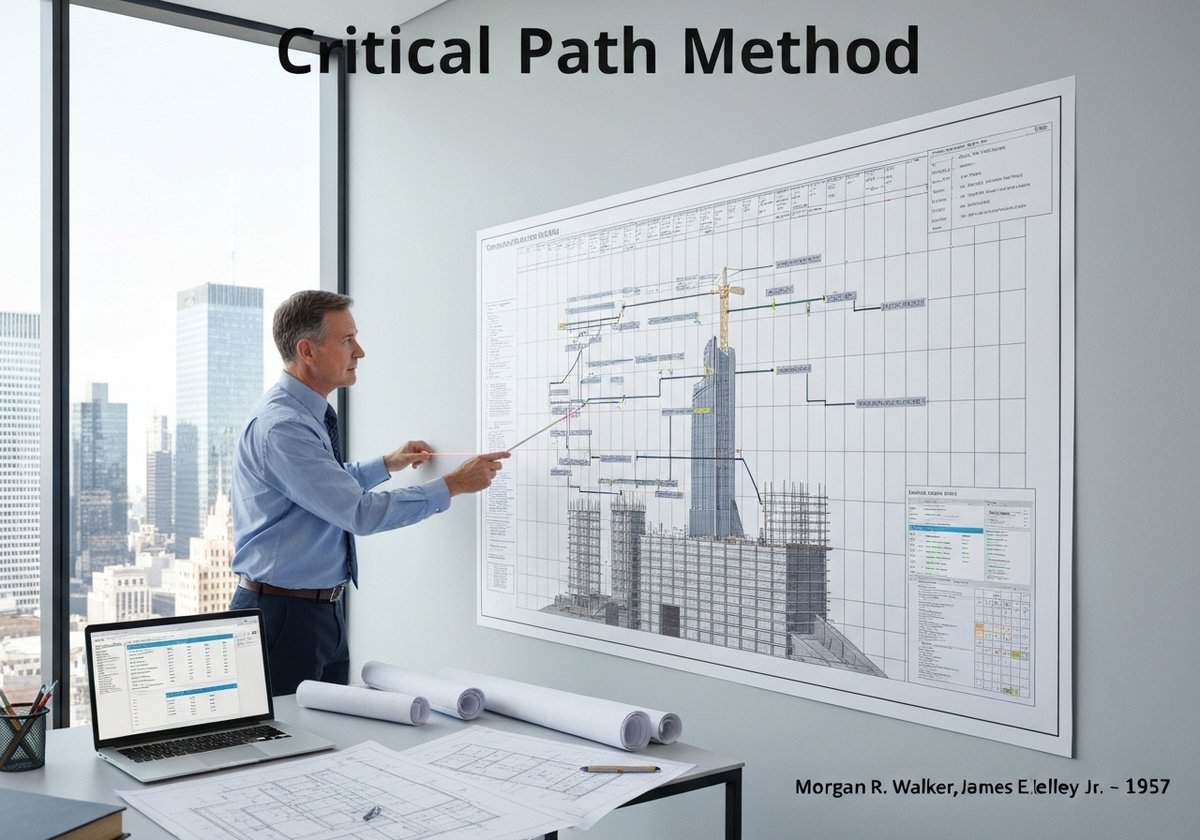
プロジェクトマネージャーが、クリティカルパス法を用いて超高層ビル建設のガントチャートを分析している。

(画像はイメージです)

The Critical Path 方法 (CPMと呼ばれることもあり、多くの分野で混乱を招く)は 方法論 プロジェクト活動のスケジュール設定に使用されます。これは、依存するタスクの最長区間(「クリティカルパス」)を特定し、開始から終了まで完了するのに必要な時間を測定します。クリティカルパス上のタスクに遅延が生じると、プロジェクトの完了日に直接影響します(ここでの目標パラメータは日付であり、コスト、品質、リソースではありませんが、これらはどれも独立していません)。結果として、リソースの割り当てとスケジュールの最適化に役立ちます。配送計画における巡回セールスマン問題の応用と同様に、クリティカルパススケジューリングは、タスクの最適な順序を見つけることです。巡回セールスマン問題の応用とクリティカルパス計画はどちらも最適な順序を探します。クリティカルパス計画はオペレーションズリサーチに属し、ジョージ・ダンツィヒがシンプレックス法を開発した分野です。

Developed in the late 1950s by Morgan R. Walker of DuPont and James E. Kelley Jr. of Remington Rand, the Critical Path Method (CPM) was created to manage complex industrial projects, initially for the maintenance of chemical plants. Its novelty lies in its use of network analysis to model a project’s workflow. The process begins by identifying all project activities, determining their sequence and dependencies, and estimating the duration of each. This information is used to construct a project network diagram, which visually represents tasks as nodes and dependencies as connecting arrows.

The core of CPM is the calculation of the ‘critical path’. This is achieved through a forward pass and a backward pass through the network. The forward pass calculates the earliest start and finish times for each activity, while the backward pass determines the latest start and finish times. The ‘float’ or ‘slack’ for each activity—the amount of time it can be delayed without affecting the project’s final deadline—is then calculated by subtracting the earliest finish time from the latest finish time. Activities with zero float are on the critical path. Any delay to these critical tasks will delay the entire project. CPM is a deterministic model, meaning it uses single, fixed time estimates for each task. This contrasts with its contemporary, PERT (Program Evaluation and Review Technique), which uses a probabilistic three-point estimate (optimistic, pessimistic, most likely) to account for uncertainty. CPM provides managers with a powerful tool to focus their attention on the most crucial tasks, optimize resource allocation, and perform ‘what-if’ analysis to assess the impact of potential delays.

UNESCO Nomenclature: 5312
経営科学

タイプ

方法論

混乱

実質的な

使用法

広く普及している

前駆物質

  • ガント charts
  • Network flow analysis
  • Graph theory
  • Operations research development during WWII

アプリケーション

  • large-scale construction projects (skyscrapers, bridges)
  • aerospace and defense projects
  • software development and it infrastructure rollouts
  • manufacturing plant shutdowns and maintenance
  • research and development projects
  • oil and gas exploration and production

特許:

NA

潜在的なイノベーションのアイデア

  • CPM algorithms that incorporate machine learning to predict task duration variability
  • quantum computing algorithms for optimizing CPM in mega-projects with millions of tasks
  • blockchain-based cpm for decentralized and trustless project execution verification
  • cpm integrated with デジタルツイン technology for real-time simulation of project progress and risks
  • ai-driven resource leveling across multiple projects based on their respective critical paths
  • cpm for optimizing complex biological processes like gene sequencing
  • automated cpm generation from natural language project descriptions
  • cpm analysis for optimizing global supply chain logistics during disruptions
  • gamified simulation tools for teaching cpm concepts
  • cpm for planning interplanetary missions and colonization efforts
Related to: critical path method, CPM, project management, scheduling, network diagram, critical path, float, slack, task dependency, operations research.

歴史的背景

クリティカルパス法(プロジェクト)

1890
1914
1942
1957
1957
1960
1960
1848
1910
1914
1950
1957
1957
1960
1960

(日付が不明または関連性がない場合、例えば「流体力学」などでは、その注目すべき出現時期の概算値が提示されます。)

10年目 周年

フルサイズの画像とダウンロードは、登録会員のみが100%無料で利用できます。