Product Design, Manufacturing & Innovation Resources
Home » TNT Melt-Casting

TNT Melt-Casting

1910
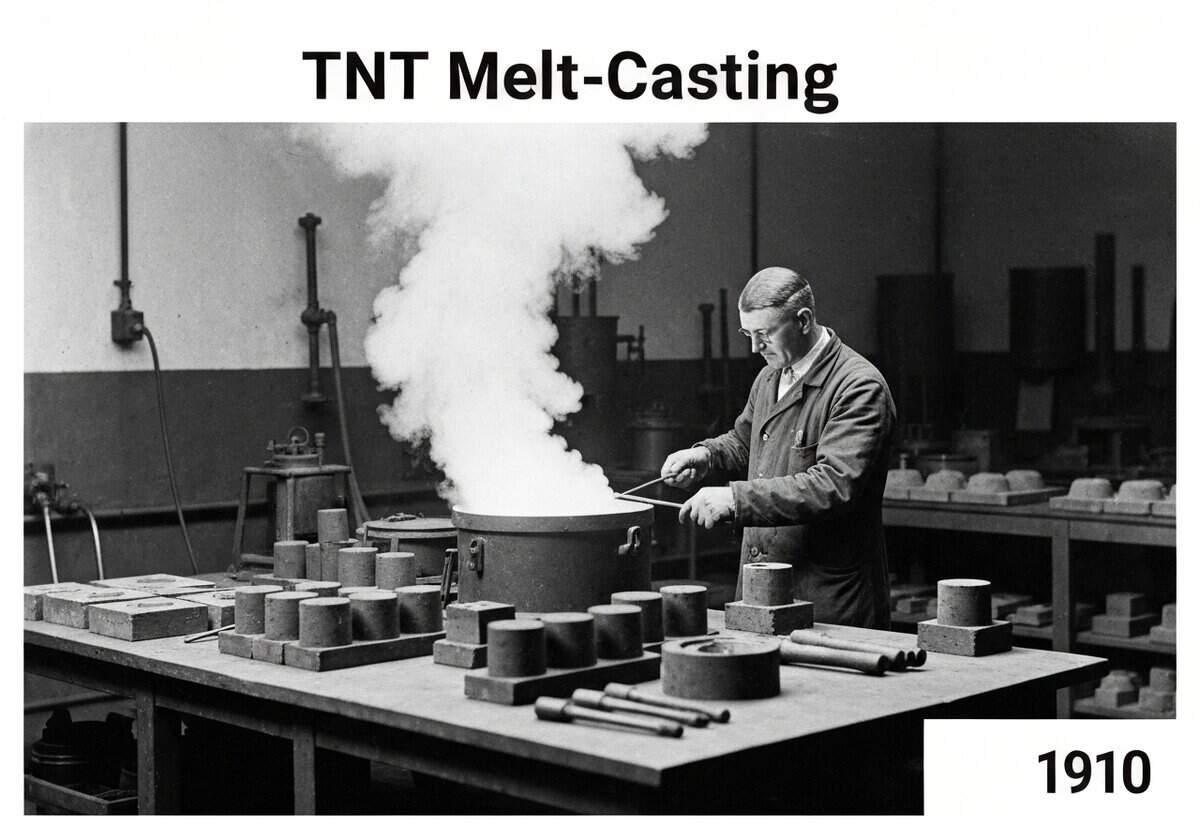
Chemical engineering workshop for TNT melt-casting in 1910.

(generated image for illustration only)

A key property of TNT is its low melting point of 80.6 °C (177.1 °F), which is well below its autoignition temperature of 240 °C. This large temperature difference allows TNT to be safely melted using steam or hot water and poured into munitions casings, a process called melt-casting. This enables the production of dense, uniform, and crack-free explosive charges.

The ability to melt-cast TNT was a revolutionary development in munitions technology. Before TNT, explosives like picric acid were used, but they were corrosive to metal casings and more sensitive. TNT’s chemical inertness and thermal stability provided a significant advantage. The process involves heating solid TNT flakes in large, steam-jacketed kettles until it becomes a liquid with a viscosity similar to water. This liquid explosive can then be poured directly into shell casings, bombs, or molds of any shape.

As the liquid TNT cools and solidifies, it contracts slightly. This requires careful management of the cooling process to avoid the formation of voids or cracks, which can create dangerous “hot spots” that might lead to premature detonation upon impact. To achieve a dense, uniform charge, the molten TNT is often poured in stages, with subsequent pours filling the contraction voids of the previous layer. This technique ensures the final explosive charge is solid, stable, and has a predictable detonation performance. The melt-castability of TNT also facilitated the creation of composite explosives, such as Composition B, where molten TNT acts as a castable matrix for more powerful but non-meltable crystalline explosives like RDX, combining the safety of TNT with the power of RDX.

UNESCO Nomenclature: 3305
– Chemical engineering

Type

Chemical Process

Disruption

Incremental

Usage

Widespread Use

Precursors

  • discovery of casting metals like bronze and iron
  • development of steam heating technology
  • synthesis of TNT by Julius Wilbrand
  • understanding of phase transitions (solid to liquid) and heat transfer
  • invention of modern artillery shells requiring a stable filler

Applications

  • manufacturing artillery shells with dense, stable explosive fills
  • producing cast demolition blocks
  • creating shaped charges for armor penetration
  • filling aerial bombs and naval mines
  • production of composite explosives like composition b (TNT mixed with RDX)

Patents:

NA

Potential Innovations Ideas

Due to scrapping bot traffic, currently more than 40k per day, this content is reserved to community members.
> Login < or > Register < (100% free) to access this, so as all other restricted content and tools.

Related to: melt-casting, TNT, explosives, munitions, artillery shell, melting point, composition b, shaped charge, demolition block, chemical engineering.

Historical Context

TNT Melt-Casting

1906
1910
1910
1910
1920
1920
1920
1903-05-10
1910
1910
1910
1910
1920
1920
1920

(if date is unknown or not relevant, e.g. "fluid mechanics", a rounded estimation of its notable emergence is provided)

Related Invention, Innovation & Technical Principles

Full size images and downloads are only available, 100% free, for registered members.

> Login <