Temper Embrittlement in Alloy Steels
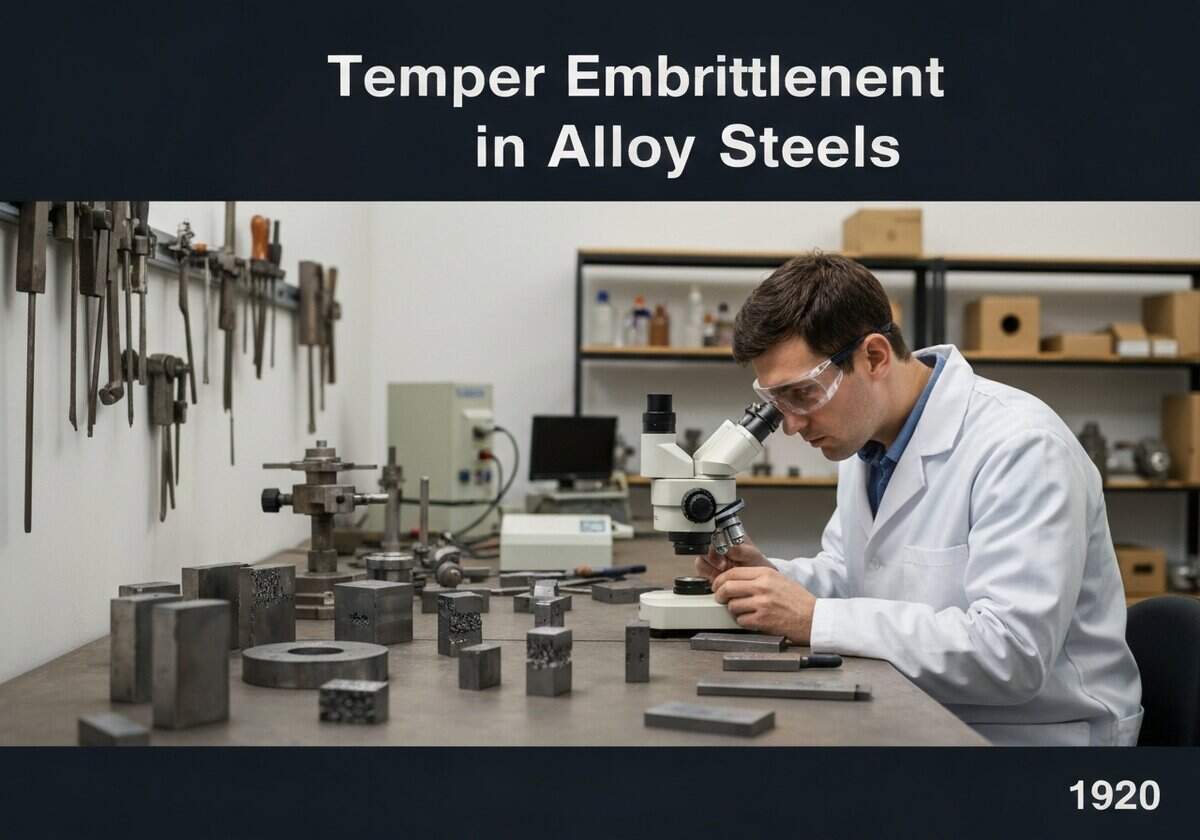
Temper embrittlement is a reduction in the toughness of certain alloy steels caused by holding them in, or slowly cooling them through, a specific temperature range (approximately 375–575 °C). This phenomenon is driven by the segregation of impurity elements (e.g., phosphorus, tin, antimony) to the grain boundaries, which weakens the cohesion between grains and promotes intergranular fracture.
The mechanism of temper embrittlement is a classic example of equilibrium segregation. At elevated temperatures, impurity atoms are dissolved within the metal grains. As the steel cools into the embrittling range, these impurities become less soluble and find it energetically favorable to migrate to the high-energy regions of the grain boundaries. Certain alloying elements, like manganese and nickel, can co-segregate with the impurities, exacerbating the effect. The result is a dramatic increase in the ductile-to-brittle transition temperature (DBTT), meaning the steel can fracture in a brittle way at temperatures where it should be tough.
A key characteristic of temper embrittlement is that it is reversible. If an embrittled component is reheated to a temperature above the critical range (e.g., >600 °C) and then cooled rapidly (quenched), the impurities are re-dissolved into the grains, and toughness is restored. This understanding was a crucial novelty in physical metallurgy, demonstrating that mechanical properties were not static but could be degraded by subtle, time-dependent changes in micro-chemistry at internal interfaces. It led to major changes in steelmaking and heat treatment practices for heavy-section components.
UNESCO Nomenclature: 3308
– Materials science
Precursors
- development of alloy steels by adding elements like chromium, nickel, and manganese
- advances in metallography for viewing the microstructure of metals
- understanding of diffusion processes in solids (fick’s laws)
- industrial demand for high-strength steels for applications like cannons, boilers, and turbines
- development of standardized mechanical tests like the charpy impact test to quantify toughness
Applications
- strict control of heat treatment procedures for large steel forgings like turbine rotors and pressure vessels
- specification of high-purity steel grades with low levels of p, sn, sb, and as for critical applications
- development of alloys containing molybdenum or tungsten, which help to scavenge impurities and mitigate segregation
- failure analysis of industrial components that operate within the embrittling temperature range
Potential Innovations Ideas
Due to scrapping bot traffic, currently more than 40k per day, this content is reserved to community members.
> Login < or > Register < (100% free) to access this, so as all other restricted content and tools.
Related to: temper embrittlement, alloy steel, grain boundary, segregation, toughness, heat treatment, intergranular fracture, phosphorus, impurities, metallurgy.