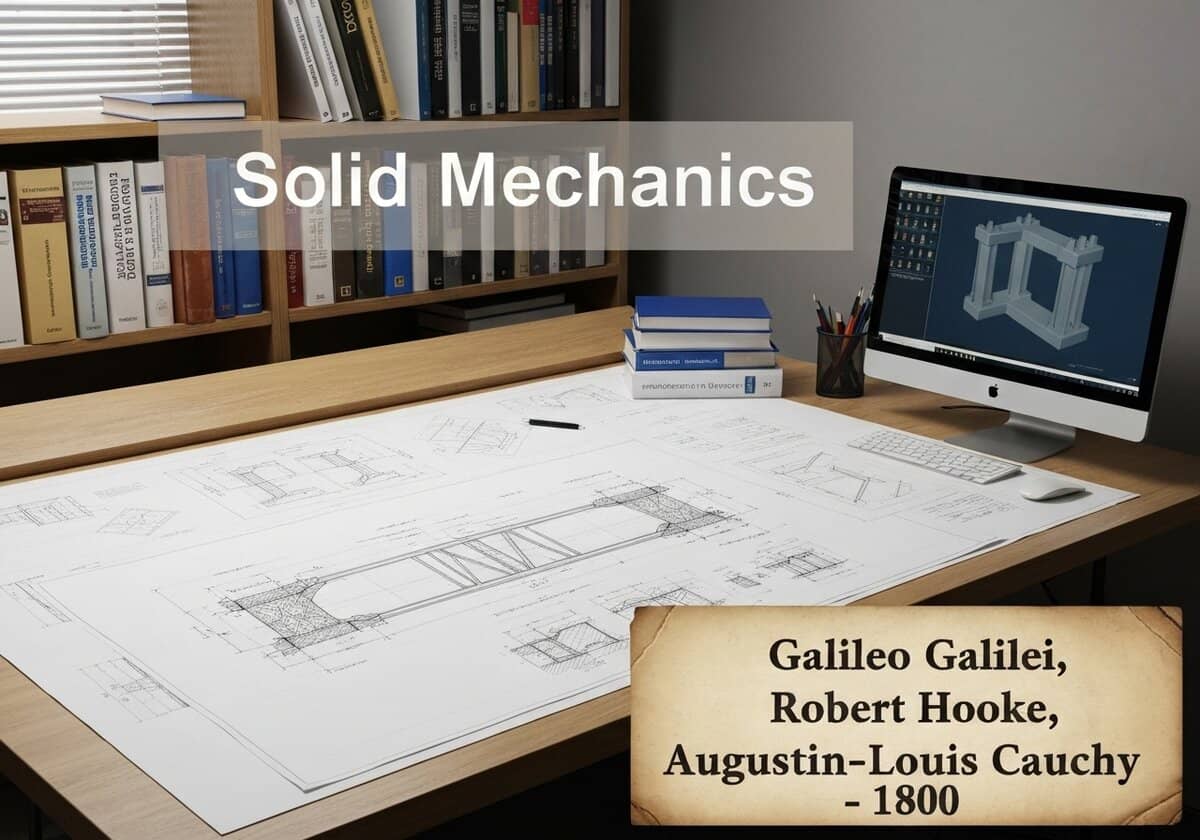
Solid Mechanics
1800
- Galileo Galilei
- Robert Hooke
- Augustin-Louis Cauchy
Solid mechanics is a branch of continuum mechanics that studies the behavior of solid materials, especially their motion and deformation under the action of forces, temperature changes, or other external loads. It is fundamental to engineering for the design and analysis of structures. Key areas include elasticity (recoverable deformation), plasticity (permanent deformation), and fracture mechanics (crack initiation and propagation).
Solid mechanics provides the theoretical framework for understanding how solid objects respond to stimuli. A central concept is the relationship between stress (internal forces per unit area) and strain (relative deformation). For many materials under small loads, this relationship is linear and described by Hooke’s Law, \(\sigma = E \epsilon\), where \(\sigma\) is stress, \(\epsilon\) is strain, and \(E\) is the Young’s modulus, a measure of stiffness. In three dimensions, these quantities are represented by tensors, the stress tensor and the strain tensor, which capture the state of stress and deformation at any point within the body.
The field is broadly divided into statics, which deals with bodies at rest or in equilibrium, and dynamics, which studies bodies in motion and includes phenomena like vibrations and wave propagation. When loads exceed a material’s elastic limit, it enters the plastic regime, where permanent deformation occurs. Solid mechanics provides theories to predict the onset of this yielding, using criteria like the von Mises or Tresca yield criteria. Furthermore, fracture mechanics, a subfield, analyzes the behavior of materials containing cracks. It aims to predict crack growth and prevent catastrophic failure in structures. These principles are applied computationally using methods like the Finite Element Method (FEM) to solve complex real-world engineering problems that would be intractable to solve analytically.
UNESCO Nomenclature: 2210
– Mechanics
Precursors
- Continuum mechanics assumption
- Newton’s laws of motion
- Development of calculus
- Experimental work on material properties by figures like Robert Hooke
Applications
- structural engineering (bridges, buildings, dams)
- mechanical design (engine parts, machine frames, landing gear)
- materials science (characterizing new alloys and composites)
- geomechanics (analysis of tectonic plate movement and landslides)
- biomechanics (modeling of bones and tissues)
Potential Innovations Ideas
Due to scrapping bot traffic, currently more than 40k per day, this content is reserved to community members.
> Login < or > Register < (100% free) to access this, so as all other restricted content and tools.
Related to: solid mechanics, stress, strain, elasticity, plasticity, deformation, structural analysis, hooke’s law.