Snell’s Law of Refraction for Ultrasonic Waves
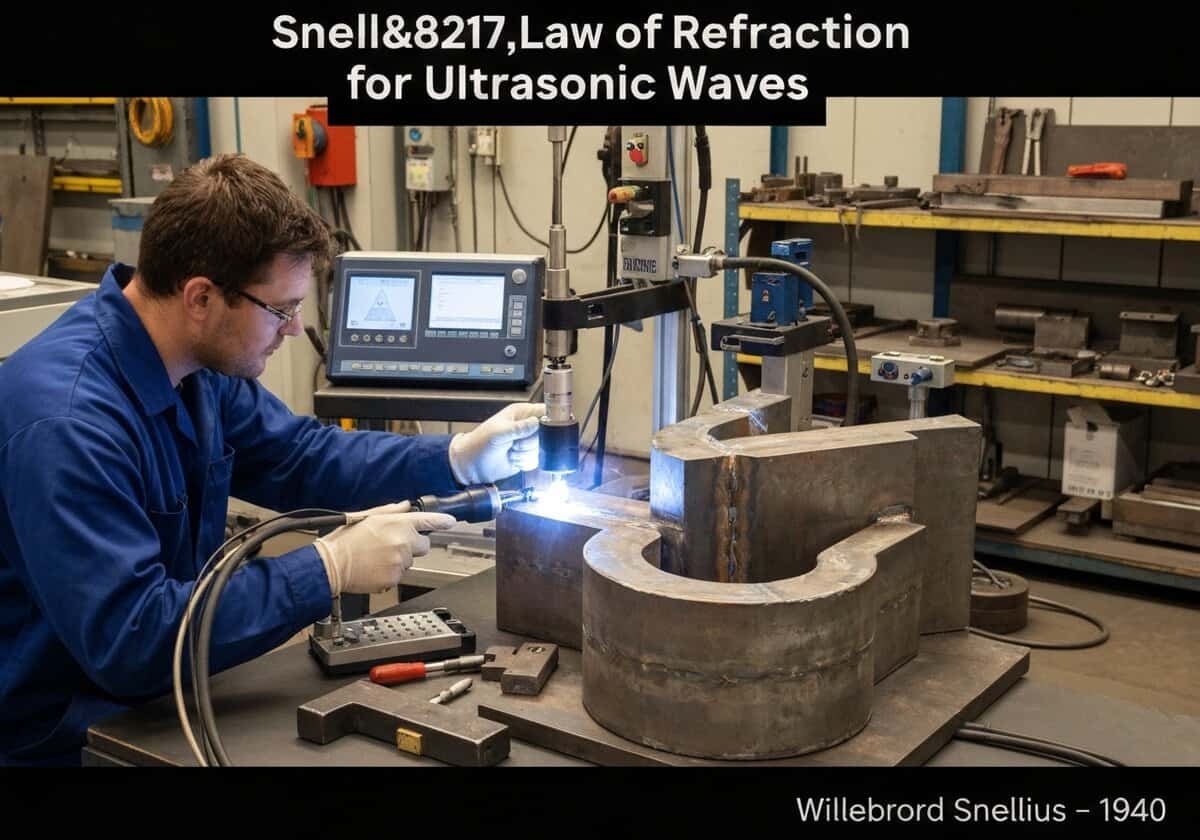
When an ultrasonic wave strikes the boundary between two different materials at an angle, it refracts, or changes direction. This is governed by Snell’s Law, which relates the angles of incidence and refraction to the wave velocities in the two media: \(\frac{\sin\theta_1}{c_1} = \frac{\sin\theta_2}{c_2}\). This principle is fundamental for angle beam testing, used to inspect components like welds not accessible from directly above.
Snell’s Law is a cornerstone of wave physics, originally formulated for light but equally applicable to sound waves. In ultrasonic testing, it is indispensable for designing inspections where a straight-on approach is impossible. This is most common in weld inspection, where the weld cap prevents placing a transducer directly on top. Instead, an angle beam transducer is used, which consists of a piezoelectric element mounted on a plastic wedge.
The formula \(\frac{\sin\theta_1}{c_1} = \frac{\sin\theta_2}{c_2}\) dictates the behavior, where \(\theta_1\) is the angle of incidence in the first medium (the wedge), \(c_1\) is the sound velocity in the wedge, \(\theta_2\) is the angle of refraction in the second medium (the test piece, e.g., steel), and \(c_2\) is the sound velocity in the test piece. By carefully choosing the wedge angle and material, inspectors can generate a shear wave or longitudinal wave at a precise, desired angle within the test part to interrogate the weld volume effectively.
A critical aspect of this is mode conversion. When a longitudinal wave hits an interface at an angle, it can generate both a refracted longitudinal wave and a refracted shear wave, each at a different angle as predicted by Snell’s Law (since shear and longitudinal waves have different velocities). Technicians often use the generated shear wave because its shorter wavelength provides better sensitivity to small defects.
UNESCO Nomenclature: 3301
– Acoustics
Precursors
- Willebrord Snellius’s original work on optical refraction in the 17th century
- Huygens’ principle explaining wave propagation and wavefronts
- the understanding that sound behaves as a wave and propagates through solids
- the development of angle beam transducers and wedges for industrial inspection
Applications
- angle beam weld inspection in manufacturing and construction
- immersion testing of complex-shaped industrial components
- design of angled wedges for ultrasonic transducers
- beam steering in medical phased array ultrasound
- seismic wave analysis in geophysics to understand earth’s layers
Potential Innovations Ideas
Due to scrapping bot traffic, currently more than 40k per day, this content is reserved to community members.
> Login < or > Register < (100% free) to access this, so as all other restricted content and tools.
Related to: Snell’s law, refraction, ultrasonic testing, angle beam, mode conversion, shear wave, NDT, weld inspection, wave propagation, acoustics.