Product Design, Manufacturing & Innovation Resources
Home » The Ruby Laser

The Ruby Laser

1960-05-16
  • Theodore H. Maiman
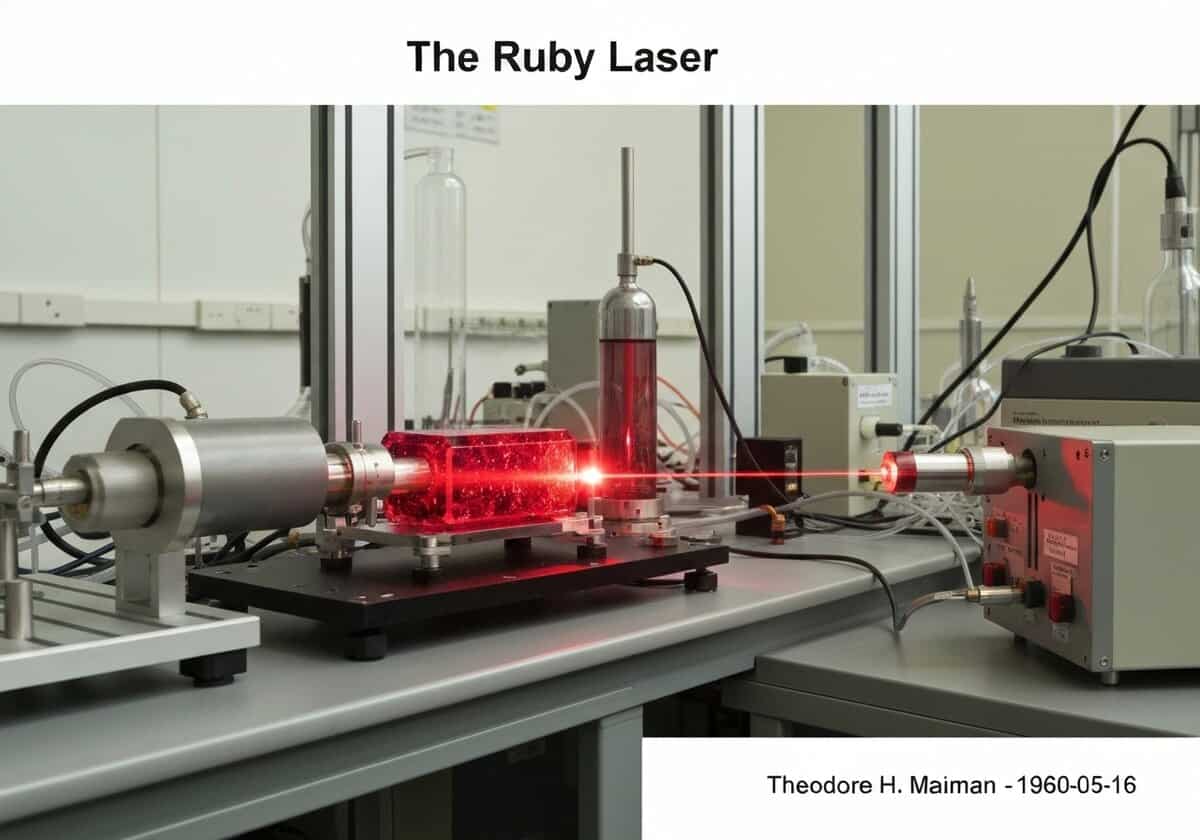
Ruby laser apparatus with synthetic ruby crystal and xenon flashtube in a laboratory setting.

(generated image for illustration only)

The first functional laser was the ruby laser, demonstrated in 1960. It is a solid-state laser that uses a synthetic ruby crystal (chromium-doped aluminum oxide) as its gain medium. The ruby is optically pumped by a powerful xenon flashtube, creating a population inversion in the chromium ions and producing a deep red beam of light at a wavelength of 694.3 nanometers.

Theodore Maiman’s successful demonstration of the ruby laser at Hughes Research Laboratories marked the beginning of the laser era. His device was surprisingly simple, consisting of a finger-sized ruby rod with its ends polished flat and silver-coated to form a Fabry-Pérot resonator. One end was fully coated, and the other was partially coated to act as the output coupler. The rod was placed inside a helical xenon flashlamp, similar to those used in photography. When the lamp flashed, its intense burst of light optically pumped the ruby crystal.

The ruby laser operates on a three-level energy system. The flashlamp’s light excites the chromium ions (\(Cr^{3+}\)) to a broad absorption band (the pump band). From there, they quickly decay non-radiatively to a metastable energy level. Because this metastable level has a relatively long lifetime (a few milliseconds), a large population of ions can accumulate there, creating a population inversion relative to the ground state. When lasing begins, the ions transition from this metastable level back to the ground state, emitting 694.3 nm photons. Because it is a three-level system where the lower laser level is the ground state, it requires very intense pumping to achieve population inversion, making it relatively inefficient. The output is typically a series of short pulses for as long as the flashlamp is active.

UNESCO Nomenclature: 2211
– Solid state physics

Type

Physical Device

Disruption

Revolutionary

Usage

Niche/Specialized

Precursors

  • the maser (microwave amplification by stimulated emission of radiation)
  • theoretical proposal for an optical maser (laser) by Schawlow and Townes
  • development of synthetic ruby crystals
  • high-intensity flashlamp technology

Applications

  • holography (early experiments)
  • tattoo and hair removal
  • industrial drilling and welding
  • scientific research (historical significance)
  • range finding

Patents:

NA

Potential Innovations Ideas

Due to scrapping bot traffic, currently more than 40k per day, this content is reserved to community members.
> Login < or > Register < (100% free) to access this, so as all other restricted content and tools.

Related to: ruby laser, Theodore Maiman, first laser, solid-state laser, chromium, optical pumping, three-level laser, 694.3 nm, Hughes research laboratories, flashlamp.

Historical Context

The Ruby Laser

1960
1960
1960
1960-05-16
1962
1963
1964
1960
1960
1960
1960
1961
1962
1963
1965

(if date is unknown or not relevant, e.g. "fluid mechanics", a rounded estimation of its notable emergence is provided)

Related Invention, Innovation & Technical Principles

Full size images and downloads are only available, 100% free, for registered members.

> Login <