The Ruby Laser
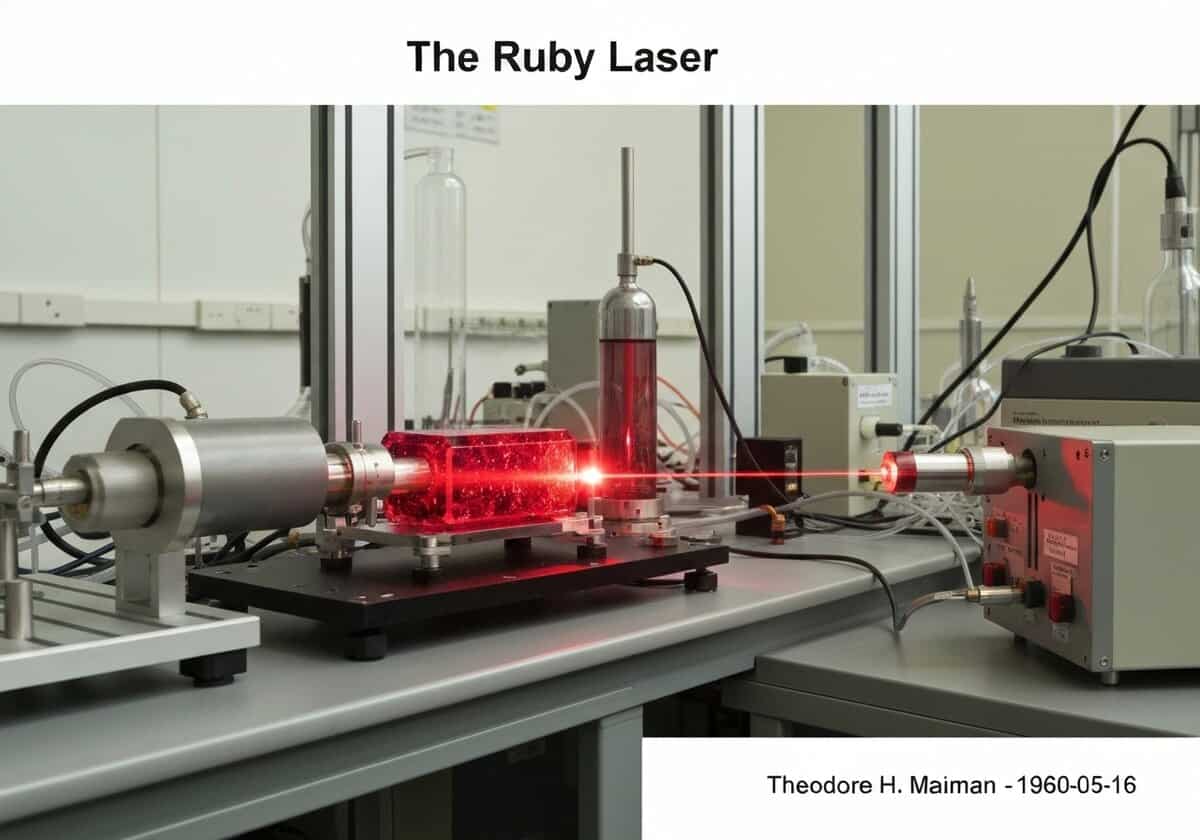
The first functional laser was the ruby laser, demonstrated in 1960. It is a solid-state laser that uses a synthetic ruby crystal (chromium-doped aluminum oxide) as its gain medium. The ruby is optically pumped by a powerful xenon flashtube, creating a population inversion in the chromium ions and producing a deep red beam of light at a wavelength of 694.3 nanometers.
La exitosa demostración del láser de rubí realizada por Theodore Maiman en los Laboratorios de Investigación Hughes marcó el comienzo de la era del láser. Su dispositivo era sorprendentemente simple: consistía en una varilla de rubí del tamaño de un dedo con los extremos pulidos y recubiertos de plata para formar un resonador Fabry-Pérot. Un extremo estaba completamente recubierto y el otro parcialmente, actuando como acoplador de salida. La varilla se colocaba dentro de una lámpara de destello de xenón helicoidal, similar a las que se usan en fotografía. Cuando la lámpara emitía un destello, su intenso pulso de luz bombeaba ópticamente el cristal de rubí.
The ruby laser operates on a three-level energy system. The flashlamp’s light excites the chromium ions ([latex]Cr^{3+}[/latex]) to a broad absorption band (the pump band). From there, they quickly decay non-radiatively to a metastable energy level. Because this metastable level has a relatively long lifetime (a few milliseconds), a large population of ions can accumulate there, creating a population inversion relative to the ground state. When lasing begins, the ions transition from this metastable level back to the ground state, emitting 694.3 nm photons. Because it is a three-level system where the lower laser level is the ground state, it requires very intense pumping to achieve population inversion, making it relatively inefficient. The output is typically a series of short pulses for as long as the flashlamp is active.
UNESCO Nomenclature: 2211
- Física del estado sólido
Uso
Nicho/Especialización
Precursores
- the maser (microwave amplification by stimulated emission of radiation)
- theoretical proposal for an optical maser (laser) by Schawlow and Townes
- development of synthetic ruby crystals
- high-intensity flashlamp technology
Aplicaciones
- holography (early experiments)
- tattoo and hair removal
- industrial drilling and welding
- scientific research (historical significance)
- range finding
Ideas para posibles innovaciones
Debido al bloqueo del tráfico generado por bots, que actualmente supera los 40.000 al día, este contenido está reservado para los miembros de la comunidad.
> Iniciar sesión < o > Registrarse < (100% gratis) para acceder a esto, al igual que a todo el demás contenido y herramientas restringidos.
Relacionado con: láser de rubí, Theodore Maiman, primer láser, láser de estado sólido, cromo, bombeo óptico, láser de tres niveles, 694,3 nm, laboratorios de investigación Hughes, lámpara de destellos.