Product Design, Manufacturing & Innovation Resources
Home » Repeatability Limit (stats)

Repeatability Limit (stats)

1980
  • International Organization for Standardization (ISO)
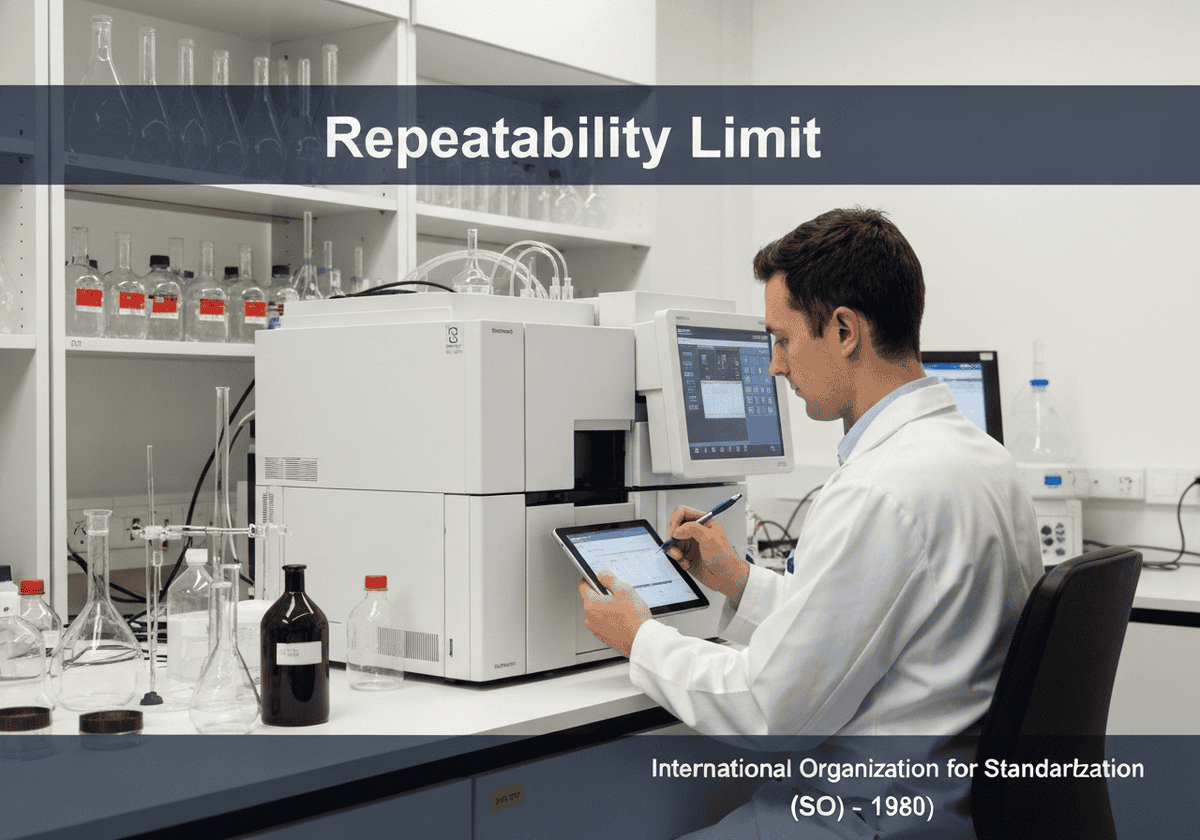
Precision analytical instrument in a laboratory for measuring repeatability limit.

(generated image for illustration only)

The repeatability limit, \(r\), is a critical value derived from the repeatability standard deviation (\(s_r\)). It represents the maximum expected absolute difference between two single test results, obtained under repeatability conditions, with a 95% probability. It is commonly calculated as \(r = 2.8 \times s_r\). If the difference exceeds \(r\), the results are considered suspect.


The repeatability limit provides a practical tool for judging the acceptability of two test results. Its statistical foundation lies in the properties of the normal distribution. The difference between two measurements drawn from the same normal distribution with standard deviation \(s_r\) is also normally distributed with a mean of zero and a standard deviation of \(\sqrt{s_r^2 + s_r^2} = \sqrt{2}s_r\). To encompass 95% of these differences, we use a coverage factor. For a normal distribution, this factor is approximately 1.96. Therefore, the 95% limit is \(1.96 \times \sqrt{2} \times s_r \approx 2.77s_r\), which is often rounded to \(2.8s_r\) for simplicity in standards like ISO 5725.

A more precise calculation uses the Student’s t-distribution, especially when \(s_r\) is estimated from a small number of measurements. The formula becomes \(r = t_{(1-\alpha/2, \nu)} \times \sqrt{2} \times s_r\), where \(t_{(1-\alpha/2, \nu)}\) is the critical value from the t-distribution for a confidence level of \(1-\alpha\) (e.g., 95%) and \(\nu\) degrees of freedom used to estimate \(s_r\). In practice, if a lab runs two tests on the same sample and the difference is greater than \(r\), it’s a signal to investigate potential issues like procedural errors, sample contamination, or instrument malfunction.

UNESCO Nomenclature: 1209
– Statistics

Type

Abstract System

Disruption

Substantial

Usage

Widespread Use

Precursors

  • Jerzy Neyman and Egon Pearson’s development of confidence intervals in the 1930s
  • The Student’s t-distribution published by William Sealy Gosset (‘Student’) in 1908
  • The ISO 5725 standard on accuracy (trueness and precision) of measurement methods and results

Applications

  • checking the consistency of duplicate measurements in a laboratory
  • defining performance specifications for analytical instruments
  • quality control charts for monitoring process stability
  • regulatory compliance in pharmaceutical and environmental testing
  • resolving disputes between two measurements of the same sample

Patents:

NA

Potential Innovations Ideas

Due to scrapping bot traffic, currently more than 40k per day, this content is reserved to community members.
> Login < or > Register < (100% free) to access this, so as all other restricted content and tools.

Related to: repeatability limit, critical difference, quality control, ISO 5725, statistical inference, confidence interval, precision, measurement.

Historical Context

Repeatability Limit (stats)

1970-01-01
1975-06-01
1980
1980
1980
1986-01-01
1990
1970
1973
1980
1980
1980
1982-07-01
1988-06-01
1990

(if date is unknown or not relevant, e.g. "fluid mechanics", a rounded estimation of its notable emergence is provided)

Related Invention, Innovation & Technical Principles

Full size images and downloads are only available, 100% free, for registered members.

> Login <