Product Design, Manufacturing & Innovation Resources
Home » The Rayleigh Criterion (optical resolution)

The Rayleigh Criterion (optical resolution)

1900
  • John William Strutt, 3rd Baron Rayleigh
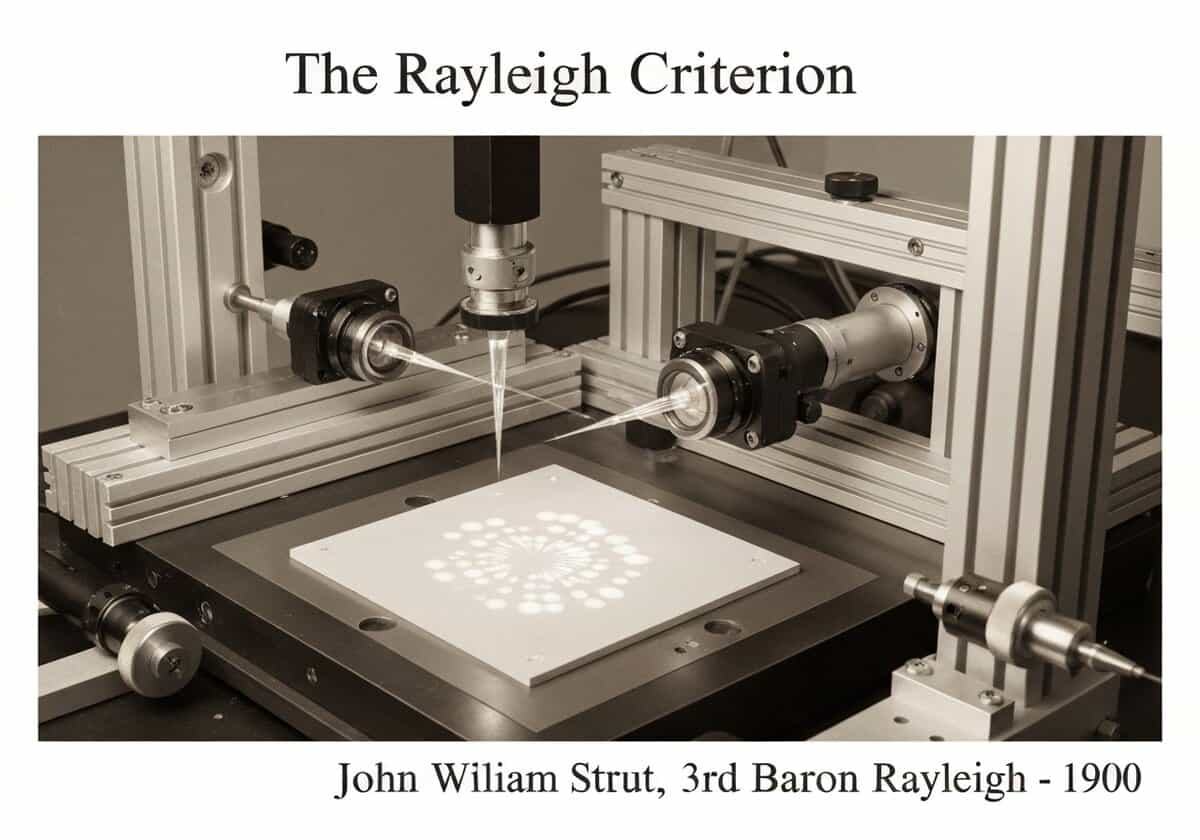
Projection photolithography system illustrating the Rayleigh criterion in optics.

(generated image for illustration only)

The minimum feature size that a projection photolithography system can print is limited by diffraction and is approximated by the Rayleigh criterion. The critical dimension (CD) is given by \(CD = k_1 \cdot \frac{\lambda}{NA}\), where \(\lambda\) is the wavelength of light, NA is the numerical aperture of the lens, and \(k_1\) is a process-related coefficient. Smaller features require shorter wavelengths or higher numerical apertures.

The Rayleigh criterion is a fundamental principle in optics that defines the limit of resolution for any imaging system, including the projection systems used in photolithography. It states that two point sources are just resolvable when the center of the diffraction pattern of one is directly over the first minimum of the diffraction pattern of the other. In the context of lithography, this translates to the smallest line or space that can be reliably printed. The formula \(CD = k_1 \cdot \frac{\lambda}{NA}\) encapsulates the three primary levers for improving resolution. Firstly, reducing the wavelength (\(\lambda\)) of the light source has been a major driver of progress, moving from g-line (436 nm) and i-line (365 nm) mercury lamps to Deep UV (DUV) excimer lasers like KrF (248 nm) and ArF (193 nm), and ultimately to Extreme UV (EUV) at 13.5 nm. Secondly, increasing the numerical aperture (NA) of the projection lens allows it to capture more diffracted light orders, leading to a sharper image. NA is defined as \(NA = n \sin \theta\), where n is the refractive index of the medium between the lens and the wafer. Thirdly, the process factor \(k_1\) represents the ‘cleverness’ of the process, encompassing improvements like resolution enhancement techniques (RET), photoresist chemistry, and process control. While theoretically \(k_1\) has a minimum of 0.25, practical manufacturing values have been pushed down from ~0.8 towards ~0.3 through immense engineering effort. This equation has been the guiding principle for the semiconductor industry’s roadmap for decades, driving the relentless scaling predicted by Moore’s Law.

UNESCO Nomenclature: 2209
– Electromagnetism

Type

Abstract System

Disruption

Foundational

Usage

Widespread Use

Precursors

  • Huygens-Fresnel principle of wave propagation
  • Fraunhofer diffraction theory
  • development of high-quality optical lenses

Applications

  • design of high-resolution microscopes
  • semiconductor lithography process development
  • astronomical telescope design
  • data storage density limits in optical discs (cd, dvd, blu-ray)

Patents:

NA

Potential Innovations Ideas

Due to scrapping bot traffic, currently more than 40k per day, this content is reserved to community members.
> Login < or > Register < (100% free) to access this, so as all other restricted content and tools.

Related to: Rayleigh criterion, resolution, numerical aperture, wavelength, k1 factor, diffraction limit, photolithography, DUV, EUV, optics.

Historical Context

The Rayleigh Criterion (optical resolution)

1900
1900
1900
1900
1902
1902
1907
1900
1900
1900
1900
1900-12-14
1902
1904
1907

(if date is unknown or not relevant, e.g. "fluid mechanics", a rounded estimation of its notable emergence is provided)

Related Invention, Innovation & Technical Principles

Full size images and downloads are only available, 100% free, for registered members.

> Login <