A Pythagorean triple consists of three positive integers a, b, and c, such that \(a^2 + b^2 = c^2\). A well-known example is (3, 4, 5). Euclid’s formula is a fundamental method for generating these triples. Given any two positive integers m and n with \(m > n\), the formula \(a = m^2 – n^2\), \(b = 2mn\), \(c = m^2 + n^2\) generates a Pythagorean triple.
A Pythagorean triple is a set of three positive integers \((a, b, c)\) that perfectly satisfy the Pythagorean equation \(a^2 + b^2 = c^2\). These triples represent right-angled triangles with sides of integer length. The simplest and most famous triple is (3, 4, 5), as \(3^2 + 4^2 = 9 + 16 = 25 = 5^2\). A triple is considered ‘primitive’ if a, b, and c share no common divisor other than 1. For example, (3, 4, 5) is primitive, but (6, 8, 10), which is just a multiple of (3, 4, 5), is not.
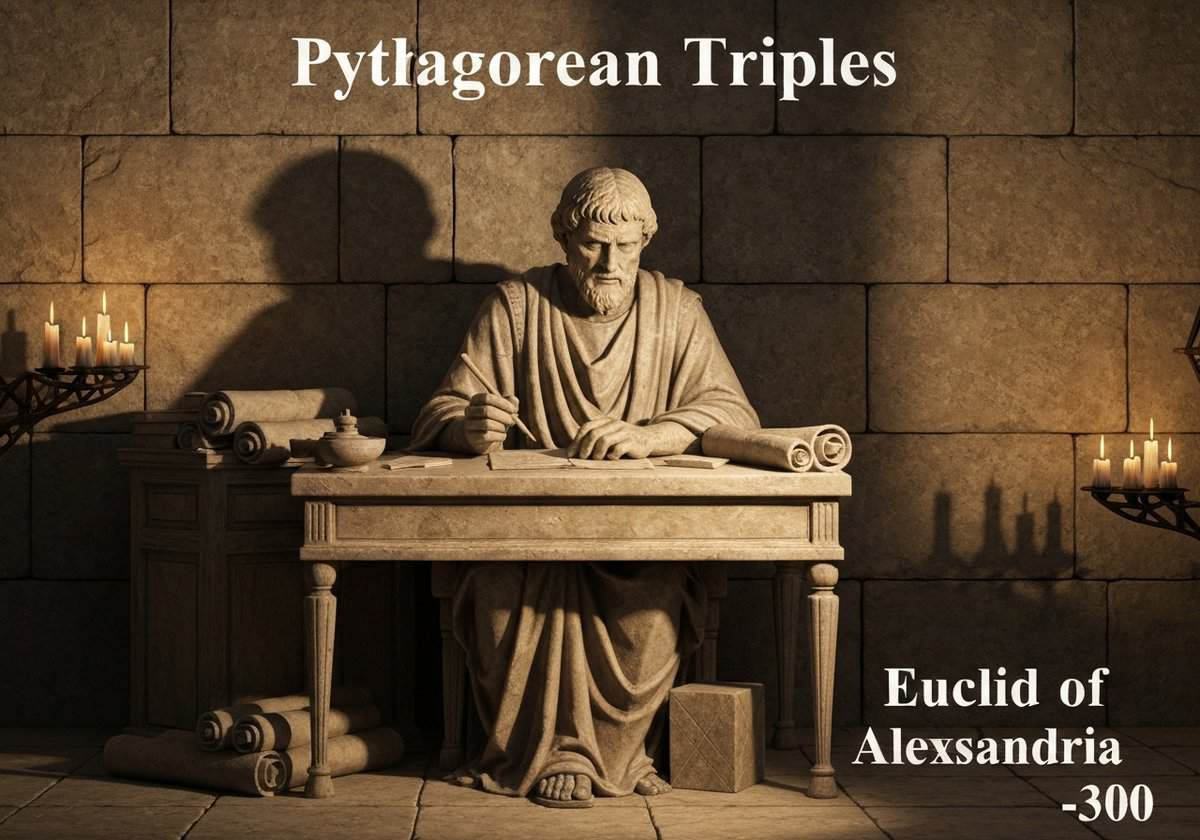
The study of these triples bridges the gap between geometry and number theory. The challenge is not just to find individual triples, but to find a systematic way to generate all of them. This problem was solved by Euclid of Alexandria. In his “Elements” (Book X, Proposition 29), he presented a formula that can generate all primitive Pythagorean triples. The formula requires two positive integers, m and n, which are coprime (share no common factors) and are not both odd, with \(m > n\). The triple is then given by: \(a = m^2 – n^2\), \(b = 2mn\), \(c = m^2 + n^2\). For example, if we choose \(m=2\) and \(n=1\), we generate the triple \(a = 2^2 – 1^2 = 3\), \(b = 2(2)(1) = 4\), and \(c = 2^2 + 1^2 = 5\), which is the classic (3, 4, 5) triple. If we choose \(m=3\) and \(n=2\), we get the primitive triple (5, 12, 13).
This formula is incredibly powerful because it transforms the problem of solving a quadratic Diophantine equation (an equation with integer solutions) into a simple substitution process. It demonstrates a deep structure within the integers and their relationship to geometry. The existence of such a parameterization has had far-reaching implications, influencing work on other Diophantine equations, including the famous Fermat’s Last Theorem, which explores the impossibility of finding integer solutions for \(a^n + b^n = c^n\) for any integer value of n greater than 2.
Related to: Pythagorean triple, number theory, Diophantine equation, Euclid’s formula, integers, algebra, geometry, (3, 4, 5), primitive triples, mathematics.